It’s Almost Halloween — Let’s Zoom With Owls!

We have several species of owls living here in San Vito so let’s have a chat with them. After all, Halloween is just around the corner and owls are prominently featured during this holiday as costumes, pumpkin carvings, cookie decorations and more.

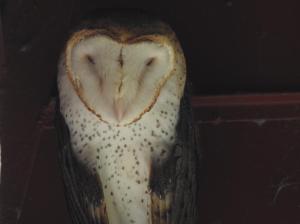
Barn Owl of San Vito. Photo by Angelo Altamura.

First we look to the Barn Owl, Tyto alba, thought by many to be the origin of ghosts. Imagine yourself, crossing a meadow at dusk and flushing this big owl — seeing its soft beige and white, heart-shaped face. With its wings stretched out in flight, it’s the same size as a human child with arms spread wide! Let’s not pretend that wouldn’t give you a fright.

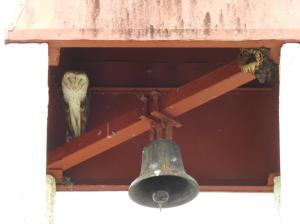
They nest in barns, under bridges and in buildings where human activity is at a minimum. This one  lives in the bell tower of a family chapel. With a diet of small mammals, including mice, rats, shrews, bats and even sleeping birds and large insects, they keep their surroundings vermin-free and are considered farmers’ friends.

Owls in the belfry. Photo by Angelo Altamura.

As to our Zoom call, first we asked this owl if it thought its kind IS the original human ghost story.  Now turn up your volume and follow the prompt to hear what it said: click here to hear. Spooky, right?

Then we asked where they used to live, before humans started building barns, bridges and belfries and it said, click here to hear that. We don’t know about you, but that kind of sounded to us like “None of your business — go away now”.

Special thanks to Angelo and Julia Altamura, new Honorary Members of the SVBC, who generously allowed us to use these wonderful photos.

A peaceful chapel, perfect for Barn Owls! Photo by Angelo Altamura.

Cotinga y el Café — Parte Uno

Autora Lilly Briggs, PhD

Versión en español

La palabra esperanza esta surgiendo mucho en el 2020. O desesperanza. O a veces las dos palabras, en una misma hora. Los motores de nuestras montañas rusas emocionales incluen: la pandemia global, incendios forestales fuera de control, y fuegos aún más feroces e inestables en la escena politica de los Estados Unidos, que tienen impactos geopolíticos trascendentales.

Es crítico enfocarnos en ejemplos pequeños, con igual de importancia, a nivel local y que día a día nos dan esperanza dentro de tanta incertidumbre. Personalmente no puedo pensar en un contrapunto mejor al caos que la historia de la Cotinga y el Café.

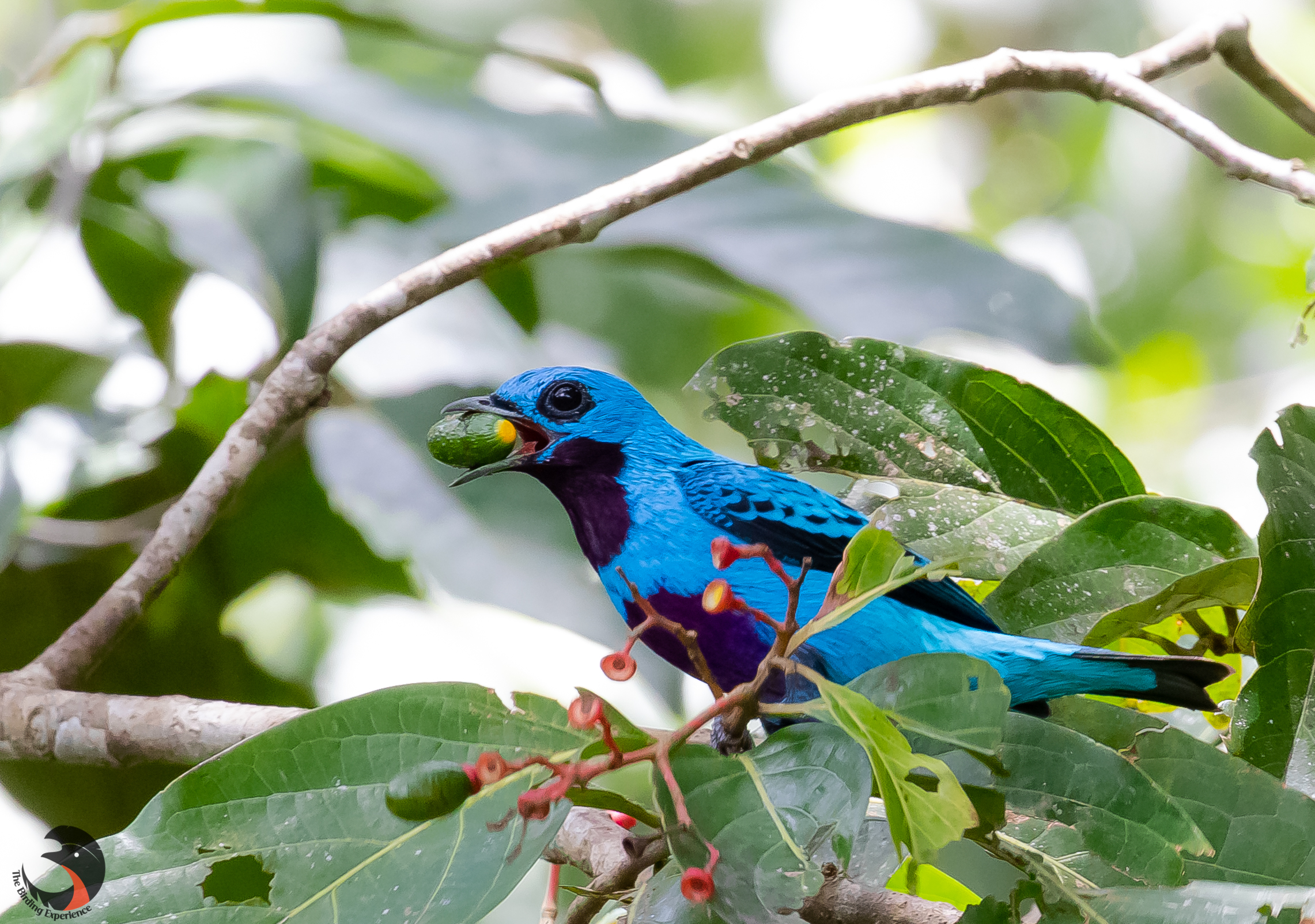
Turquoise Cotinga, foto de David Arias Rodríguez

La Cotinga Turquesa, una especie “casi endémica” es codiciada por las pajareras y los
pajareros, tanto nacionales como internacionales. No solamente se debe a que tiene una distribución limitada a Costa Rica y Panamá, sino también porque es simplemente una especie espectacular. Su apariencia sugiere que salió de las exuberantes aguas del Pacífico, revestida en ese turquesa brillante que da origen a su nombre, en combinación con el violeta rico de su pecho. Luce esos colores tan bien y con tanto brillo que su aparición podría provocar derramar el café caliente sobre su regazo.

¿Qué tiene que ver el Café con la Cotinga?
En tiempos de COVID, negocios pequeños en todo el mundo han estado golpeados
fuertemente. Pero la luminiscencia de la Cotinga Turquesa destaca el hecho de que
cultivando la ética de conservación y apreciación por la naturaleza, puede verse
beneficiada la economía y el medio ambiente, aún durante una pandemia.

“Cholo”, el dueño de Mercado Viriteca en Sabalito de Coto Brus, hizo una decisión
consciente en nombre de la conservación al abrir su negocio en medio de una intersección llena de bullicio. Al frente de una antigua estación de servicio en el centro de Sabalito, es un lugar improbable para encontrar un río y una exquisita vegetación que su local protege. Cuando tomó posesión del local hace cuatro años, dedicó tiempo y energía a limpiar la quebrada. Los Aguacatillos contribuyen a crear un ambiente bonito y relajante para la clientela, y sus frutos son tan atractivos para las aves (no solamente para la Cotinga, también a otras especies especiales como el Quetzal, el Guácharo y el Pájaro Campana), como los granos de café son para los humanos.

Recientemente, el fruto de esta labor del Mercado Viriteca se manifestó con los frutos del Aguacatillo de su patio, para el deleite histérico de la comunidad de pajareras y pajareros locales y más allá. Los Pajareros del Sur cuentan entre la multitud de gente juntándose para fotografiar a la Cotinga comiendo de estos preciados frutos. La cafetería al aire libre y el espacio entre sillas, ofrecen un lugar perfecto, en esta época de distanciamiento social, para poder disfrutar de un buen pinto y la vista de un buen pájaro. Cholo dice que ha hablado con mucha gente de sectores sobre esta increíble especie, acerca de porque los esfuerzos de conservación son tan importantes, y en cómo han ayudado a su negocio.

Es importante de entender las fuerzas grandes estructurales que impactan el mundo entero hasta nuestros contextos locales. Pero es de igual importancia enfocarnos en las acciones positivas que empiezan en nuestros contextos locales, que causan una reacción en cadena, para tener un impacto al revés: de local a global. Entonces, cuando usted empiece a desesperarse sobre las próximas elecciones o debido a
las aves migratorias muertas por causa de los incendios forestales, los animo a recordar también historias como esta. Cómo la Cotinga y el Café han unido a personas que les importa la conservación y la comunidad. Esta historia representa un llamado de esperanza, en un año tan diferente como lo es el 2020.

¡Próximamente compartiremos una entrevista que hicimos con Cholo!

Lilly Briggs, PhD

Directora, Asociación Ambiental Finca Cántaros 

San Vito de Coto Brus, Costa Rica

Facebook y Instagram: Finca Cántaros
 

Cotinga and a Coffee — Part 1

Hope is coming up a lot in 2020. Or hopelessness. Or both, sometimes within the same
hour.


The engines of our emotional rollercoasters include but aren’t limited to: the global
health pandemic, raging forest fires, and the even more ferocious and volatile political
fires in the US, which for better or worse have far-reaching geopolitical impacts.
The need to focus on small but equally impactful everyday, local examples of hope have
never been more important. I can’t think of anything better in our community as a counterpoint to the chaos than the Cotinga and a Coffee story.

The Turquoise Cotinga is coveted by national and international birders alike, as a “near-
endemic” species. Not only special because of its limited distribution in Costa Rica and
Panama, but also because it is simply spectacular. It looks like it emerged from exquisite
Pacific waters permanently coated in the bright turquoise that gives rise to its name,
complete with a rich purple accent on the chest. It wears these colours so well and so
vibrantly that its appearance could provoke you to spill hot coffee all over your lap.

Where does coffee come in?
In COVID times, small businesses have been hit hard. But the Turquoise Cotinga’s
luminescence shines a spotlight on how cultivating a conservation ethic and appreciation
for nature can benefit the environment and the economy, even during a pandemic.

“Cholo,” the owner of Mercado Viriteca in Sabalito de Coto Brus, made a conscious
conservation decision when opening his business in the middle of a bustling intersection.
Across from the abandoned gas station in downtown Sabalito, it is an unlikely place to
find the rushing river and lush forest patch that Cholo’s establishment protects. When he
took over the location four years ago, he dedicated time and energy to cleaning up the
creek. Aside from creating a relaxing ambient for his clientele, the fruits of the
Aguacatillo trees in this patch are as attractive to birds (not only the Cotinga, but other
special species such as the Resplendent Quetzals, Oilbirds and Three-Wattled Bellbirds)
as caffeinated beans are to humans.

Recently, the fruits of his labour were manifested in the Aguacatillo’s fruits attracting the
Turquoise Cotinga to the hysterical delight of the local birding community and beyond.
The Pajareros del Sur are among the masses flocking to Viriteca’s patio to photograph the
Cotinga or to simply admire it over their gallo pinto. The outdoor venue and spacing
between seats are especially advantageous in an era of social distancing. Cholo says he
has talked to people from all walks of life and all ages about this incredible bird, why
conservation efforts are important, and how they have helped his business.

It’s important to understand the larger forces at work and how they trickle down to each
of our local contexts. But it’s equally important to focus on the “trickle-up” effect of
these positive local actions, and the collective impact they have on the world.
So when you start to despair about the upcoming elections or the migratory birds killed in
the forest fires, I encourage you to also remember the many people who still care enough
to support a local business that conserves habitat for beautiful birds and other species.

Stay tuned for an interview with Cholo: Part 2 of Cotinga and a Coffee

Photo by David Arias Rodriguez

Lilly Briggs, PhD, Director of Finca Cántaros Environmental Association

Migration Is On: Sweepstakes Early Spotting Prize to Judy Richardson!

Judy Richardson, photo by Juan Carlos Calvachi

Herewith we announce the Early Migrant Sweepstakes winner: Judy Richardson!

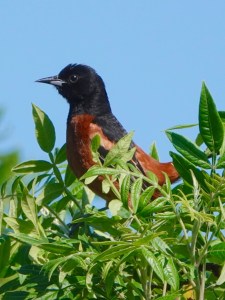
Wait, what? You didn’t realize we had a Migrant Sweepstakes going on? Neither did we until a minute ago. Never mind, we have it now and the first bird reported was a beautiful Orchard Oriole.

Orchard Oriole, photo by Mark Garland

Judy found him in early August at Hacienda Pino Collina, next door to the Wilson Botanical Garden; her home in San Vito where she’s been passing Covid-19 pandemic time birding, gardening, reading and cooking.

Let’s get into the swing of this people! How about we run a Migrant Spotting Contest from now until September 30? Just go outside with your phone and the two apps from Cornell, Merlin and eBird, and get started. Send your list to our Birder-in-Chief Greg Homer at: eltangeral@gmail.com by September 30, 2020 and we will see who finds the most waterthrushes, warblers, flycatchers and more.

Or, if you’re still operating like it is 1970, take a pencil, notepad and the Garrigues and Dean field guide outside and get going with those.

We will give you a prize, promise!

Judy is going to have one of her favorite desserts: Sticky Toffee Pudding with vanilla ice cream — delivered to her door. Just think what you might win?! Yum yum!

Heliconia Help Line: Ask Us Anything!

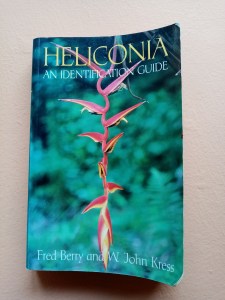
Excellent field guide by Fred Berry and W. John Kress.

Do you have a hankering to learn to identify something other than birds? How about the wild and beautiful tropical plants called heliconias?

We’ve become hooked on these exuberant blooms recently after walking in the Wilson Botanical Garden Heliconia area where all the plants are sprouting improbably-shaped and wildly-colored inflorescences holding small flowers for hummingbird species with just the right bill. The bills fit perfectly into the varied flowers which, if you weren’t looking closely, you might miss or mistake for detritus, hidden as they are in the bright framework.

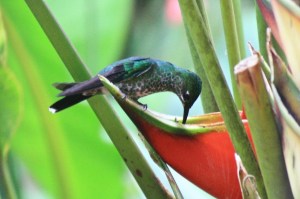
Green-crowned Brilliant on the widely-cultivated Heliconia bahai. Photo by Jo Davidson


In fact, here is the ideal transition photograph by Jo Davidson to move your mind from birds to blooms. This is an ‘early Jo Davidson’, taken in 2009 — one of her first attempts at capturing a hummingbird — this time, a Green-crowned Brilliant.


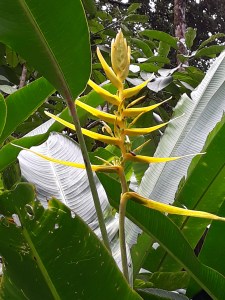
Heliconia lingulata, Peru to Bolivia. Photo by Ellen Beckett

Here is another beauty, an erect yellow showing off in the sun. Geographic distribution of Heliconia is restricted primarily to the American tropics. A disjunct group is found in the Old World tropics from Samao to Sulawesi, all of which have primarily green bracts and flowers with coppery red leaves.

The OTS Las Cruces Biological Station aka Robert and Catherine Wilson Botanical Garden is open for visitors  — a stroll through the newly-renovated Heliconia Garden is worth the trip all by itself but other highlights await, for example, the Maranta Garden, the Pollinator Garden and the Canopy Tower.

At Heliconia Central, on a recent visit, every plant was in bloom and birds were busy investigating available nectar and fruit. So it’s a must-see stop for birders and natural history photographers will hardly be disappointed.

Wipe off your lenses, be they eyeglasses, spotting scopes, binoculars or cameras — it is all out there, waiting for you! Send an email request to visit to: recepcionlc@tropicalstudies.org with the date, number in your party and then just follow the four new rules:

— Wear a mask

— Pay at the Entrance Gate, fee is $10 tourists or $3 residents

— Have your temperature taken

— Wash your hands

Pendant ‘Sexy Pink’. Photo by Julie Girard

We can practically guarantee your spirits will be lifted by some intensely beautiful  tropical plants, feathered delights in every direction and the occasional agouti gambolling across the grounds.


Bird Walks Coming Soon as Wilson Botanical Garden Re-Opens

Violet Sabrewing, the largest hummingbird in Costa Rica. Photo by Jean-Philippe Thelliez

OTS Las Cruces/Wilson Botanical Garden re-opened to the public yesterday, Friday, June 26. New Rules due to Covid-19 preventive restrictions include mandatory reservations for any kind of visit including Bird Walks. Entrance Fees must be paid at the new Gatehouse; costs are $3 for locals and residents and $10 for non-residents. (The colones equivalent will be calculated at the daily exchange rate.) Masks and hand sanitization are required so bring your mask! Staff will have hand sanitizer at the gate and at Reception.

If you would like to go on your own, please send an email to recepcionlc@tropicalstudies.org, noting the date and time you wish to go and the number of people in your party.

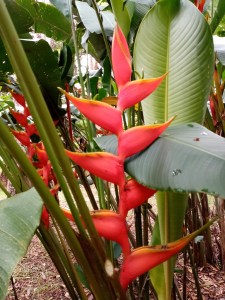
Upright red with yellow trim. Photo by Alison Olivieri

In the coming weeks, we will schedule a SVBC Bird Walk with an imbedded link for you to RSVP. That way, we can make the reservation and keep numbers within an acceptable limit.

Because the pandemic has hit tourism spots very hard, SVBC members must now pay Entrance Fees – additionally, we encourage you to add a donation of whatever you can afford!

Hellzapoppin Heliconias!

Right now, the Heliconia Garden is glorious; nearly every plant is in flower and they are all amazing. As you birders know, hummingbirds are going to be busy in there – nectaring and zipping around — so you will have a double treat if you go soon.

Pendant ‘Sexy Pink’. Photo by Julie Girard

Two of the Country’s Five Jays Have Hit Our Patch!

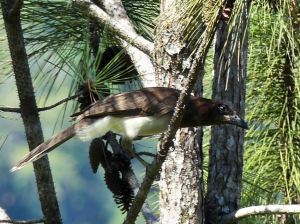
Brown Jay, photo by Jo Davidson.

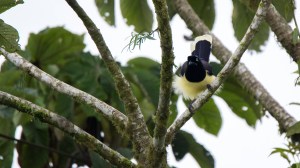
Suddenly we have two species of jays to be pursued in San Vito: the garrulous Brown Jay and the far more flamboyant Black-chested Jay.

Brown Jays have been with us for some time now – not in great numbers as in the rest of the country but every so often one or two pop up, giving their “piyah, piyah” call. This usually brings us up short and, as we struggle to place it, this unmistakeable fellow glides into view.  Traveling in “Boisterous parties” is how they are described in the second edition of The Birds of Costa Rica by Garrigues and Dean.

Black-chested Jay. Photo by Pepe Castiblanco.

Meanwhile, Black-chested Jays are far less common with a range formerly restricted to southern Caribbean lowlands. They have been seen sporadically over time in and around Coto Brus; for example near the Panama border at Canas Gordas.  In contrast to their brown cousins, they are described as “. . . a bit more furtive.” But now we have a small flock up in Concepcion, above the Wilson Botanical Garden/Las Cruces, that can often be seen in early morning near the open-on-weekends restaurant Los Jilgueros. In fact, Sr. Gamboa, the owner, is quite attuned to these handsome birds and can often point a hopeful birder in the right direction.

Jays fascinate us for many reasons. They are loud and have a big presence — when you are near a jay you know it. They have personalities with definite likes and dislikes, complex social systems, tight family bonds and some species are good mimics. They’re smart and can solve problems posed by researchers like their fellow corvids, crows and ravens. Often Costa Rican birders who visit the United States come back with the North American Blue Jay at the top of their Favorite Bird list.

Bird Walk Tomorrow: Sunday, October 27!

Northern Waterthrush: a migrant to watch for! Photo by Gail Hull

Please join us for a free Bird Walk at the Wilson Botanical Garden tomorrow morning, October 27, at 7:30 a.m.

As usual, we will meet at the Reception Building and have binoculars and bird guides to share.

Many migrants have arrived in the past several weeks so we will look for them as well as whatever other beauties we can find.

Look forward to seeing you there!


Welcome White-winged Doves!

We have been waiting for quite some time for these angelic-looking birds to show up in our beloved southern zone and it appears our vigil might be over.

White-winged Doves. Photo by Jim Zook

First, a pair was spotted in September near La Union de Sabalito by Jim Zook who was on the job doing bird counts for Stanford University. Shortly thereafter, one was found by Randall Jiménez Borbón, a Pajarero Del Sur member and Detectives de Aves teacher, in his garden in Linda Vista just south of San Vito on the road to Ciudad Neily.

In the Stiles and Skutch Guide to the Birds of Costa Rica (published in 1989), they were considered a ‘. . . locally abundant permanent resident in dry Pacific NW, south to Jaco.’ In more recent times, they are described as ‘. . . common resident in northern Pacific and across the Central Valley . . . ‘ by Garrigues and Dean in the second edition of The Birds of Costa Rica. You can see the trajectory; it was just a matter of time.

They are pretty easy to see if you are expecting them: Garrigues describes them as “. . . commensal with humans. . . ” and goes on to say they favor open areas and are often seen feeding along roadsides. They look a lot like Mourning Doves except for the white band down the length of the wing – this is easily seen at rest and a lovely display in flight. Further, Mourning Doves have long, tapered tails and black spots on their wings, both of which are lacking in the Whities.

From November to May, our resident populations are joined by migrants from the southwestern US. The entire range goes from Arizona, New Mexico and Texas in the US; throughout Mexico and down through Central America to western Panama, as well as throughout the Caribbean islands.

Breeding season is January to March, so we will try to keep an eye on the Sabalito pair. And, meanwhile, keep a sharp eye out as they may turn up at your house any day now!