Celebrate Earth Day 2021 on Saturday, April 24 at Finca Cántaros

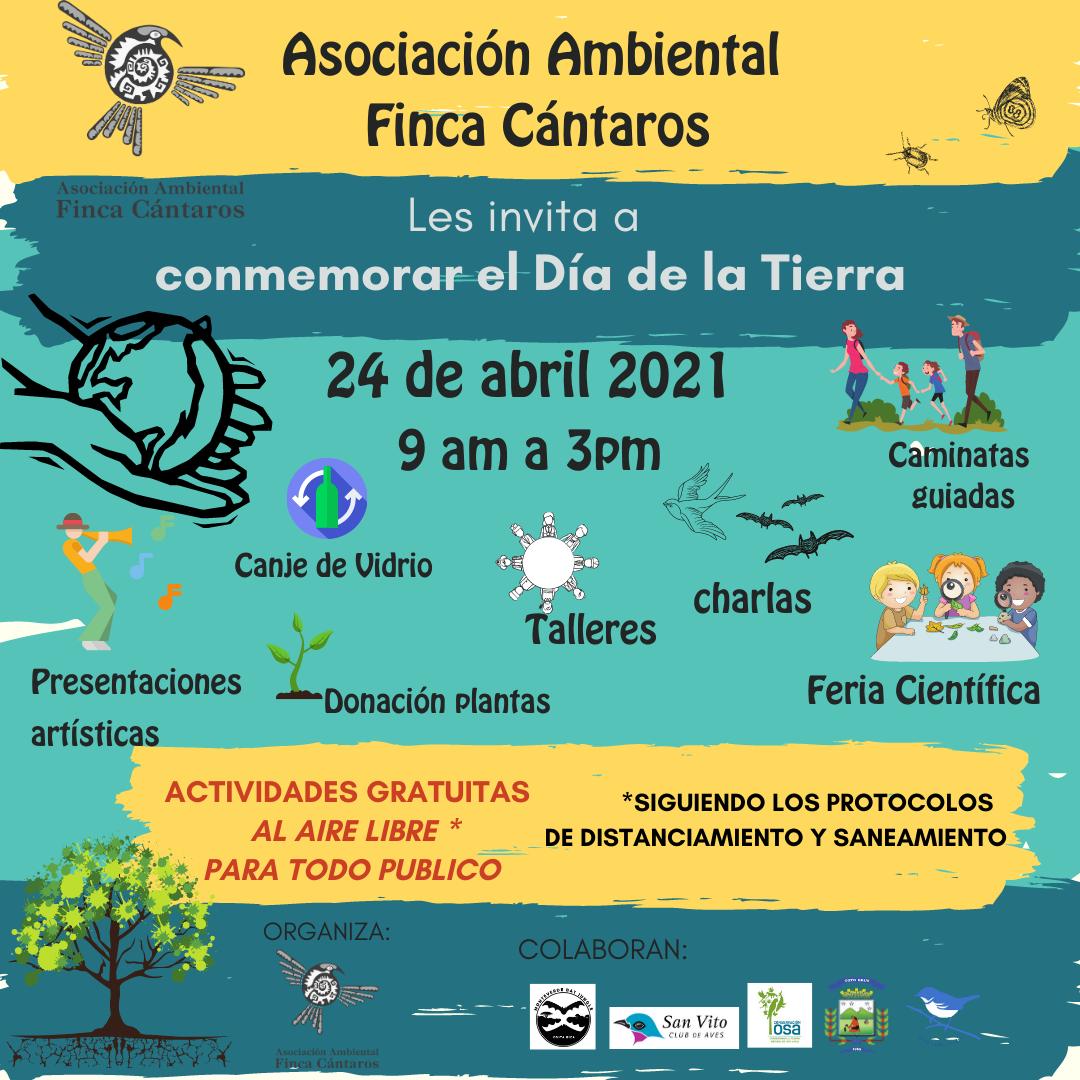
Join us on Saturday, April 24 for an Earth Day Festival at the Finca Cántaros Environmental Association from 9 am to 3 pm.

As you can see from the posters below, the team has created all kinds of activities including guided walks, workshops (How to Make a Vegetable Garden, Exploring Nature) and two science talks, one about bats and one about bird migration (The MOTUS Tower) PLUS the 1st Annual Science Fair for elementary school students!

Meet your new neighbors! Practice your Español! Bring your recyclable glass to trade for a glass! Buy treats at the Bake Sale* and enjoy live music and art presentations!

All activities will be outside and adhere to Covid protocols. This will be a fun-filled day in a strange and difficult time so please treat yourself by visiting the AAFC — Asociación Ambiental Finca Cántaros!

And here is the schedule:

*If you would like to buy virtual cookies and make a donation to the new Asociación, please go to your PayPal account and enter ‘Finca Cantaros’ or info@fincacantaros.

Tomorrow’s Bird Walk Postponed!

We are sorry to report we had no sign-ups for tomorrow’s Bird Walk at Las Cruces/Wilson Botanical Garden, so it is officially cancelled.

In two weeks, we will schedule a free Bird Walk at a different location and hope you will join us!

Meanwhile, Finca Cantaros will host an Earth Day Celebration next Saturday, April 24! We urge you to attend and meet the new team — your new neighbors. Details of the event will be posted here on Wednesday.

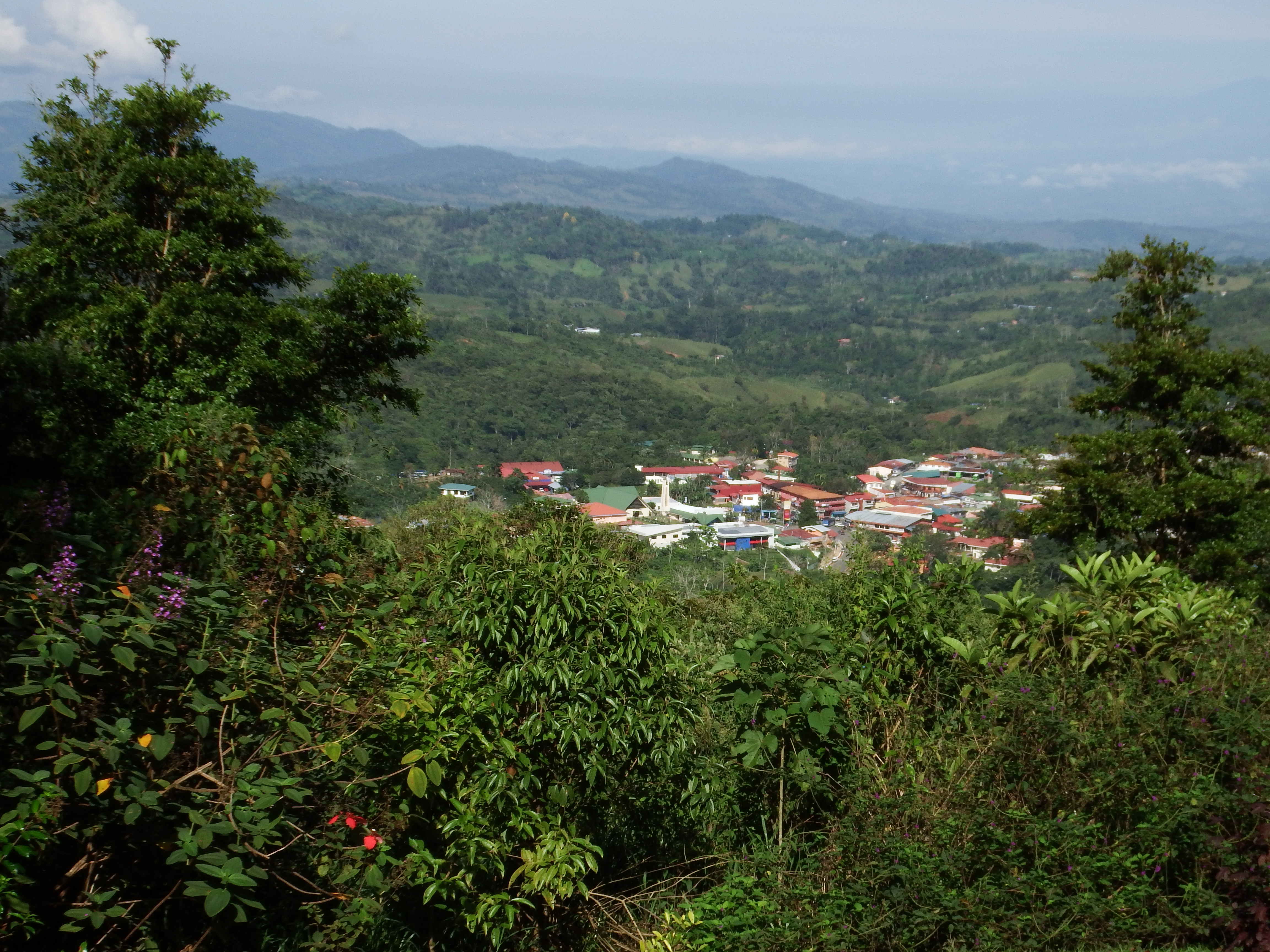
San Vito from the Finca Cantaros Mirador, photo by Alison Olivieri

Bird Walk Sunday April 18

Please join us for a Bird Walk at the Las Cruces Wilson Botanical Garden this Sunday, April 18. We will meet at the Entrance Gate at 730 a.m. and observe the following Covid-19 protocols:

  1. Wear a mask
  2. Wash your hands at the sink
  3. The guard will take your temperature
  4. Record your name, national ID, phone number and temperature
  5. Pay the Entrance Fee: $3 residents/nationals, $10 visitors

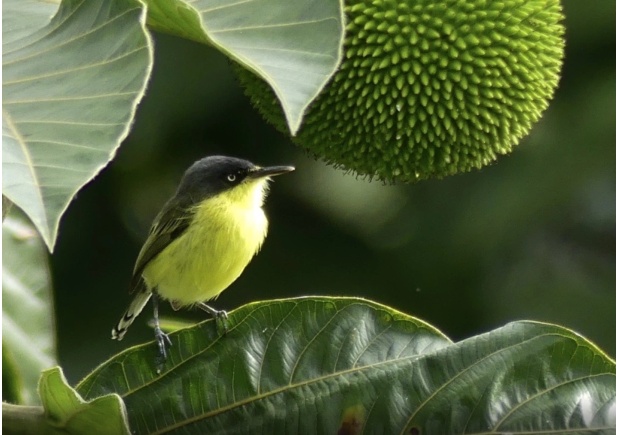
Maybe we’ll see these top-heavy flycatchers building a nest outside the Reception Building. And we’ll do three stops at the Heliconia, Maranta and Pollinator Gardens.

Please click here to sign up — we look forward to seeing you there!

Where We Bird — Rio Negro

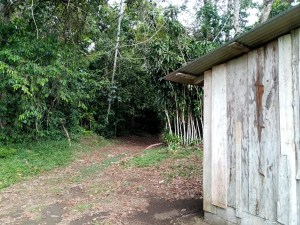
The trail entrance at Rio Negro. Photo by Alison Olivieri

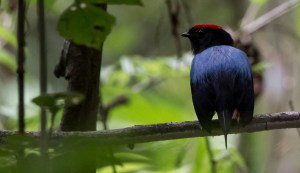
Walk with us into the tunnel of ‘To-le-do’, the song of the Lance-tailed Manakin. A superstar of San Vito birding, this active and beautiful bird also makes a mewing, catlike call. The red cap, blue back, tiny tail and orange legs make males unmistakeable; females are greenish, as are all the lady manakins, but she does have that tail! Here, they are only found at our southern Pacific border with western Panama but their range extends from Costa Rica to

See the tail? Photo by Pepe Castiblanco

Venezuela. Inhabiting the humid and second growth forests, Chiroxiphia lanceolata males are active at leks from Janury to March. Excellent and acrobatic dancers, you can find them on YouTube but, really, why not come here and see for yourself?

Bicolored Hawks can be found all around Costa Rica but they are categorized as ‘rare’. Luckily for us, they are regularly seen at this site or from the car on the way! The rufous thighs are diagnostic in adults but the juveniles are easily confused with forest-falcon species.

Juvenile Bicolored Hawk, Accipiter bicolor, photo by Jo Davidson

These raptors prey on birds, diving after them from perches at any height in mature, wet forests and tall secondary growth — even forest edges and gardens. They are in the same genus with Sharp-shinned and Cooper’s Hawks in the north.

Finally, we come to a bird found at lower levels of the forest following ant swarms: Bicolored Antbird. Plump and endearing with a big, blue eye-ring, it’s hard not to want to scurry after them. This species is said to have been the favorite of Dr. Alexander Skutch, author of ‘A Guide to the Birds of Costa Rica’ with F. Gary Stiles.

Bicolored Antbird, Gymnopithys leucaspis, photo by David A. Rodriguez Arias

Where We Bird — the Poro Road

Riverside Wren with nesting material. Photo by Sarah Beeson-Jones

Thanks to Julie Girard-Woolley, the SVBC has been birding this hidden road for a few years and found some pretty great birds there. Julie is a ‘walker’ (and an SVBC founder) and this spot is spectacular in March with a huge grove of blooming Poro trees. But we are not there for the trees — so let’s start with a bang: the Riverside Wren.

Endemic to southern Costa Rica and western Panama, Cantorchilus semibadius is one of many very loud wrens

Rufous-capped Warbler. Photo by Jo Davidson

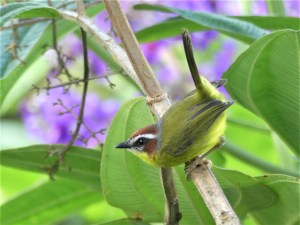
Next up, we have not a migrant but a resident, Rufous-capped Warbler. Although ‘common’ in the northern Pacific, Central Valley and southern Pacific, it’s always a jolt to see that red head, white eyebrow and cocked up tail. Basileuterus rufifrons shares its genus with three other resident Tico warblers.

Here is another photo from Jo who has documented so many species in San Vito from her porch, she is admired far and wide. This is her Smoky-brown Woodpecker — just the head, but that is enough. Who doesn’t love woodpeckers? These are found in the northern half of the Caribbean slope and on the Pacific slope but are ‘uncommon’ in both locations. How did she get this photo? See below for a view you would be lucky to see in the field. Picoides fumigatus shares its genus with the Hairy Woodpecker, the Costa Rican race of which is smaller and darker than those in North America.
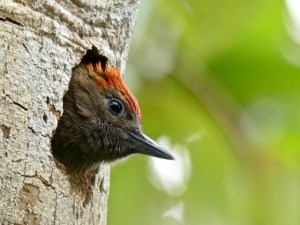
Smoky-brown Woodpecker by Jo Davidson

By now you will have noticed the photos are all out of synch with the text but it’s hard to resist including all these birds because obviously we are trying to entice you to visit us in San Vito, when you feel safe, and we will be here to welcome you.

One last bird — yes, we saved the best for last — and then the local spot where we go for breakfast when our walk is over. 

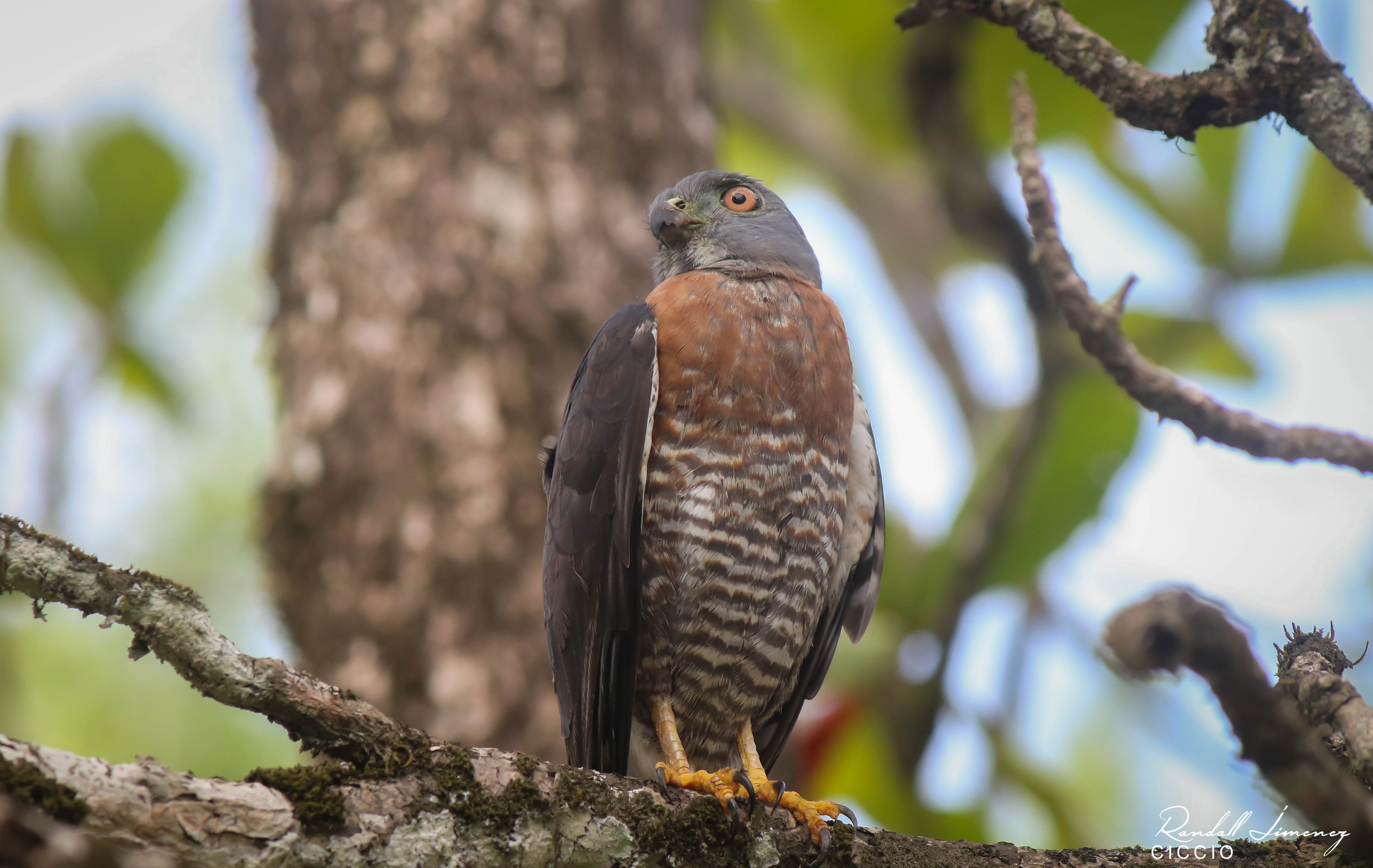
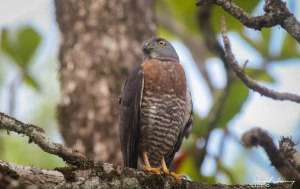
The last bird photo is a Double-toothed Kite and we saw two, building a nest, on one of our excursions to the Poro Road. It was pretty exciting! See below for a photo by Randall Jiménez Borbón who works as the Community Outreach Coordinator at the  Asociación Ambiental Finca Cántaros.

Double-toothed Kite, Harpagus bidentatus, by  Randall Jiménez Borbón, aka Ciccio

Double-toothed Kites often perch in the forest waiting for a troop of monkey to follow. They fly low to pick off any tasty critters the monkeys spook, like lizards and large insects.

See below for another photo we hope will be of interest: the Soda La Negra where we often go for breakfast after a Poro Road bird walk. Highly recommended are the scrambled eggs, rice and beans, sausages, tortillas and the coffee. The interior of this welcoming place is full of plants for sale, too, so you can augment your garden or your porch with some nicely potted flowers after breakfast.

Soda La Negra, just below the San Vito Hospital. Photo by Alison Olivieri


 

Frederick D. Schroeder 1934-2021

Treasurer Schroeder at a SVBC Annual Meeting. Photo by Jo Davidson

Fred and Jean Schroeder have been loyal members and generous supporters of the San Vito Bird Club since its inception in 2004. We probably don’t have to tell you how sad we are to report Fred died last weekend after a long illness.

As the Treasurer of the SVBC for nearly a decade, he kept us on the straight and narrow, tracking your membership dues, donations, restricted and general gifts.

Jean and Fred visited San Vito every winter for 12 years, staying at their beloved ‘Jungle Cottage’ at Hacienda Pino Collina, adjacent to the Wilson Botanic Garden. During these trips, they made so many devoted friends in San Vito and helped so many, they will be missed by all their Tico friends — and others all over the world where their travels took them. 

Fred’s gentle but sly sense of humor, his kindness, his truthfulness, intellligence and probity were readily apparent. His interests? Birds, butterflies, books, history, gardening, international travel, the wines of France, the arts — a long list in an extraordinary life.

Jean and Fred have been married for 62 years, shared a wonderful life together and  made the most of the short time alloted to each of us.

In addition to his work as our financial officer, he served on the board of the Connecticut Audubon Society, the Connecticut Ornithological Association and the Redding Conservation Commission.

In closing, this photograph by Jo Davidson portrays, better than words ever could, Fred and Jean’s remarkable love affair showing the joy of life and the joy of love.

Photo by Jo Davidson

If you would like to honor his memory in some way, please make a contribution to Connecticut Audubon by emailing: info@ctaubudon.org or click on this link to the New Pond Farm Fred Schroeder Memorial Fund 


Where We Bird — the Wilson Botanical Garden

Entrance to the Wilson Garden, photo by Alison Olivieri
The San Vito Bird Club’s roots are here in the Robert and Catherine Wilson Botanical Garden at the Organization for Tropical Studies Las Cruces Biological Station — this is a long name for a magical place. Birders come from all over the world to this spot with its list of half of the country’s land birds. We have been offering bi-monthly Bird Walks here, free and open to the public since 2004, binoculars included!

In and around San Vito, we have many ‘specialties’ — birds not easily found elsewhere. Two of the most sought-after are reliably found here where you can stay in comfortable cabins with three meals a day included, a birder’s dream destination.

Ruddy Foliage-gleaner, Clibanornis rubiginosus, photo by Randall Jiménez Borbón, aka Ciccio

The Ruddy Foliage-gleaner can be found in early morning at the beginning of the Rio Java Trail. The best way to find it is to learn the call as it is usually vocalizing as the flock moves along the forest edge.

Another, smaller beauty — the White-crested Coquette — is also here in the Pollinator Garden and can be found at virtually any time of day. It is endemic to southern Costa Rica and western Panama

White-crested Coquette, Lophornis adorabilis, photo by Pepe Castiblanco

from the canopy to forest edge and gardens. You’ll have to be on your game as this exquisite creature is ‘bee-like’ in flight.

We are sure these coquettes are stealing your heart and reminding you to clean your binoculars.

And the female White-crested Coquette in this lovely photograph by Yeimeri Badilla


Continue to scroll down from here to see just a few more photos from of this special site. The lovely garden vista was designed by Roberto Burle-Marx, a renowned Brazilian landscape designer who was a board member of the Wilson  Garden in its very early days.

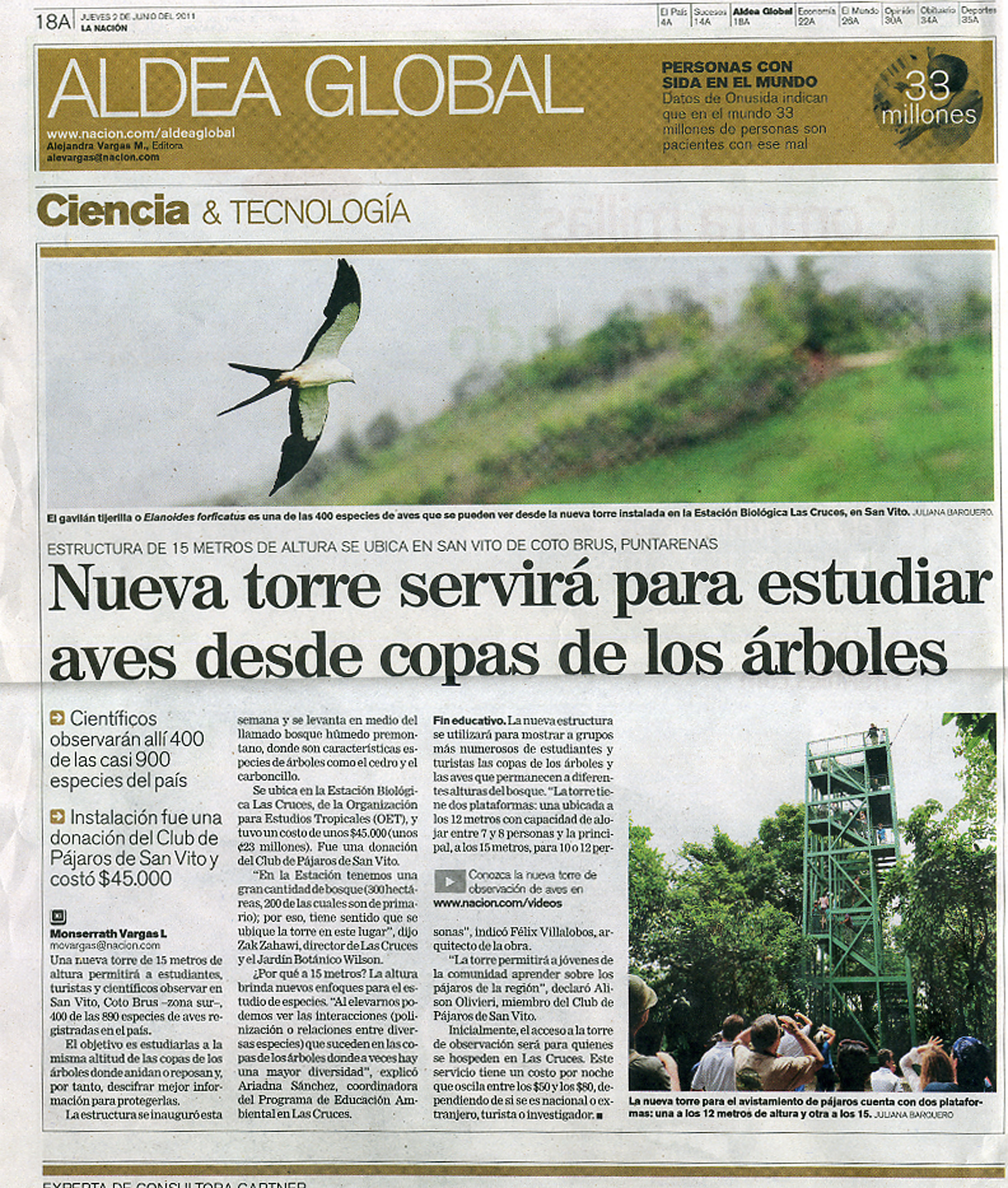
This is followed by the Canopy Tower donated by the SVBC in 2011. If you get lucky up there, you might even see a field mark on a fast-flying swift.

Meeting spot at The Wilson Botanical Garden, photo by Alison Olivieri
The Canopy Tower at Las Cruces, photo by Harry Hull III

The last beauty shot of the Wilson Garden Mirador, photo by Alison Olivieri

Greetings of the Season and Two Presents for You

We wish you Happy Holidays with some hope on the horizon. Here are two fun gifts from us to you:

1) No Membership Dues for 2020. If you were thoughtful enough to send dues this year, we will extend them to 2021 when we hope to offer Bird Walks, Outings to local hotspots, the Annual Meeting, other Special Events and Detectives de Aves classes in local schools.

2) A rooted, ready-to-plant Hampea appendiculata, full of brown clusters of fruit at this time of year and feeding tyrannulets, warblers, flycatchers, tanagers, thrushes, saltators, motmots, aracaris and toucans! If you don’t have one of these in your garden, you DO want one — trust us. It’s a small, thin tree and doesn’t get super tall so all these birds are readily seen.

Please send an email to: alison.w.olivieri@gmail.com to place your order!

It’s a Hampea Holiday!

Special thanks to Harry Hull for his festivication of the Hampea photo.

Happy Birding! High Hopes for 2021!


Zooming With Owls — Part 5, the End

What is the first thing you do when planning a birding trip? Buy or borrow a bird book and note the ones you really want to see. In the case of your trip to Costa Rica, who didn’t include the Crested Owl?

Crested Owl at Finca Cantaros, photo by David Rodríguez Arias, Biólogo Regente de Vida Silvestre at Finca Cántaros

So, we’ve saved the ‘best’ for last and we’re saying ‘best’ because this owl is San Vito’s Most Distinguished Avian Visitor of 2019-20. For the past two years, one — and sometimes two — of them have spent the green season right here, in a huge stand of bamboo near the lake at Finca Cántaros: arriving in June and departing in December.

We have many questions, not the least of which is ‘where do they go’? And ‘why’? Thirty years ago, when the definitive book A Guide to the Birds of Costa Rica by F. Gary Stiles and Alexander F. Skutch was published, not a huge amount of this species’ natural history was known. Their diet was described as “. . . beetles, orthopterans, roaches, caterpillars.” But, as one of their habits was said to be “. . . daytime roosts, especially at gaps and edges and along streams. . . “, what do you want to wager the diet included aquatic insects, frogs, small fish?

So here is the question we asked this beguiling owl, “Where do you go when you leave Finca Cántaros?” and the owl said, click here and hit ‘play’ to hear its answer.

Roughly translated, this means, “. . . to Guanacaste, like everybody else!” Just kidding, we have no idea what this Crested Owl was saying but it was recorded by Costa Rica’s own Patrick O’Donnell (Google him, if you haven’t already).

And now, we are sorry to say, it is time to ‘End Meeting for All’. 


Zooming With Owls — Part 4

Tropical Screech-Owl, Megascops choliba, photo by Randall Jiménez Borbón, aka Ciccio

Of the five species of Screech-Owls in Costa Rica, we are lucky to have two in our corner of the southern Pacific: Tropical Screech-Owl and Chocó Screech-Owl. Fairly commonly heard (and seen) in San Vito is the Tropical, with two color variations. Seen here is the gray version (of four sightings spread over 20 years, the author claims three of them were the rarer rufous morph). An important field mark is the facial disk outlined in black.

These endearing creatures are small, about 9″, and can be found in forested areas along with gardens and city parks. They pounce on prey from bare, low branches favoring large insects, spiders and scorpions (!).

Chocó Screech-Owl, photo by Pepe Castiblanco

Chocó Screech-Owl (Megascops centralis) is harder to find and was formerly known as Vermiculated Screech-Owl. With some perseverence, you might find one a little lower down the ridge toward Cuidad Neily. A good field mark for the Chocó is its lack of a distinct facial disk and less vertical streaking on the breast.

When we asked the Screechies if they found it difficult to sleep during the day, the Tropical said (click here and press play to listen), “Yes, because you humans are constantly taking pictures of us” — in Owlish, of course. On the other hand, the Chocó (click here) said, “No, because we know where to hide.”