Cotinga y el Café — Parte Uno

Autora Lilly Briggs, PhD

Versión en español

La palabra esperanza esta surgiendo mucho en el 2020. O desesperanza. O a veces las dos palabras, en una misma hora. Los motores de nuestras montañas rusas emocionales incluen: la pandemia global, incendios forestales fuera de control, y fuegos aún más feroces e inestables en la escena politica de los Estados Unidos, que tienen impactos geopolíticos trascendentales.

Es crítico enfocarnos en ejemplos pequeños, con igual de importancia, a nivel local y que día a día nos dan esperanza dentro de tanta incertidumbre. Personalmente no puedo pensar en un contrapunto mejor al caos que la historia de la Cotinga y el Café.

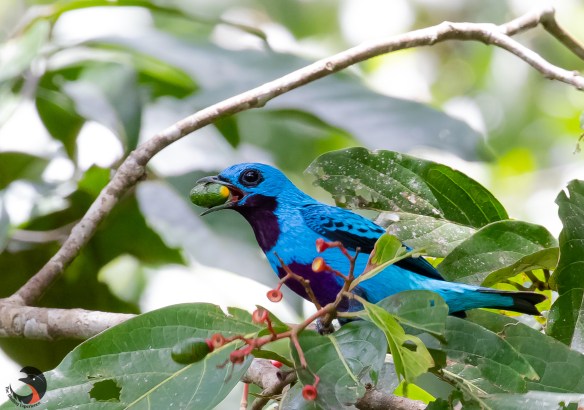
Turquoise Cotinga, foto de David Arias Rodríguez

La Cotinga Turquesa, una especie “casi endémica” es codiciada por las pajareras y los
pajareros, tanto nacionales como internacionales. No solamente se debe a que tiene una distribución limitada a Costa Rica y Panamá, sino también porque es simplemente una especie espectacular. Su apariencia sugiere que salió de las exuberantes aguas del Pacífico, revestida en ese turquesa brillante que da origen a su nombre, en combinación con el violeta rico de su pecho. Luce esos colores tan bien y con tanto brillo que su aparición podría provocar derramar el café caliente sobre su regazo.

¿Qué tiene que ver el Café con la Cotinga?
En tiempos de COVID, negocios pequeños en todo el mundo han estado golpeados
fuertemente. Pero la luminiscencia de la Cotinga Turquesa destaca el hecho de que
cultivando la ética de conservación y apreciación por la naturaleza, puede verse
beneficiada la economía y el medio ambiente, aún durante una pandemia.

“Cholo”, el dueño de Mercado Viriteca en Sabalito de Coto Brus, hizo una decisión
consciente en nombre de la conservación al abrir su negocio en medio de una intersección llena de bullicio. Al frente de una antigua estación de servicio en el centro de Sabalito, es un lugar improbable para encontrar un río y una exquisita vegetación que su local protege. Cuando tomó posesión del local hace cuatro años, dedicó tiempo y energía a limpiar la quebrada. Los Aguacatillos contribuyen a crear un ambiente bonito y relajante para la clientela, y sus frutos son tan atractivos para las aves (no solamente para la Cotinga, también a otras especies especiales como el Quetzal, el Guácharo y el Pájaro Campana), como los granos de café son para los humanos.

Recientemente, el fruto de esta labor del Mercado Viriteca se manifestó con los frutos del Aguacatillo de su patio, para el deleite histérico de la comunidad de pajareras y pajareros locales y más allá. Los Pajareros del Sur cuentan entre la multitud de gente juntándose para fotografiar a la Cotinga comiendo de estos preciados frutos. La cafetería al aire libre y el espacio entre sillas, ofrecen un lugar perfecto, en esta época de distanciamiento social, para poder disfrutar de un buen pinto y la vista de un buen pájaro. Cholo dice que ha hablado con mucha gente de sectores sobre esta increíble especie, acerca de porque los esfuerzos de conservación son tan importantes, y en cómo han ayudado a su negocio.

Es importante de entender las fuerzas grandes estructurales que impactan el mundo entero hasta nuestros contextos locales. Pero es de igual importancia enfocarnos en las acciones positivas que empiezan en nuestros contextos locales, que causan una reacción en cadena, para tener un impacto al revés: de local a global. Entonces, cuando usted empiece a desesperarse sobre las próximas elecciones o debido a
las aves migratorias muertas por causa de los incendios forestales, los animo a recordar también historias como esta. Cómo la Cotinga y el Café han unido a personas que les importa la conservación y la comunidad. Esta historia representa un llamado de esperanza, en un año tan diferente como lo es el 2020.

¡Próximamente compartiremos una entrevista que hicimos con Cholo!

Lilly Briggs, PhD

Directora, Asociación Ambiental Finca Cántaros 

San Vito de Coto Brus, Costa Rica

Facebook y Instagram: Finca Cántaros
 

Migration Is On: Sweepstakes Early Spotting Prize to Judy Richardson!

Judy Richardson, photo by Juan Carlos Calvachi

Herewith we announce the Early Migrant Sweepstakes winner: Judy Richardson!

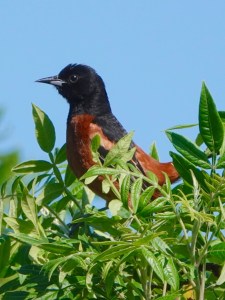
Wait, what? You didn’t realize we had a Migrant Sweepstakes going on? Neither did we until a minute ago. Never mind, we have it now and the first bird reported was a beautiful Orchard Oriole.

Orchard Oriole, photo by Mark Garland

Judy found him in early August at Hacienda Pino Collina, next door to the Wilson Botanical Garden; her home in San Vito where she’s been passing Covid-19 pandemic time birding, gardening, reading and cooking.

Let’s get into the swing of this people! How about we run a Migrant Spotting Contest from now until September 30? Just go outside with your phone and the two apps from Cornell, Merlin and eBird, and get started. Send your list to our Birder-in-Chief Greg Homer at: eltangeral@gmail.com by September 30, 2020 and we will see who finds the most waterthrushes, warblers, flycatchers and more.

Or, if you’re still operating like it is 1970, take a pencil, notepad and the Garrigues and Dean field guide outside and get going with those.

We will give you a prize, promise!

Judy is going to have one of her favorite desserts: Sticky Toffee Pudding with vanilla ice cream — delivered to her door. Just think what you might win?! Yum yum!

Heliconia Help Line: Ask Us Anything!

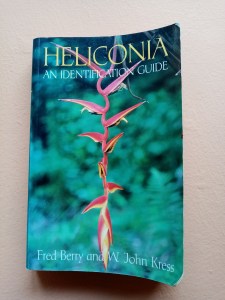
Excellent field guide by Fred Berry and W. John Kress.

Do you have a hankering to learn to identify something other than birds? How about the wild and beautiful tropical plants called heliconias?

We’ve become hooked on these exuberant blooms recently after walking in the Wilson Botanical Garden Heliconia area where all the plants are sprouting improbably-shaped and wildly-colored inflorescences holding small flowers for hummingbird species with just the right bill. The bills fit perfectly into the varied flowers which, if you weren’t looking closely, you might miss or mistake for detritus, hidden as they are in the bright framework.

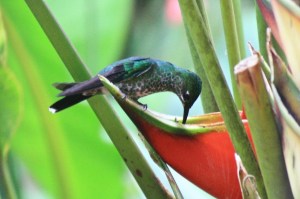
Green-crowned Brilliant on the widely-cultivated Heliconia bahai. Photo by Jo Davidson


In fact, here is the ideal transition photograph by Jo Davidson to move your mind from birds to blooms. This is an ‘early Jo Davidson’, taken in 2009 — one of her first attempts at capturing a hummingbird — this time, a Green-crowned Brilliant.


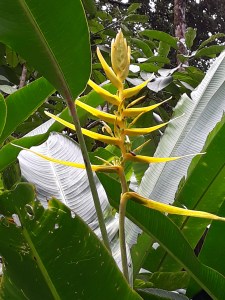
Heliconia lingulata, Peru to Bolivia. Photo by Ellen Beckett

Here is another beauty, an erect yellow showing off in the sun. Geographic distribution of Heliconia is restricted primarily to the American tropics. A disjunct group is found in the Old World tropics from Samao to Sulawesi, all of which have primarily green bracts and flowers with coppery red leaves.

The OTS Las Cruces Biological Station aka Robert and Catherine Wilson Botanical Garden is open for visitors  — a stroll through the newly-renovated Heliconia Garden is worth the trip all by itself but other highlights await, for example, the Maranta Garden, the Pollinator Garden and the Canopy Tower.

At Heliconia Central, on a recent visit, every plant was in bloom and birds were busy investigating available nectar and fruit. So it’s a must-see stop for birders and natural history photographers will hardly be disappointed.

Wipe off your lenses, be they eyeglasses, spotting scopes, binoculars or cameras — it is all out there, waiting for you! Send an email request to visit to: recepcionlc@tropicalstudies.org with the date, number in your party and then just follow the four new rules:

— Wear a mask

— Pay at the Entrance Gate, fee is $10 tourists or $3 residents

— Have your temperature taken

— Wash your hands

Pendant ‘Sexy Pink’. Photo by Julie Girard

We can practically guarantee your spirits will be lifted by some intensely beautiful  tropical plants, feathered delights in every direction and the occasional agouti gambolling across the grounds.


Bird Walk Tomorrow: Sunday, October 27!

Northern Waterthrush: a migrant to watch for! Photo by Gail Hull

Please join us for a free Bird Walk at the Wilson Botanical Garden tomorrow morning, October 27, at 7:30 a.m.

As usual, we will meet at the Reception Building and have binoculars and bird guides to share.

Many migrants have arrived in the past several weeks so we will look for them as well as whatever other beauties we can find.

Look forward to seeing you there!


Welcome White-winged Doves!

We have been waiting for quite some time for these angelic-looking birds to show up in our beloved southern zone and it appears our vigil might be over.

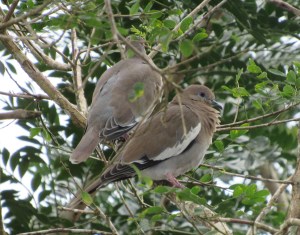
White-winged Doves. Photo by Jim Zook

First, a pair was spotted in September near La Union de Sabalito by Jim Zook who was on the job doing bird counts for Stanford University. Shortly thereafter, one was found by Randall Jiménez Borbón, a Pajarero Del Sur member and Detectives de Aves teacher, in his garden in Linda Vista just south of San Vito on the road to Ciudad Neily.

In the Stiles and Skutch Guide to the Birds of Costa Rica (published in 1989), they were considered a ‘. . . locally abundant permanent resident in dry Pacific NW, south to Jaco.’ In more recent times, they are described as ‘. . . common resident in northern Pacific and across the Central Valley . . . ‘ by Garrigues and Dean in the second edition of The Birds of Costa Rica. You can see the trajectory; it was just a matter of time.

They are pretty easy to see if you are expecting them: Garrigues describes them as “. . . commensal with humans. . . ” and goes on to say they favor open areas and are often seen feeding along roadsides. They look a lot like Mourning Doves except for the white band down the length of the wing – this is easily seen at rest and a lovely display in flight. Further, Mourning Doves have long, tapered tails and black spots on their wings, both of which are lacking in the Whities.

From November to May, our resident populations are joined by migrants from the southwestern US. The entire range goes from Arizona, New Mexico and Texas in the US; throughout Mexico and down through Central America to western Panama, as well as throughout the Caribbean islands.

Breeding season is January to March, so we will try to keep an eye on the Sabalito pair. And, meanwhile, keep a sharp eye out as they may turn up at your house any day now!

An Exquisite Visitor

Stop the presses! Male Rufous-crested Coquette debuts in San Vito. Photo by Pepe Castiblanco.

For several weeks in September, excitement ruled the birding world of San Vito as a male Rufous-crested Coquette was found feeding at an Inga tree on the road to a nearby neighborhood called Piedra Pintada. It was a THRILLING find — a new species for CR!

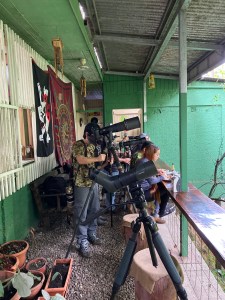
This captivating, tiny bird was a source of delight and fascination for the many birders who came running to see it, along with unsuspecting motorists puzzling over the crowd that suddenly appeared daily at 5:30 am clamoring out of cars and off motorcycles with telescopes, tripods, binoculars and cameras.

Look at this flare!

The RCCO has a short history here. It was reported in 2016 and again in 2018 at Rancho Naturalista in Turrialba. In the second edition of The Birds of Costa Rica by Richard Garrigues and Robert Dean it is listed in the back under ‘Rarities’. Historically, it is included in A Guide to the Birds of Costa Rica by Gary Stiles and Alexander Skutch, published in 1989, that cites four male specimens taken near San Jose in 1892 and 1906. It can be found in six other countries: Panama, Colombia, Ecuador, Peru and Bolivia.

What about the tail?

Considered ‘uncommon’ where it occurs, it zooms around like a large bee. It has two ‘country cousins’ that share the same status of ‘uncommon’: the White-crested Coquette and the Black-crested Coquette. ‘Whitey’ is endemic to southern CR and western Panama so we are often hosting birders who hope to see it at the Wilson Botanical Garden. ‘Blacky’ can be found in the Caribbean foothills —  Arenal Volcano National Park is a good place to look — and is likewise beelike and difficult to find.

The lesson here is that you never know! It could easily appear in your garden on one of our beautiful flowering trees – Corals and Mayos will start flowering soon – and roadsides and gardens have hedgerows of Rabo de Gato (Stachytarpheta), favored by many species of hummingbirds.

Can’t have too many photos of this wonder so here is just one more.

A special thank you to Pepe Castiblanco, co-owner of Casa Botania Lodge, for these photos.

The Children’s Forest of Coto Brus, Part 3

The Musical Arts of ‘Pest Network’

Pest Network performing as ‘Pajaros de Bobos’. Photo by Michael Olivieri

A big surprise was waiting at the end of each future forest tree planting day at Finca Cantaros for the Detectives de Aves students, as ‘Pajaros de Bobos’ popped out of the woods to sing and dance, as well as play percussion, guitar and recorder!

Integrating the arts with environmental and sustainability education is an idea that has taken hold over the past several decades and was in full ‘swing’ here recently, grabbing some gleeful attention from our student reforesters!

Sabalito students enjoy the performance organized by Carla Azofeifa in red at rear. Photo by Alison Olivieri

As Arts-in-Residency participants at the local Jaguar Luna Arts Collective in Copabuena, Sean Smith and Félix Prater entertained the students with great verve, color and flair.

As most SVBC members know well, Lesson’s Motmots “whoot” and “whoot” in gardens and forests throughout the country so these larger-than-life Bobos’ repeated multi-syllabic refrains, “Escucha! Escucha! El ritmo! El ritmo!” reverberated in our ears in quite a similarly tuneful way.

Sean? Or Felix? Thank you for your part of this exciting project. Photo by Michael Olivieri

We want to extend huge thanks to Sean and Félix for bringing each of the Childen’s Forest Tree Planting days to such exciting finales with their invigorating and unexpected performances.


The Children’s Forest of Coto Brus, Part 2

Tree Sources

The first 50 trees for this future forest were donated by Finca Las Alturas de Coton. The tree species include roble (tropical oak), amarillon (a hardwood), aguacatillo (wild avocado) and inga (pollinator attractor). You can watch a short video about Las Alturas, narrated by the manager Fernando Castañeda, by clicking here.

Rod de Sousa at Las Cruces

The OTS Las Cruces Biological Station’s Native Tree Nursery, started and managed by Rodrigo de Sousa, contributed more trees and Rod helped with placement and reforestation expertise.

Maria Rosa Rodriguez Rodriguez also provided trees for the new forest. She has a highly regarded booth at the local Feria de Agriculturas on Saturday mornings at the Campo Ferial de San Vito from 7 am to noon. Many SVBC members consult with Dona Maria for flowering plants, shrubs and trees for their gardens.

More Collaborators

LSAMP Las Cruces 2019

A university student group from the OTS Las Cruces Biological Station’s program called the Louis Stokes Alliance for Minority Participation (LSAMP) Research Experience for Undergraduates (REU) came to observe the program in action as well as help plant trees.

Coordinator Scott Walter.

The group’s Coordinator Scott Walter is a longtime OTS staff member and SVBC supporter.

All in, this is a great project with volunteers spanning generations from the 5th grade to senior citizens: SVBC-ers share the same curiosity, fascination and reverence for wildlife and natural history. From now on, ‘habitat restoration’ is our middle name.

The Children’s Forest of Coto Brus, Part 1

Dr. Lilly Briggs is up to something very wild in her new digs at Finca Cantaros: she’s working to create The Children’s Forest of Coto Brus — or, perhaps a little more melodically speaking, El Bosque de los Ninos de Coto Brus.

We talk endlessly about our Detectives de Aves environmental education program from the Cornell University Laboratory of Ornithology. In fact, Lilly is one of the co-authors of this curriculum, Lesson 9 of which is a Community Project.

This Flows So Well

In the first two weeks of July, students from six participating schools chose to plant trees as their Community Project — so they, and we, are part of the reforestation effort that will ultimately create The Children’s Forest.

Alexandrina is all smiles with her ‘personal’ part of the future forest. Photo by Peter Wendell.

The staked out young trees have been GPS-ed by SVBC President Peter Wendell and every student was photographed with his/her planting. Lilly is encouraging them to come back whenever possible to check on the tree’s growth and — one day — to bring their children and grandchildren to see their trees in the future mature forest.

Each school heard a talk on the history of Finca Cantaros, given by former owner and reforestation leader Gail Hewson Hull, followed by a discussion of the importance of trees for healthy environments and habitats, and, lastly, a brief demonstration of tree planting techniques.

Escuela Copal from Concepcion; Director Jairo Murillo accompanied his students. Photo by Peter Wendell.

The students fanned out in the pasture directly east of F. Cantaros to find their own personal sapling that they then planted with shared shovels, big smiles and great vigor!

As of the end of July 2019, 110 trees were planted by an equal number of students.

To date, participating schools include Escuelas Santa Rita, San Marcos near Sereno, Copal in Concepcion, Los Angeles, Linda Vista and Gonzalo Acuña in Sabalito. We will update this list as the forest grows!

Tree Planting Photo Essay, June 30, Concepcion

Thanks to an army of volunteers last Sunday, the Restoration Project in Concepcion on the Gamboa Property was a huge success!

Rodrigo de Sousa organized this large group for a morning of grunt work that resulted in 450 new trees planted, new fencing installed to curtail bovine wandering and reforestation to benefit the community’s future.

Troops fanned out going out and around the pasture and watershed; a morning well spent.

Even the youngest members of this volunteer group worked all morning, digging holes, staking young trees and ensuring an enhanced habitat for wildlife. Special thanks to San Vito Bird Club stalwart supporter Terry Farling for these photos!