The Canopy Tower Today

It is still standing and an attraction for visitors to the OTS/Las Cruces Research Station and Wilson Botanical Garden.

This photo, from 10 years ago, will remind you of pre-pandemic SVBC events! The Tower requires a climb of 75 steps to reach the top.  All of the folks you see in the photo above have done it; many times. Photo by Harry Hull III.

The slender and powerful young man in this photo, however, is the only person to have made the climb in less than one minute while toting 36 pairs of binoculars, 20 birding books and 120 juice boxes … Peter Wendell, head of the SVBC, standing alone. That’s what a pandemic will do for you. Photo by Alison Olivieri.

Thank You Again!

Speaking of which, we would like take some space here to honor the major donors to the construction of this amazing gateway to another world: Wildwood Foundation, Judy Richardson, Peggy and Fred Sibley, Jean and Fred Schroeder, Patricia J. Scott, Lauren and John Royer, Theodore Wickwire Royer and Zak Zahawi.

Finally, this is how small you look from the top; photo by Peter Wendell.

Finca Cántaros Environmental Association

Something great has come out of this strange and terrible pandemic: the Finca Cántaros Environmental Association. With the Class A brain of Dr. Lilly Briggs whirring and whirling while the world was at a seeming standstill, here comes a new nonprofit organization dedicated to environmental education, forest restoration and research with three key action words: “Learn. Connect. Act.”

Canada to Costa Rica and Back

Based in Canada but operating in San Vito, the FCEA will have impact and influence in the Canton of Coto Brus but also the entire country. Working with Proyecto Cerulea partners Ernesto Carman and Paz Irola, Lilly had the country’s second MOTUS tower installed and has already downloaded information on migrating Swainson’s Thrushes, originally tagged in Canada(!).

The Website

And that is just ONE of the myriad projects being worked on by Lilly’s knowledgeable and energetic team. They have just launched a new English-language website — we encourage all our members to take a look. It is beautiful and packed with information about the ongoing projects, plus you can meet the team.

The Projects

Interested in, well, birds? Of course! Weekly Bird Counts are conducted at Finca Cantaros following strict protocols. What about bats? Monthly site visits by the Monteverde Bat Jungle crew are gathering information on local bats and watching natural reforestation in action, especially in the Children’s Rain Forest of Coto Brus, just outside Cántaros’ forested area. Reforestation? There’s a Tree Nursery collaboration with Osa Conservation! Sustainable food production? Women Committed to the Earth is a program working on agroecology practices applicable to local conditions. Art and Science? What about Nature Sketch from the Robert Bateman Foundation? And finally we circle back to the SVBC sponsored program, member-supported Detectives de Aves, now being taught in local schools for the first time in almost two years.

Bird Walk Sunday, May 9

Please join us this Sunday for a free Bird Walk on the Poro Road. We will meet at 7:30 am down the hill where we leave the cars. As always, we will have binoculars to lend.

Directions: from Las Cruces toward San Vito, take the first unpaved (lastre) road to the right after the hospital. From San Vito toward the hospital, take the unpaved road to the left after Soda La Negra.

The walk will go for about an hour. If we are lucky, we might see a pair of nesting Riverside Wrens or Double-toothed Kites! We don’t have a sign-up link this time — we will be there anyway.

REMINDER: International Migratory Bird Day and a Global Big Day occur the day before, on Saturday, May 8. Don’t forget to bird around your house, along the road or at your favorite spot and submit your list to eBird.

Please Buy Virtual Cookies and Cake . . .

As part of the Finca Cantaros Environmental Association’s Earth Day Celebration, SVBC members’ ovens were fired up for a Bake Sale. Take a look at the yummies below and place your order via PayPal. It’s easy as pie (!) — all you do is go to your PayPal account and search for ‘Finca Cantaros‘ or ‘info@fincacantaros.org‘ to make your donation.

Galletas de Dulce by Pedro

Now for the Strawberry Cake:

Queque Rosada de Fresa

And, while you are at it, please go to the brand new English-language website of the Finca Cantaros Environmental Association: www.fincacantaros.org — prepare to be impressed and proud to participate!

Watch this space for an article about this new nonprofit organization. We are so excited to have these wonderful neighbors and when you meet the team, learn the vision and hear about ongoing events and activities, you will be too.

Oh, wait, if you really DO want cookies or cake, email us and the next time you are near we will see that you have some.

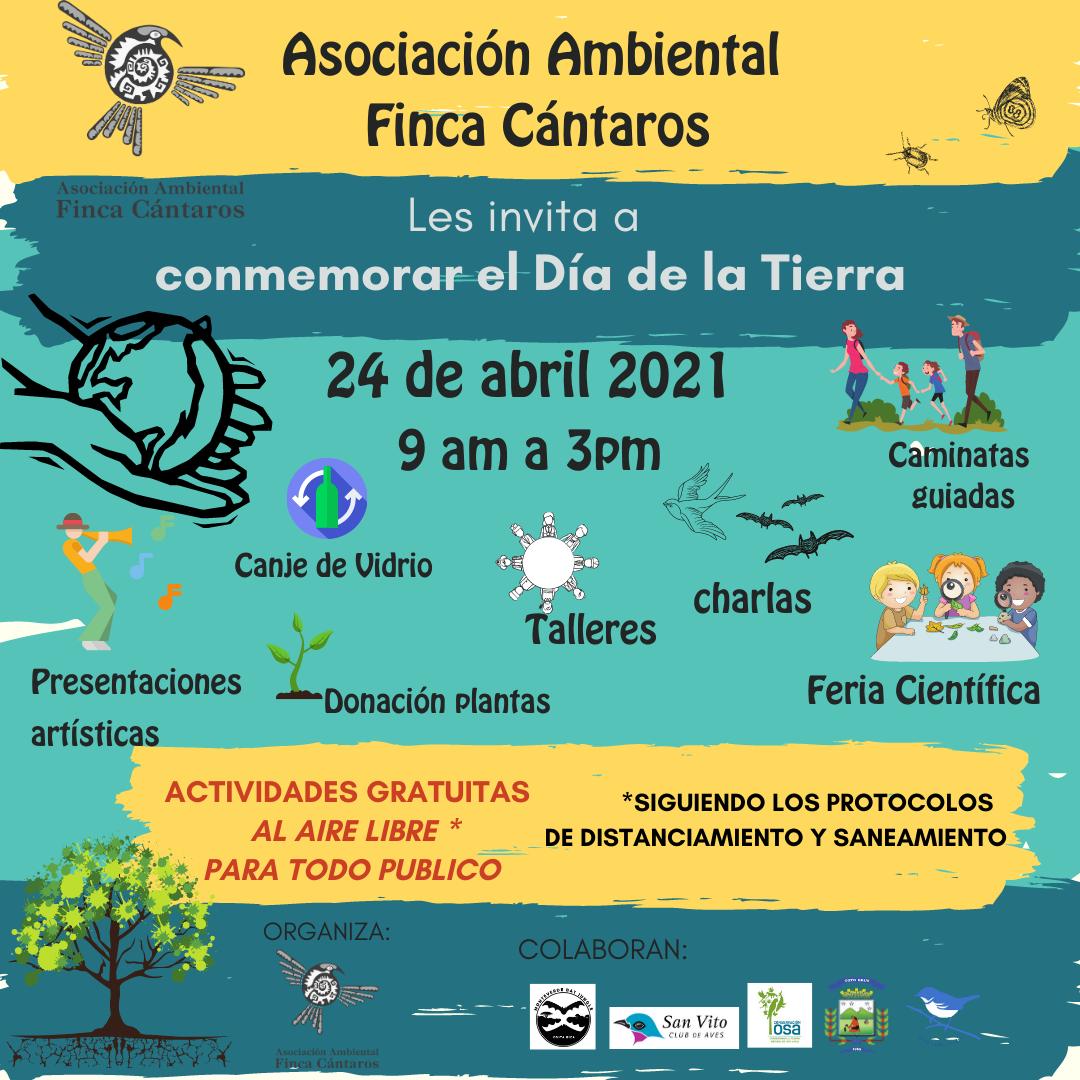
Celebrate Earth Day 2021 on Saturday, April 24 at Finca Cántaros

Join us on Saturday, April 24 for an Earth Day Festival at the Finca Cántaros Environmental Association from 9 am to 3 pm.

As you can see from the posters below, the team has created all kinds of activities including guided walks, workshops (How to Make a Vegetable Garden, Exploring Nature) and two science talks, one about bats and one about bird migration (The MOTUS Tower) PLUS the 1st Annual Science Fair for elementary school students!

Meet your new neighbors! Practice your Español! Bring your recyclable glass to trade for a glass! Buy treats at the Bake Sale* and enjoy live music and art presentations!

All activities will be outside and adhere to Covid protocols. This will be a fun-filled day in a strange and difficult time so please treat yourself by visiting the AAFC — Asociación Ambiental Finca Cántaros!

And here is the schedule:

*If you would like to buy virtual cookies and make a donation to the new Asociación, please go to your PayPal account and enter ‘Finca Cantaros’ or info@fincacantaros.

Tomorrow’s Bird Walk Postponed!

We are sorry to report we had no sign-ups for tomorrow’s Bird Walk at Las Cruces/Wilson Botanical Garden, so it is officially cancelled.

In two weeks, we will schedule a free Bird Walk at a different location and hope you will join us!

Meanwhile, Finca Cantaros will host an Earth Day Celebration next Saturday, April 24! We urge you to attend and meet the new team — your new neighbors. Details of the event will be posted here on Wednesday.

San Vito from the Finca Cantaros Mirador, photo by Alison Olivieri

Where We Bird — the Poro Road

Riverside Wren with nesting material. Photo by Sarah Beeson-Jones

Thanks to Julie Girard-Woolley, the SVBC has been birding this hidden road for a few years and found some pretty great birds there. Julie is a ‘walker’ (and an SVBC founder) and this spot is spectacular in March with a huge grove of blooming Poro trees. But we are not there for the trees — so let’s start with a bang: the Riverside Wren.

Endemic to southern Costa Rica and western Panama, Cantorchilus semibadius is one of many very loud wrens

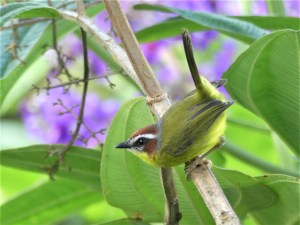
Rufous-capped Warbler. Photo by Jo Davidson

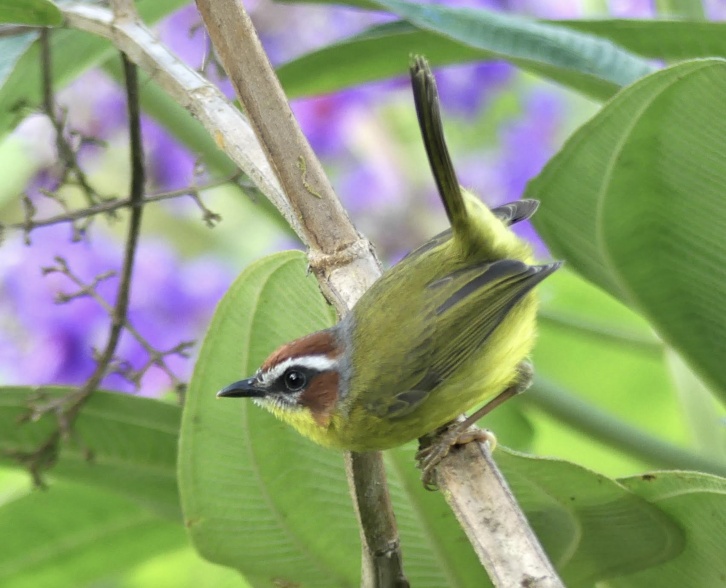
Next up, we have not a migrant but a resident, Rufous-capped Warbler. Although ‘common’ in the northern Pacific, Central Valley and southern Pacific, it’s always a jolt to see that red head, white eyebrow and cocked up tail. Basileuterus rufifrons shares its genus with three other resident Tico warblers.

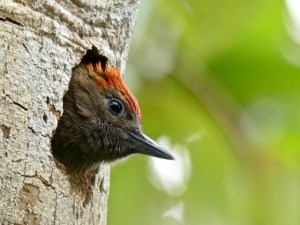
Here is another photo from Jo who has documented so many species in San Vito from her porch, she is admired far and wide. This is her Smoky-brown Woodpecker — just the head, but that is enough. Who doesn’t love woodpeckers? These are found in the northern half of the Caribbean slope and on the Pacific slope but are ‘uncommon’ in both locations. How did she get this photo? See below for a view you would be lucky to see in the field. Picoides fumigatus shares its genus with the Hairy Woodpecker, the Costa Rican race of which is smaller and darker than those in North America.

Smoky-brown Woodpecker by Jo Davidson

By now you will have noticed the photos are all out of synch with the text but it’s hard to resist including all these birds because obviously we are trying to entice you to visit us in San Vito, when you feel safe, and we will be here to welcome you.

One last bird — yes, we saved the best for last — and then the local spot where we go for breakfast when our walk is over. 

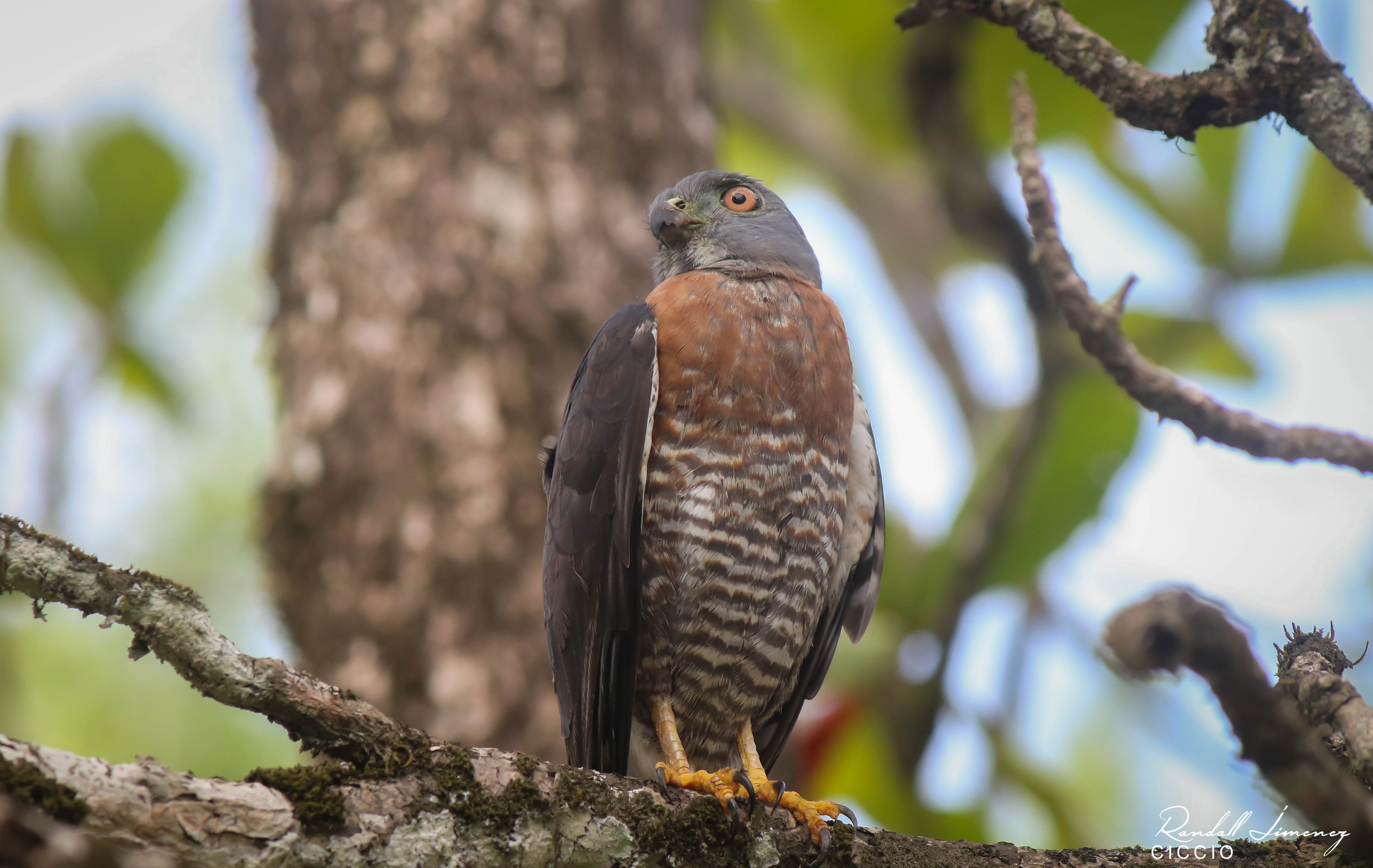
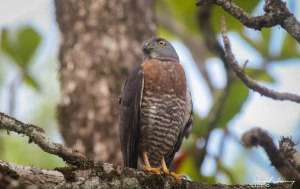
The last bird photo is a Double-toothed Kite and we saw two, building a nest, on one of our excursions to the Poro Road. It was pretty exciting! See below for a photo by Randall Jiménez Borbón who works as the Community Outreach Coordinator at the  Asociación Ambiental Finca Cántaros.

Double-toothed Kite, Harpagus bidentatus, by  Randall Jiménez Borbón, aka Ciccio

Double-toothed Kites often perch in the forest waiting for a troop of monkey to follow. They fly low to pick off any tasty critters the monkeys spook, like lizards and large insects.

See below for another photo we hope will be of interest: the Soda La Negra where we often go for breakfast after a Poro Road bird walk. Highly recommended are the scrambled eggs, rice and beans, sausages, tortillas and the coffee. The interior of this welcoming place is full of plants for sale, too, so you can augment your garden or your porch with some nicely potted flowers after breakfast.

Soda La Negra, just below the San Vito Hospital. Photo by Alison Olivieri


Zooming With Owls — Part 4

Tropical Screech-Owl, Megascops choliba, photo by Randall Jiménez Borbón, aka Ciccio

Of the five species of Screech-Owls in Costa Rica, we are lucky to have two in our corner of the southern Pacific: Tropical Screech-Owl and Chocó Screech-Owl. Fairly commonly heard (and seen) in San Vito is the Tropical, with two color variations. Seen here is the gray version (of four sightings spread over 20 years, the author claims three of them were the rarer rufous morph). An important field mark is the facial disk outlined in black.

These endearing creatures are small, about 9″, and can be found in forested areas along with gardens and city parks. They pounce on prey from bare, low branches favoring large insects, spiders and scorpions (!).

Chocó Screech-Owl, photo by Pepe Castiblanco

Chocó Screech-Owl (Megascops centralis) is harder to find and was formerly known as Vermiculated Screech-Owl. With some perseverence, you might find one a little lower down the ridge toward Cuidad Neily. A good field mark for the Chocó is its lack of a distinct facial disk and less vertical streaking on the breast.

When we asked the Screechies if they found it difficult to sleep during the day, the Tropical said (click here and press play to listen), “Yes, because you humans are constantly taking pictures of us” — in Owlish, of course. On the other hand, the Chocó (click here) said, “No, because we know where to hide.”

Zooming With Owls — Part 3

Striped Owl, photo by Randall Jimenez Borbón, aka Ciccio

The Striped Owl is a favorite — just look at that photo! Considered “local” and “uncommon” in the Coto Brus-Terraba region, they can be found perched on roadside utility wires at night. Let’s say, for example, you are driving home to San Vito after a weekend at Manuel Antonio National Park. You see an upright figure on a wire ahead and it’s getting dark so you slow down to see what this might be: a Striped Owl! What a prize!

The ear tufts are reminiscent of Long-eared and Short-eared Owls of North America but hunting techniques differ in that the northern birds tend to fly over large, open areas like salt marshes whereas ‘Stripeys’ favor roadside edges of forest or rice or palm plantations, often near lights, where they can dive for prey that includes small mammals, large insects, amphibians and occasionally small birds. 

We wanted to know more about “owl pellets”, so fascinating to nature centers around the world, so we decided to ask ‘Stripey’: why do you all cough up those (potentially) gross detritus-y balls of ??? and this is the answer (click here and click play). The bird didn’t really answer the question but we were happy to hear a recording from so close to home.

This Striped Owl comes to us from the extensive nature photography collection of Randall Jimenez, a Detectives de Aves teacher, who works at Finca Cántaros as the Coordinador de Alcance Comunitario, i.e., the public face of the new Asociación Ambiental Finca Cántaros.

Randall can be found on Facebook, WhatsApp and other social media platforms and, should you wish to visit Cántaros, please contact him.

Zooming With Owls — Part 2


Mottled Owl, photo by Pepe Castiblanco

Everybody loves owls, no? Yes! They are particularly endearing and, with their round heads, round bodies and big eyes, they almost look like Bobblehead Toys. The problem is we need to go out at night to see them or have a spectacular bit of luck on a daytime bird walk.

Mottled Owls are the most commonly heard of them all in San Vito. You can often hear them start to call at dusk or later into the night and they sound a little bit like dogs in the distance until you accustom yourself to their voice. They start breeding in February and, when two of them get each other wound up — calling back and forth — it makes a big, kind-of-scary, duetting racket!

Apparently there is a question on the correct scientific name of this owl. According to the Taxonomy Seer of the SVBC Jo Davidson, in Costa Rica we use Ciccaba virgata. You will see it referred to as Strix virgata in the links below. In either case, or both, Mottled Owls are found from Mexico to Ecuador, Bolivia and Argentina.

Black-and-white Owl, photo by Yeimiri Badilla

The larger Black-and-white Owl is far less common but has been reliably seen and heard near the forested area around the Las Cruces Biological Station. It takes bigger prey than its cousin, feeding on small rodents and bats in addition to large insects favored by both.

You won’t be surprised to learn these owls are in the same genus with their similarly rounded shape, no ear tufts and prominent, fancy eyebrows. Ciccaba nigrolineata is the Black-and-white found from Mexico to Venezuela and Peru.

Let’s see what they have to say for themselves when asked about swiveling their heads around to nearly 180 degrees: is it fun? It looks like a conjuring trick! Click the link here and press play to hear the Mottled Owl’s reply. It sounds like it is saying, “Wow, wow, wow!” And the Black-and-white had this to say: click and press play. This sounds like “Just who are YOU?” to us.

And finally here are both of them arguing over the answer; see if you can tell who is calling by clicking here!

Just one more view of the Mottled Owl from Pepe Castiblanco’s collection.