Your Weekly–‘Tiny Moment’

From SVBC member Jo Davidson.

As those who know me are aware, every morning – whether it’s hot, cold, sunny, rainy or snowy – I sit on the front porch to sip my coffee and see what Mother Nature might have in store to catch my eye. A couple of days ago, she wasn’t kidding around! I have been lucky in my rather lengthy life to have seen a good number of European Starling murmurations, usually off in the distance over an open field as I drove down a rural stretch of road. (On the off chance someone hasn’t had the same good fortune, there is a link to a video below.) On this particular morning, however, the murmuration came to me! Quite literally! I had scarcely settled into my chair when I looked toward the little cherry tree in the front yard to see if the resident Northern Mockingbird was there to sing me awake. Just at that moment, about 600 Starlings swooped in over that very tree and headed toward me. I had little time to react as they came within a few feet, rose upward, swooped down again, made a quick turn and then another, and as suddenly as they had arrived, flew out of sight! I’m not sure whether their wings or my heart were fluttering faster! By murmuration standards, it was a small one, but by Tiny Moment standards, it will loom large for a long time.

Your Weekly–‘Tiny Moment’

We’ll, it’s been nearly eight months since since we’ve been in San Vito. We’re getting very anxious to come back and visit our friends, bird with all our Club members, play Mex Train, and enjoy hiding from our Connecticut winter.

Here is my Maggie practicing for the flight! She was wary to start, but those treat rewards for entering her carry bag make it her ‘happy’ place!

It’s not a wild ‘tiny moment’, but it’s the tiny moment that gets me closer
to San Vito!

Arriving 5 December!

photo courtesy of Judy Richardson

La Rojita is in San Vito

Welcoming migrant birds in September and October is such a pleasure! Black-and-whites, Chestnut-sideds, Golden-wingeds — these small and fearless flyers have made it back again!

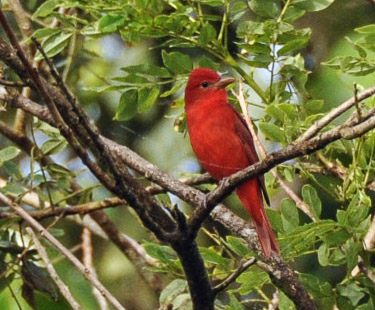
This week a Summer Tanager — La Rojita — arrived in our garden with its cheerful ‘picky-tuk’ call and bright red feathers.

Summer Tanager, photo by Julie Girard

Each of these arrivals is a miracle. Flying thousands of miles with hunger, muscle fatigue, bad weather … how does it even happen?

Let 2023 be a special year for these visiting migrants and bring some joy and peace to all.

We plan to augment occasional Bird Walks with butterfly and plant experts and to add outings to special ‘birdy’ places we haven’t visited in recent years.

Please help us with these plans by sending your annual dues for 2023. You can click on the Support the Club button found below or on the website’s Home Page (www.sanvitobirdclub.org) and pay via PayPal or credit card.

Or bring cash to a Bird Walk — the dues are: $25 resident individual, in colones C15,500; $50 resident family, in colones C30,000 OR $20 international individual and $40 international family.

We look forward to spending more time together in our favorite pursuit.

Your Weekly–‘Tiny Moment’

From SVBC member Ellen Beckett

I am fascinated by leafcutter ants, although friends tell me this is only possible because I am a renter, not a landowner.  I could watch them for hours, tirelessly carrying large pieces of leaves on their heads, scurrying in an almost straight line back to the nest and then returning to pick up another chunk.  Looks like the equivalent of me carrying four-by-eight pieces of plywood on my head. (They can actually carry pieces of leaves almost 50 times their own weight, and they have a groove in the top of their head that helps balance them.)

And what motivates them?  Sociobiologists of course tell us that they are ensuring that their genes will be passed on, as all species do.  Still, do they ever wake up and say, “Nah, not today”?  Do they think of organizing a strike?  What consequences do lazy ants face?

Next time, before you go for the poison, take a minute to appreciate one of nature’s marvels:  the leafcutter ant.

Atta cephalotes (Leafcutter Ant) courtesy of Wikipedia

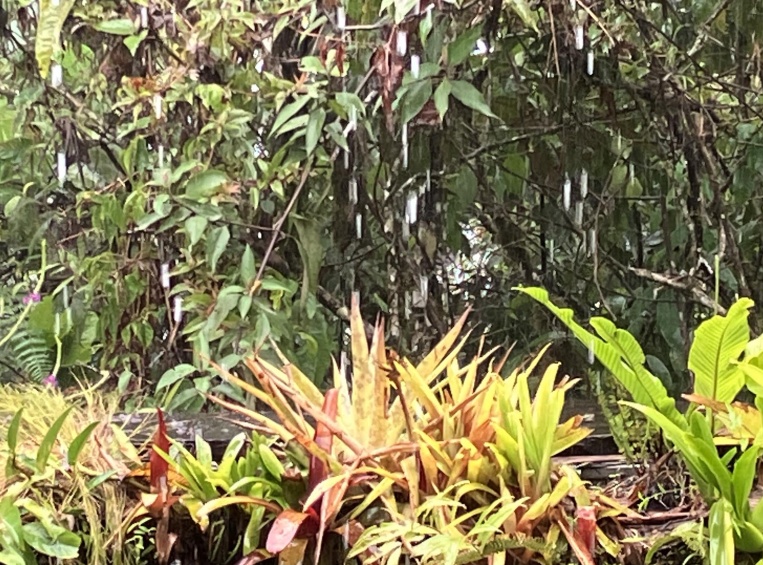
‘They get wet.’

‘Ahhh, what happens to the poor little birds when it rains this hard and this long?’

(My answer is in the title above)

There’s nothing wrong with getting wet! Birds are homeothermic (warm blooded) just like we are and the monkeys are and the agoutis are and the bats are. We all generate own own body heat and have the ability to maintain an almost constant temperature; it’s like having an ‘internal thermostat’.

But that internal thermostat will cease to function if isn’t fed. Calories are required. Birds must eat.

So during these extended and intense rainstorms we’ve been having don’t worry too much about the birds. They know what they’re doing.

And here’s a bird watching tip: When the intense rain slows down or stops, get out there and look around. You’ll likely see lots of birds coming out to get a quick bite to eat.

And if you get wet…don’t worry! Dry off and have a bowl of hot oatmeal. You’ll be fine. Worrying about getting wet is much worse for your health than getting wet.

When it rains, it pours.

Your Weekly–‘Tiny Moment’

From SVBC member Judy Richardson.

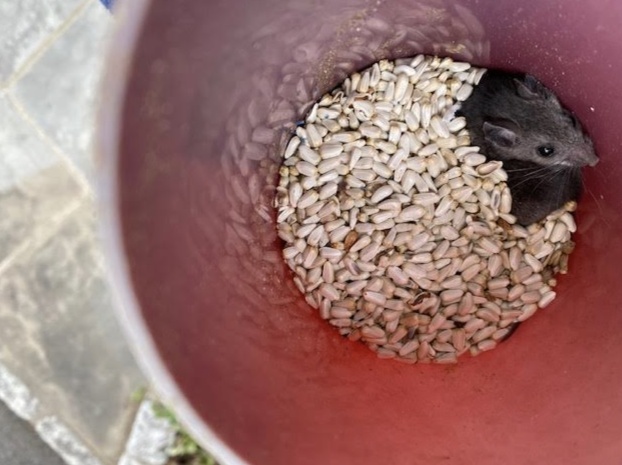
So fall is here in Connecticut, and I went to fill the bird feeder. The seed is in a plastic container with a lid to keep it fresh. When I opened the lid, to my surprise, there were four, baby mice huddled in a corner! Yikes, how did they get in there?
I scooped them up in the seed scoop and dashed outside to free them. Some seeds went with them for a snack.  They were so cute, and didn’t seem the least bit scared of me. Clearly there was a party that I was wasn’t invited to!

Mouse in the millet photo, courtesy of Judy Richardson.

Your Bi-Weekly–‘Tiny Moment’

From SVBC member and former Detectives de Aves instructor Roni Chernin.

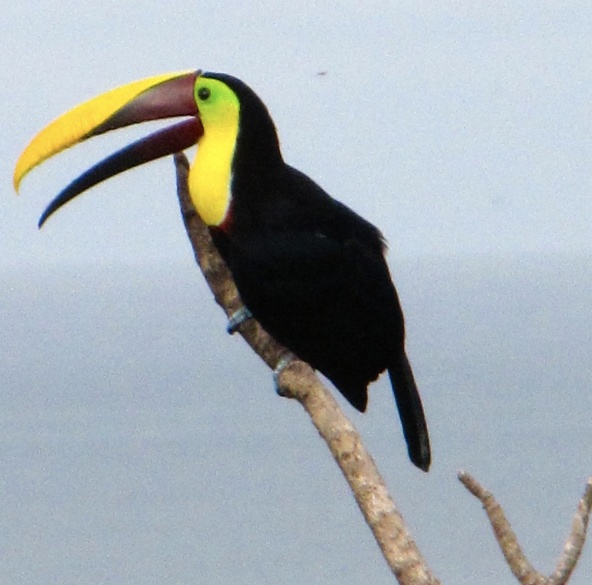
For years I had heard about how Yellow-throated Toucans rob other birds nests and eat the eggs; but I had never seen it personally. Until now.

The other morning I heard some scuffing in a tree and looked up. A Toucan was in there along with a few other birds on nearby branches.

I watched him take off for a nearby tree, carefully balancing an entire nest in his beak. He perched in a fairly open tree so I could plainly see him working his beak and claw with the nest. Though I could not see the outcome I hoped the meal was eggs and not chicks

When he was finished, the empty nest fell to the ground, not unlike a discarded sandwich wrapper.

Some may call the Toucan’s behavior nasty or rude. But nature makes no such judgements.

Yellow-throated Toucan; photo courtesy of Helen LeVasseur.

Your Weekly–‘Tiny Moment’

From SVBC member Nancy Warshawer.

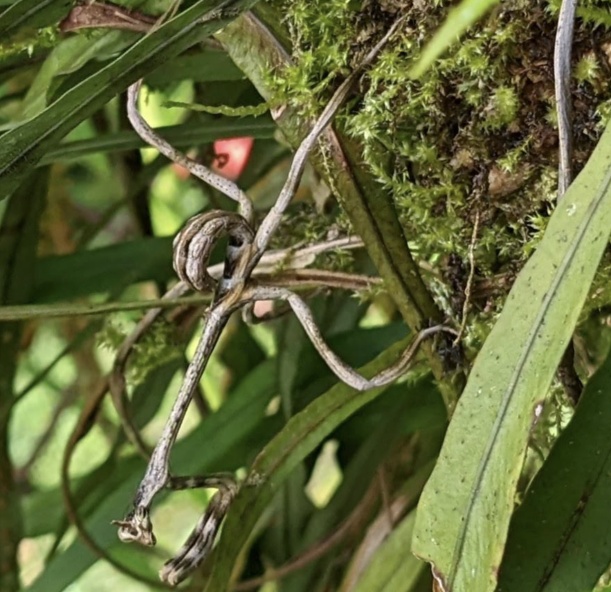
A couple weeks ago I was checking in on my epiphyte-filled trees (as one does), and I was just about to brush aside some thready dead fern leaves when they began to vibrate. There was no breeze and nothing else was moving, so it got my attention. It took a second to figure out I was looking at a…praying mantis.

I suppose her defense mechanism of vibrating didn’t evolve to defend against humans! Ironically, it may have saved her from an accidental death at my hands. I have been checking in on her regularly and she’s remained within 6 inches of where I found her. It’s always fun (for me, anyway) to follow some individual creature going about its life.

Photo courtesy of Nancy Warshawer

Your Weekly–‘Tiny Moment’

From SVBC member Helen LeVasseur.

Yesterday, as nightfall approached we heard the familiar call of our neighbor from the forest, the Gray-cowled Wood-rail.   This bird frequently calls while walking the perimeter of our cabin.  The call is very loud and although short-lived, less than 30 seconds, it has a cadence and frequency that denotes urgency.   This is evident and most dramatic at dawn, just before sunrise, as two voices echo beneath our windows, announcing the beginning of the day.  In effect, the Gray-cowled Wood-rail is our alarm clock.

I am very fond of these neighbors. Do any of you use the same alarm clock?

Gray-cowled Wood-rail painting; courtesy of Helen LeVasseur.

Your Bi-Weekly–‘Tiny Moment’

Last week I had the opportunity to do some birding on the property of a friend who lives in Campo Dos (down the hill from San Vito). Wonderful secondary and some primary forests; valleys, quebradas, waterfalls and hillsides.

As we hiked on the trail I commented;

‘This sure is a beautiful spot.’

The owner replied;

‘Yup…screensavers everywhere.’

Now normally I’m pretty quick on the uptake; but it took me about 3 1/2 seconds to get his meaning. At that point I gave out with genuine and prolonged laughter.

Photo courtesy of the author.