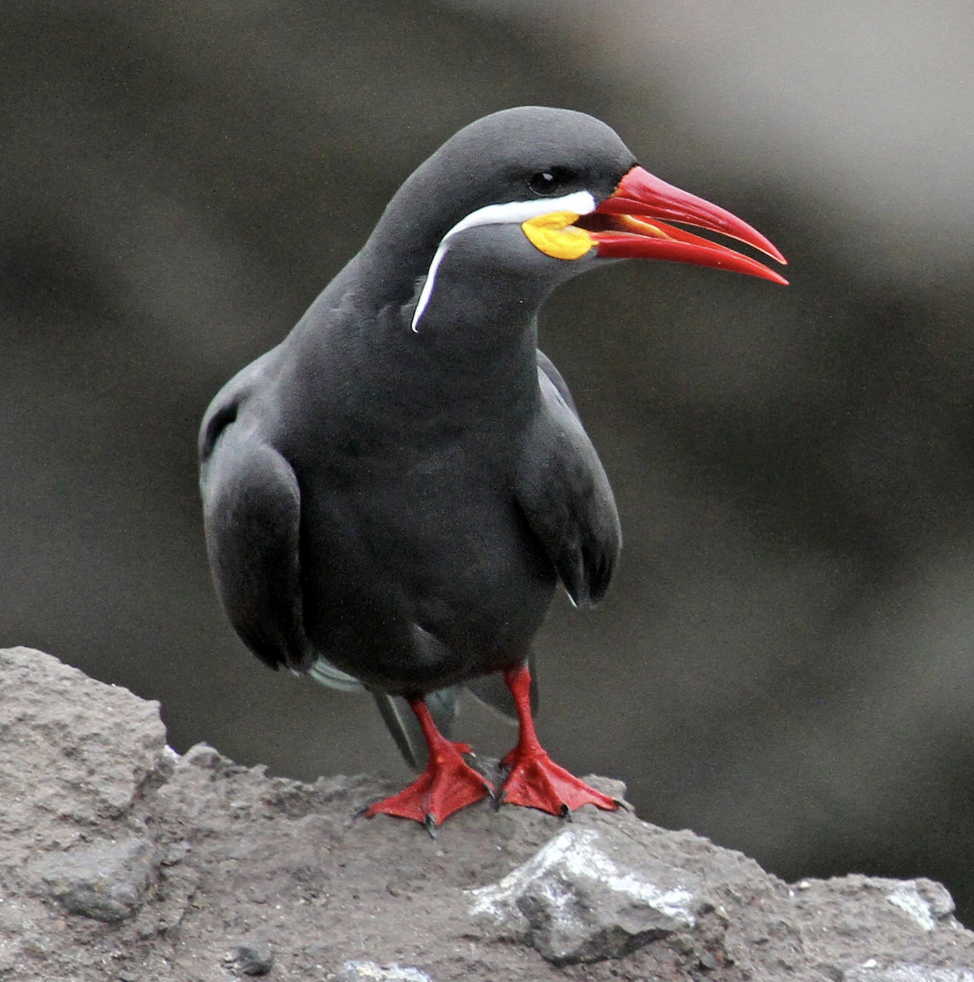
Our good birding friends and neighbors around Playa Pavones have been spotting a most charismatic shore bird; a species associated with the cold water Humboldt Current and rarely seen in Costa Rica.
This is Inca Tern.
Inca Tern (Larosterna inca): photo courtesy of eBird.
Seen and photographed around Playa Pavones for the past week; but as we know…they do move about.
If you’re spending some time at our close-by beaches, keep your eyes open for the Inca Tern.
If it shows up at your back-year feeding station in San Vito…call me…collect.
Everyone’s favorite neo-tropical bird is the Resplendent Quetzal…if you were to ask anyone…anyone, from the most casual $49 Bushnell binocular birder to the most dedicated Swarovski ‘I-do-this-for-a-living’ Cornell ornithologist, if you were to ask them this one question…
‘Tell me…where does the Quetzal build its nest?’
This is the answer you’d get:
‘Oh, that’s easy! The Resplendent Quetzal always builds its nest in an excavated hole, high up in a dead or decomposing tree. Geez, I thought EVERYONE knew that. GEEZ!’
And so it was…until a couple of days ago.
A couple of days ago, that answer became only a portion of the correct response to that very question.
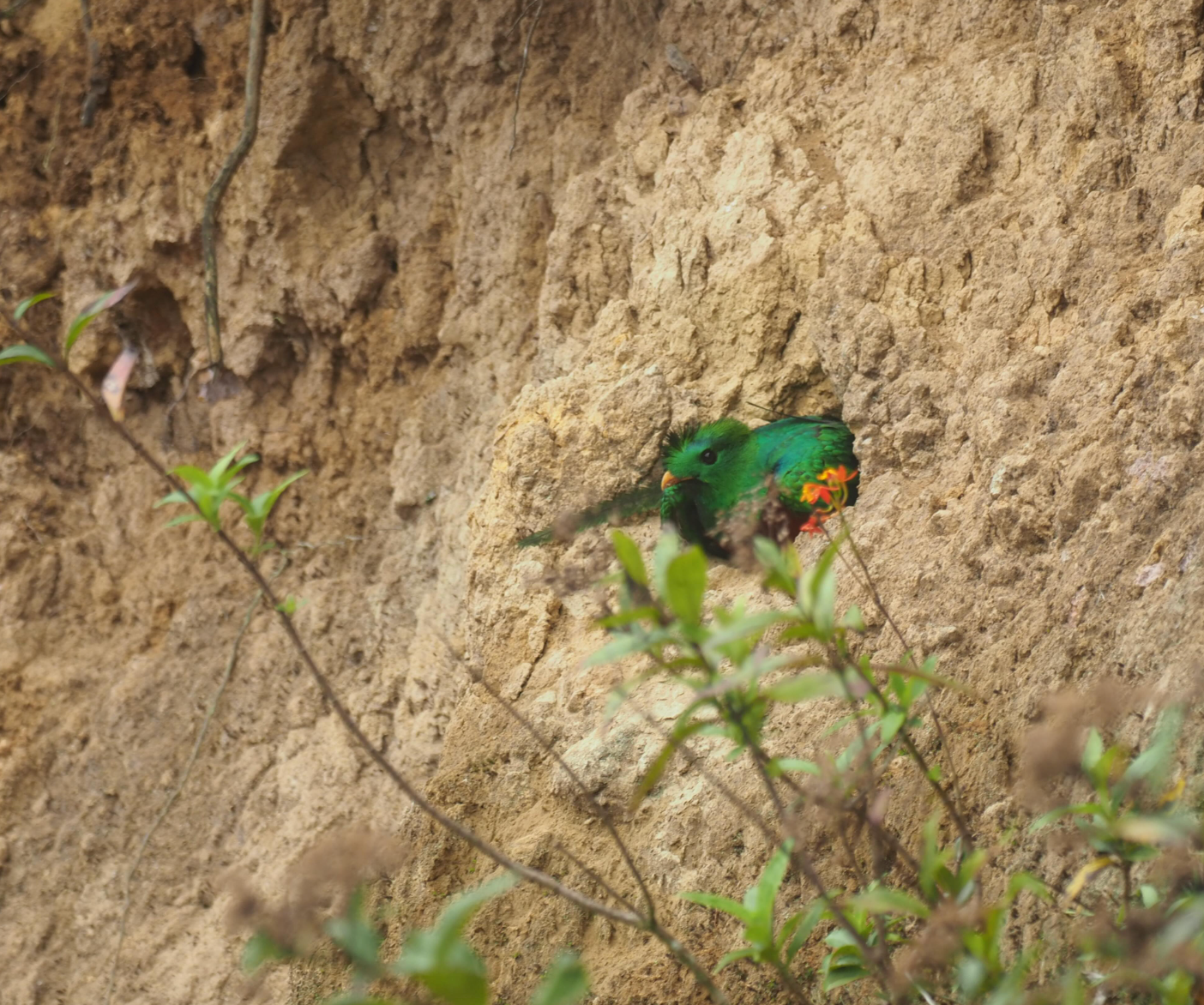
Up on the Cerro de la Muerte of Costa Rica in a high altitude location known as the Zona Protectora Río Navarro–Río Sombrero, a pair of Quetzals were observed (and continue to be observed) diving into and out of an excavated embankment tunnel nest! (see below)
(photo courtesy of the great Serge Arias)
Once again, we are compelled to acknowledge this truism:
‘Science is never truly settled.’
Science must always remain open to the discovery of new observations, new data and then must modify itself based upon that new data.
Okay, this Quetzals nesting in excavated embankment tunnels discovery may not be the biggest scientific discovery of the millennium…or even of the week…but it should serve as a reminder to us that what is accepted and true today, may not be quite so true and accepted tomorrow.
By the way, this discovery was made by some regular folks…CITIZEN SCIENTISTS! So my friends, keep your eyes wide open and keep your $49 Bushnell binoculars (or whatever you have) within reach.
ps: My hypothesis (which is just an educated guess) as to why this pair of Resplendent Quetzals modified their behavior and chose to place their nest in an excavated embankment tunnel rather than high up in a dead or decaying tree is this:
The Resplendent Quetzal numbers must be on the increase (at least here in Costa Rica). This bird is so revered, so coveted and protected that…maybe…the suitable, traditional nesting trees are all occupied with other Resplendent Quetzals. Any port in a storm, as they say.
Please join the San Vito Bird Club for our regular Sunday bird walk.
Sunday, March 22nd…meet at the Recepcion office of the Wilson Botanical Garden (OTS Las Cruces), 7:00am.
As always, everyone is welcome to join us for this birding event. Binoculars are available as needed. Experienced birders are on hand to assist you with any questions you may have. Actually, any BIRDING OR NATURE questions you may have. I mean, its probably not a good idea to ask questions pertaining to such topics as car maintenance, dating, crypto-investing, the history of British royalty or fashion tips. But if you do…be assured we’ll give out with the best answers we have; even if they are just made up answers.
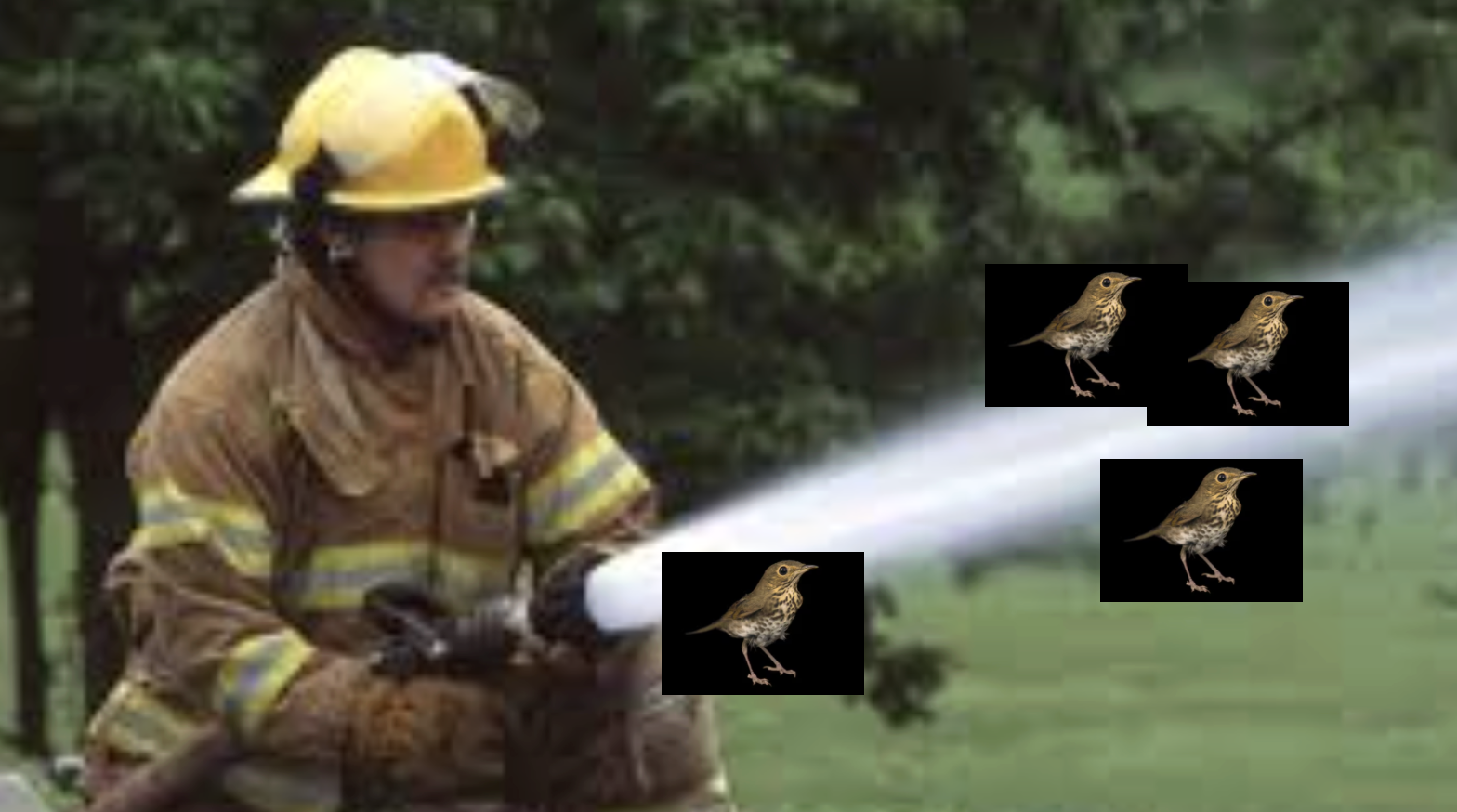
We hope to see you. FYI: The northward migrating Swainson’s Thrushes have arrived in San Vito (a bit early I believe). It’s like a fire hose of Swainson’s Thrushes are upon us.
Please join Cecelia Sansonetti and the San Vito Bird Club for our next Sunday morning Bird Walk…March 8th at 7:00am.
The 74th anniversary of the founding of San Vito took place just this past week. In honor of that event, Cecelia Sansonetti (daughter of the original founder AND a long time supporter and member of the San Vito Bird Club) has graciously offered us a bird walk on her property.
Cecelia will lead us on a fairly flat and wide trail with mixed secondary forest on both sides. Should be easy walking.
As with all of our Bird Walks there is no charge and everyone is welcome. Binoculars and local birders are available to enhance the experience for you.
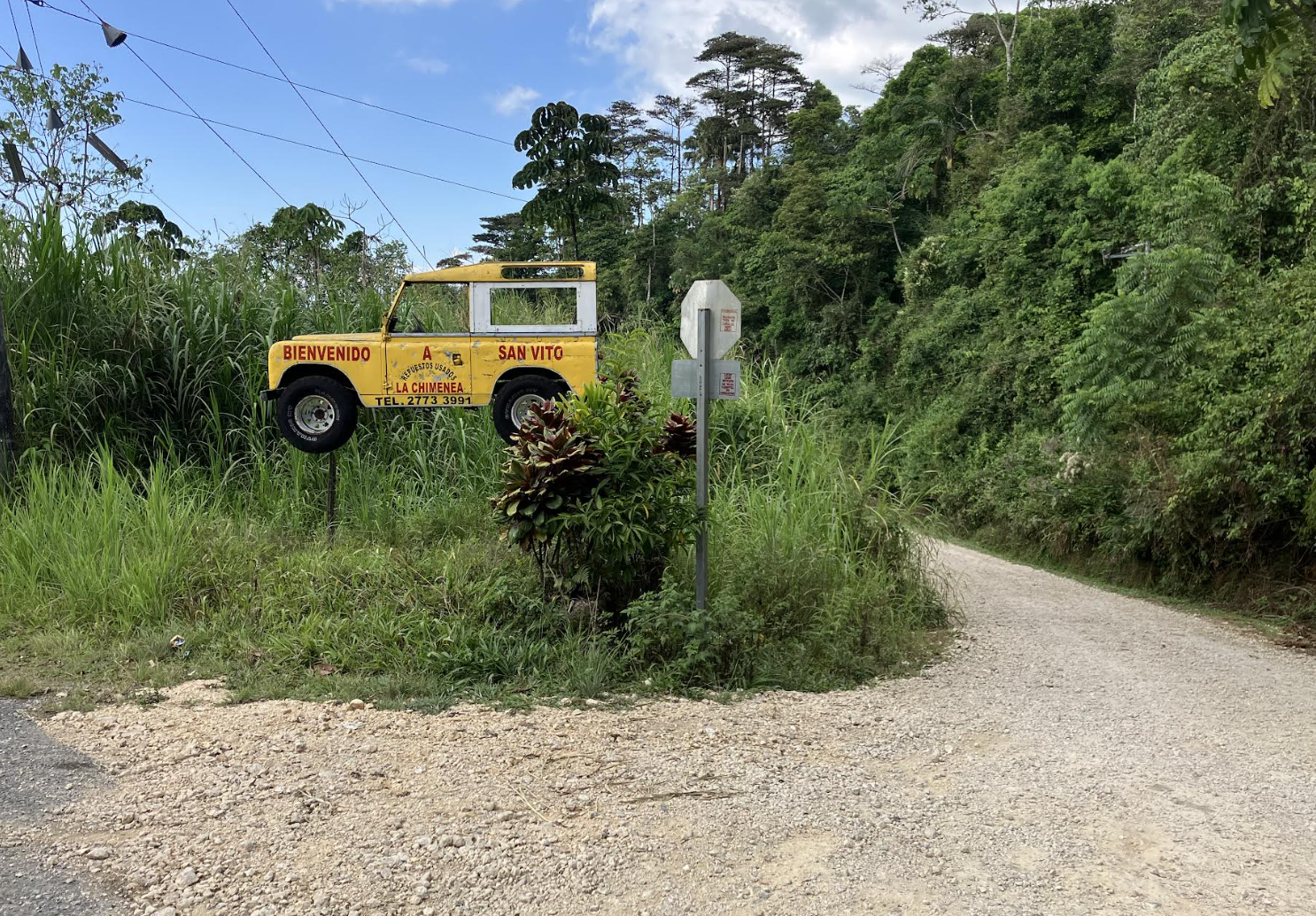
Many of you know where to find the Sansonetti Road; but if you do not, see the photo below. It is on the main road between Linda Vista and San Vito…just past Finca Cantaros.
Take this road until you come to the sawmill and the iron gates (less than one kilometer). We will meet up there prior to the walk. Parking should not be a problem.
Following the bird walk any or all are welcome to reconvene at the Mottola Cafe.
Local musician, artist and friend of the San Vito Bird Club, Jose Ippolito, is pleased to present an original Operetta of his own creation, free of charge to our friends and neighbors of San Vito on Sunday, Feb. 22 at Cascata del Bosco…3pm.
Please join us for this romantic, unique and inspiring presentation.
Afterward, please join the San Vito Bird Club at the Wilson Botanical Garden (OTS Las Cruces), for a screening of the documentary movie, ‘Flyway of Life’…5pm. See this site for more information.
Truly, an afternoon of culture to be remembered; and good fellowship.
In an earlier post…of a couple of weeks ago…I mentioned the arrival of some unusual big birds (BDBs or Big Damn Birds) that have shown in up lately:
The American Flamingo…over on the Caribbean coast last year.
The Sandhill Crane…currently in some rice fields between Tarcoles and Quepos.
The Jabiru Stork…in the wetlands of Coto 47, maybe or maybe not still around.
Here’s a fourth one but it is much closer to San Vito. This species is NOT a rare bird, oh no. This species is commonly found, even abundant, around the the rice fields of Las Pangas and Coto 47. I refer to the Wood Stork (see below).
The Wood Stork is a very successful and wide-ranging bird, found over much of North, Central and South America. However, the Wood Stork, to paraphrase Eliza Doolittle, ‘…stays mainly on the coastal plain.’ Three Wood Storks are currently paying us a visit up in the foothills. Where are they?
Three Wood Storks were spotted in our very own Humedal de San Joaquin. Look for them behind the Marisqueria Restaurant on the road to Sabalito, near the San Vito airstrip. Peter Wendell tells me he saw it the three Wood Storks ‘…behind the church in the same area.’ These birds are unmistakable; very big, standing about a meter high.
Will the three Wood Storks stick around for a while? Who knows, who can say. All I can say is, if they are smart Wood Storks, they will stick around. Who wouldn’t want to spend some quality time, some relaxing time in San Vito?
The Magic Road delivered one-hundred and one Christmas presents (and by ‘presents’ I mean bird species) on Saturday, Dec. 20th to the Coto Brus Christmas Bird Count Team.
The Christmas Bird Count is a world-wide annual event, sponsored by the Audubon Society. Not surprisingly, Costa Rica always shines brightly in the Bird Count.
The Magic Road is a wonderful place to watch birds; check it out.
The San Vito Bird Club wishes all of our readers a very Merry Christmas, Happy Holiday and Happy New Year.
Olive-crowned Yellowthroat, one of the 101 species identified during the Christmas Bird Count. Photo from eBird.
You must be logged in to post a comment.