Once again our sharp-eyed and energetic colleagues, los Pajareros del Sur, have spotted an amazing and beautiful new species to our area.
A Rufous-crested Coquette! (see photo below) Lophornis delattrei
Previously seen only one other time in Costa Rica (near Turrialba), the Rufous-crested Coquette is a southern species of hummingbird found in western South America and as far north as Panama…until now!
Congratulations to the Pajareros del Sur and to all of us who have had the opportunity view this spectacular bird.
(Photo courtesy of Pepe Castiblanco; taken on the road to Pintada near Aguas Claras. Feeding on Inga flowers.)
[Before I get started with this tutorial, let me acknowledge one thing–I totally get it if you’re not interested in getting ‘way deep down in the weeds’ with your birding. I think most week-end birders are perfectly content with macro-birding; ‘…Parrot’, ‘…Tanager’, ‘…Pigeon’…’Euphonia’‘…Flycatcher’. Hell, I’m that way with food and especially with wine. ‘…Red’ or ‘…White’ are about as far as I care to go with wine. (I guess you could say I’m a macro-wino.) So I warn you; this tutorial does go fairly deep–deep into the weeds with tiny but significant differences between our six beautiful Euphonias. That said, I encourage you to read on. These six birds are just so special.]
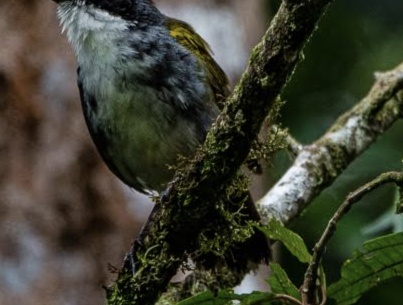
Thick-billed
Yellow-throated
Yellow-crowned
White-vented
Spot-crowned
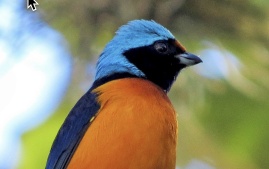
Elegant
Six species of Euphonia are found down here in Coto Brus…all beautiful…all fairly similar. How can you tell them apart?
Firstly, all Euphonias:
are about the size of a small tanager.
have pointy but cone-shaped bills.
show profound differences between males and females, with males being more colorful.
And most importantly, male Euphonias present with a rather specific variation on the same theme; a bright yellow underside contrasting with a dark-blue back and head.
These variations are the key to identifying which of the six species you’re looking at.!
Number 1: When you see a Euphonia, always check to see if the Euphonia has a yellow throat or a dark blue throat.
If it has a yellow throat, you’re looking at either the Thick-billed Euphonia or the Yellow-throated Euphonia.
The next part is a bit more challenging.
The Thick-billed Euphonia has a yellow throat and a long cap. ‘Long cap’ just means the yellow extends past the eye (see below).
The Yellow-throated Euphonia also has the yellow throat but has a short cap (yellow cap stops right at the eye),
Two down, four to go.
Number 2: If the Euphonia has a dark blue throat, it is one of three Euphonia species.
Yellow-crowned Euphonia, White-vented Euphonia or Spot-crowned Euphonia.
The Yellow-crowned Euphonia has the blue throat with long yellow cap (again, past the eye.)
The Spot-crowned Euphonia also has the blue throat but with a short yellow cap (see below). There are some little spots on the crown but they are very hard to see.
The White-vented Euphonia also has the blue throat with a short yellow cap, plus it also has a white under-belly and vent (butt) and it’s a wonderful dancer (see Fun Facts below).
Five down, one to go.
If you see a Euphonia and are totally stupified by its bright POWDER BLUE cap and RUFOUS belly, it is an Elegant Euphonia. This bird truly cannot be confused with any other bird.
Now you know all six of our beautiful Euphonia species!
Euphonia Fun Facts!
The name ‘Euphonia’ comes from the Latin and means ‘good sound’.
Back when I first came to Costa Rica in the early 1980s, Euphonias were very popular cage birds; not only because of their beauty but their ‘good sound’ singing. No more caging our native birds…please.
The White-vented Euphonia can also be identified by its almost constant dancing. Both males and females do a booty-shake dance.
Euphonia females are the designated nest tenders and baby care-givers and as such they have rather drab coloration to avoid being seen,.
Up in dryer Guanacaste, there are three other Euphonia species.
The Spot-crowned Euphonia has as its scientific name, Euphonia imitans. Spot-crowns have the ability to imitate many other bird’s calls; including Roadside Hawk, Buff-throated Saltator, and Lesser Goldfinch. Thick-bills also have this ability, to a lesser degree.
Lastly, my dear friends, as to identifying the female Euphonias; rather than drag you even deeper in the weeds…just call me or send me an email with your questions/concerns. And congratulations if you’ve managed to read this far.
Please join the San Vito Bird Club for our next walk on Sunday, July 21st.
Location: La Troja Restaurant and trails in Limoncito; see below for directions.
As usual, we have a 6:00am walk scheduled and a 7:30am walk.
The 6am walk will be lead by Alamo Matarrita, who is the creator of the new trail system. This walk is long and fairly difficult; about a 3 hour loop. Very, very good second growth birding and wonderful scenery. Bring water and possibly an umbrella.
The 7:30am walk will be lead by Greg Homer. This walk will be only about one hour; again, great birding.
Also, for those who prefer to stay close the restaurant, you may join Alison Olivieri for a stroll about the grounds. Birding around the restaurant is also great.
La Troja restaurant is on the road north toward Buenos Aires but is only about 15-20 minutes from downtown San Vito. You will see the ‘LA TROJA’ sign on the right side of the road as you come into Limoncito.
You can meet up and follow Alamo Matarrita at 5:45am near the Nuevo Mundo Chinese restaurant for the 6am walk. For the 7:30 walk, you can meet up with Greg Homer at 7:15, same place.
Following your walk, La Troja serves reasonably priced breakfasts, lunches and beverages.
The owners of La Troja have great plans to reforest parts of their property; an action we all support and encourage! Hope to see you there.







 San Vito Bird Club
You must be logged in to post a comment.