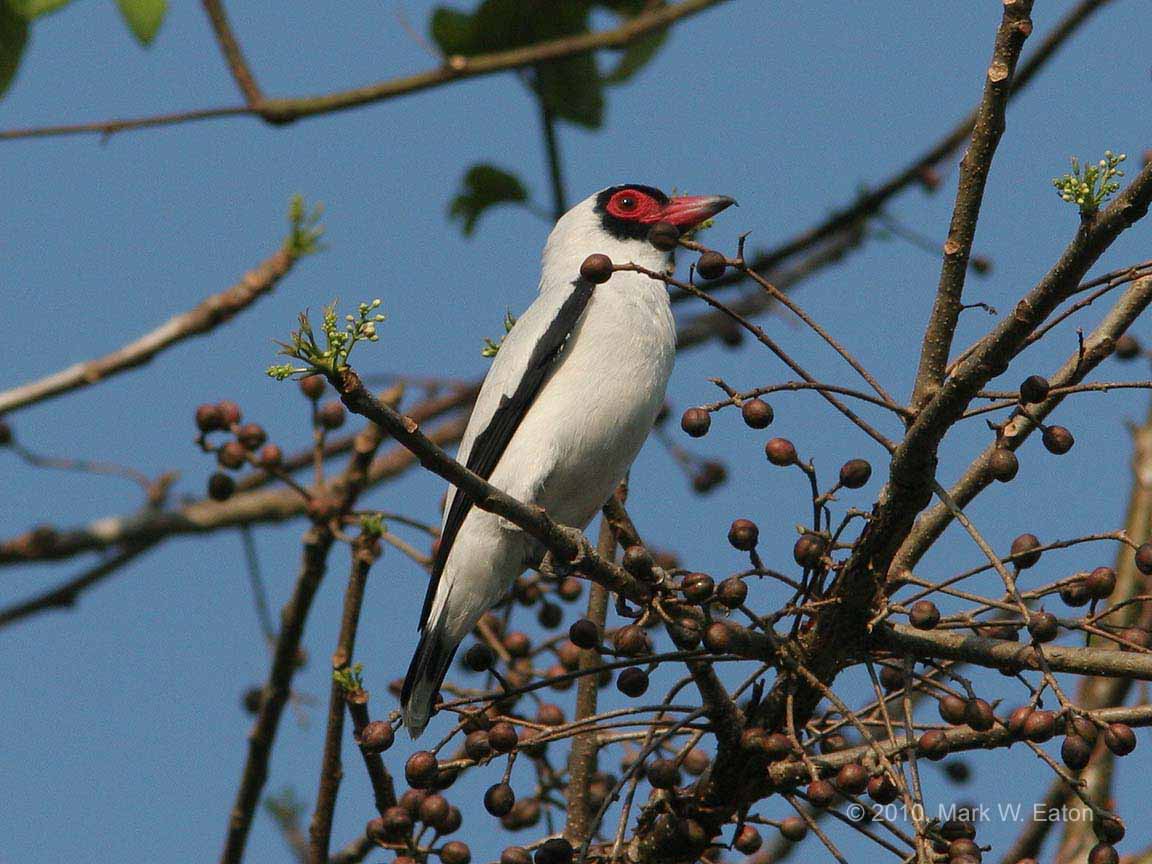
On a recent Bird Walk at the Wilson Botanical Garden, our group of 10 climbed the Canopy Tower to look for returning migrants. Although we did not see any of those, we did see two Masked Tityras, spotted by Caroline Torres.
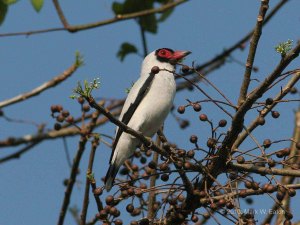
Masked Tityra (Photo by Mark W. Eaton)
I’m not sure why but these birds always give me a jolt of surprise. Maybe it’s the incredible white plumage or perhaps it’s the bright pink orbital skin around the eye and face? Being close to them in the canopy was a thrill as their size is often diminished when they’re seen – typically high in the trees — from the ground. Here, on the Tower, we had the chance to view them at slightly lower than eye level, allowing us to experience them as striking-looking, big, white flycatchers.
When the Tower was inaugurated in May 2011 (click here to read more about this event), we decided to keep a list of all species seen and/or heard in the immediate vicinity. On our recent visit we added add two new ones to the Canopy Tower Bird List: Laughing Falcon (heard not seen) and Spot-crowned Euphonia.
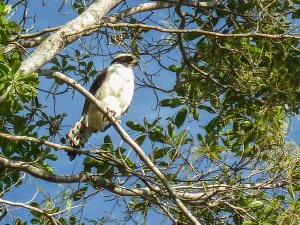
Laughing Falcon (Photo by Alison Olivieri)
The falcon’s resonant, slightly eerie call is described by F. Gary Stiles and Alexander F. Skutch in A Guide to the Birds of Costa Rica, as “. . . . a long, rhythmic series of loud, hollow notes with somewhat the quality of a child’s shout.” The local name of this raptor, Guaco, is synchronous with its call so once you learn and hear it, you can be certain it’s a Laughing Falcon. It is well known that this bird of prey’s favorite food item is any kind of snake so they are cherished by local people and those of us who wish they would visit often and eat their fill.
Our female Spot-crowned Euphonia perched quite close to the Tower, affording some of the group excellent looks at her distinctive field marks of rufous forecrown and belly. Identifying this species is easy if you are prepared to do a little work with your field guide. The males are the only euphonia with yellow spots on the crown patch but, if you are looking from below, it is often easier to identify the female. This is a puzzle where the range maps in the Garrigues and Dean field guide (The Birds of Costa Rica) really come in handy. You’ll quickly see another species with similar markings on the female, Olive-backed Euphonia, but a glance at the map will tell you the Olive-backed is found on the Caribbean side and Spot-crowned is the bird you see here.
To date we have 67 species on this list and 10 birders have contributed sightings. If you are curious and would like a copy, don’t hesitate to contact us. Likewise, please let us know if you see or hear a species we are missing.
Thanks to Caroline Torres, Roni Chernin, Jeff Wick, Barb Barton, Judith and Joe Ippolito, Donna and Tony Pagano and their surrogate grandson Rolando for joining us on this walk.




You must be logged in to post a comment.