Here is a link to the study that many of us, professionals and amateurs alike, are thinking about today. Please take a moment to actually read the study — and not just the headline. It is a dire message we must consider as we go forward with our lives here on earth.
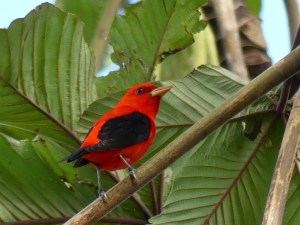
Scarlet Tanager, a migrant from North America. Photo by Jo Davidson.
Please join us for a special bird walk this Sunday, September 1st at 7:30 AM at Finca Cántaros. We will have Randall Jiménez as a special guide, who will be showing everyone the lovely birds of Cántaros, including, if we´re lucky, the fantastic Crested Owls. This week the Bird Club is extending a special invitation to the students of Detectives de aves and their families from the escuela San Joaquín. Please bring your own coffee, juice, etc. for conversation in the rancho grande after the walk. Binoculars and guides will be available as always.
Por favor júntese con nosotros para par ver aves el próximo domingo, 1 de septiembre a las 7:30 AM a la Finca Cántaros. Tendremos una guía especial, Randall Jiménez, quien nos mostrará las aves hermosas de la finca. Si tendríamos suerte, veremos los buhos muy chivas que duermen allá. Esta semana extendemos una invitación muy especial a los estudiantes de Detectives de aves de la escuela de San Joaquín y sus familiares. Podría llevar su propio café, té, jugo, etcétera para la conversación en el rancho grande después de la caminata. Binoculares y guías estarán disponibles como siempre.
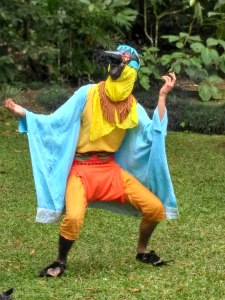
Pest Network performing as ‘Pajaros de Bobos’. Photo by Michael Olivieri
A big surprise was waiting at the end of each future forest tree planting day at Finca Cantaros for the Detectives de Aves students, as ‘Pajaros de Bobos’ popped out of the woods to sing and dance, as well as play percussion, guitar and recorder!
Integrating the arts with environmental and sustainability education is an idea that has taken hold over the past several decades and was in full ‘swing’ here recently, grabbing some gleeful attention from our student reforesters!
Sabalito students enjoy the performance organized by Carla Azofeifa in red at rear. Photo by Alison Olivieri
As Arts-in-Residency participants at the local Jaguar Luna Arts Collective in Copabuena, Sean Smith and Félix Prater entertained the students with great verve, color and flair.
As most SVBC members know well, Lesson’s Motmots “whoot” and “whoot” in gardens and forests throughout the country so these larger-than-life Bobos’ repeated multi-syllabic refrains, “Escucha! Escucha! El ritmo! El ritmo!” reverberated in our ears in quite a similarly tuneful way.
Sean? Or Felix? Thank you for your part of this exciting project. Photo by Michael Olivieri
We want to extend huge thanks to Sean and Félix for bringing each of the Childen’s Forest Tree Planting days to such exciting finales with their invigorating and unexpected performances.
Please join the San Vito Bird Club for our next walk on Sunday, July 21st.
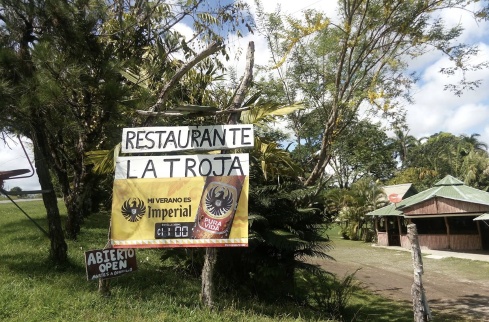
Location: La Troja Restaurant and trails in Limoncito; see below for directions.
As usual, we have a 6:00am walk scheduled and a 7:30am walk.
The 6am walk will be lead by Alamo Matarrita, who is the creator of the new trail system. This walk is long and fairly difficult; about a 3 hour loop. Very, very good second growth birding and wonderful scenery. Bring water and possibly an umbrella.
The 7:30am walk will be lead by Greg Homer. This walk will be only about one hour; again, great birding.
Also, for those who prefer to stay close the restaurant, you may join Alison Olivieri for a stroll about the grounds. Birding around the restaurant is also great.
La Troja restaurant is on the road north toward Buenos Aires but is only about 15-20 minutes from downtown San Vito. You will see the ‘LA TROJA’ sign on the right side of the road as you come into Limoncito.
You can meet up and follow Alamo Matarrita at 5:45am near the Nuevo Mundo Chinese restaurant for the 6am walk. For the 7:30 walk, you can meet up with Greg Homer at 7:15, same place.
Following your walk, La Troja serves reasonably priced breakfasts, lunches and beverages.
The owners of La Troja have great plans to reforest parts of their property; an action we all support and encourage! Hope to see you there.
Great things, stupendous things, things of legend often come in threes for some reason.
Remember the famous Three Tenors? Those three dudes who were the best opera singers in the world; Pavarotti…and that other guy whose name I can’t quite remember….and uh…the other dude whose name no one can remember?
The three best baseball players of the 1950s…Willie, Mickey and the Duke. There was even a wonderful song written about them.
Plus, our world has so many other big threes, such as:
The Three Musketeers.
The Three Stooges.
Goldilocks and the Three Bears.
Here in San Vito we have our very own BIG THREE. Our ‘Big Three’ approaches legend, they are highly sought-after and they possess near mythical qualities.
Who are the San Vito Bird Club BIG THREE? They are of course…rare birds.
Rosy Thrush-tanager (Rosy).
Mouse-colored Tyrannulet (Mousey).
Bran-colored Flycatcher (Branny).
Rosy (the Rosy Thrush-tanager) is the biggest and most beautiful of the Big Three, as the descriptor ‘Rosy’ might imply. Found low to the ground, generally in weedy fields Rosy is highly sought after by most birders who come to Costa Rica.
Mousey (the Mouse-colored Tyrannulet) is often described…quite accurately…as ‘a little brown bird’. Found throughout much of South America, Mousey has used great wisdom and extended its range northward into Coto Brus.
Branny (the Bran-colored Flycatcher) has almost the very same range as Mousey. Branny too has made our area its northernmost home. What I find so fascinating about the Bran-colored Flycatcher is its name. Who, other than cubicle-dwelling taxonomists, would look at Branny and think–’Hey, that bird is the color of bran.’ I suspect many taxonomists eat a lot of bran (if you know what I mean).
Please click on the link below. It leads you to our wonderful ‘Gallery of Local Birds’ page where you can see photos of Rosy, Mousey and Branny; plus several of our other special birds including Pepe Castiblanco’s choices for the Big Three, Ruddy and Manny (the Ruddy Foliage-gleaner and the Lance-tailed Manakin.






 San Vito Bird Club
You must be logged in to post a comment.