Many, many thanks to everyone who attended the 2025 San Vito Bird Club Annual Meeting. Great fun, great fellowship, great sharing of experiences.
Juan Carlos Mena Burgos (shown below) gave us a great talk on the future of tourism in Coto Brus; hint…it’s pretty exciting, oh yeah.
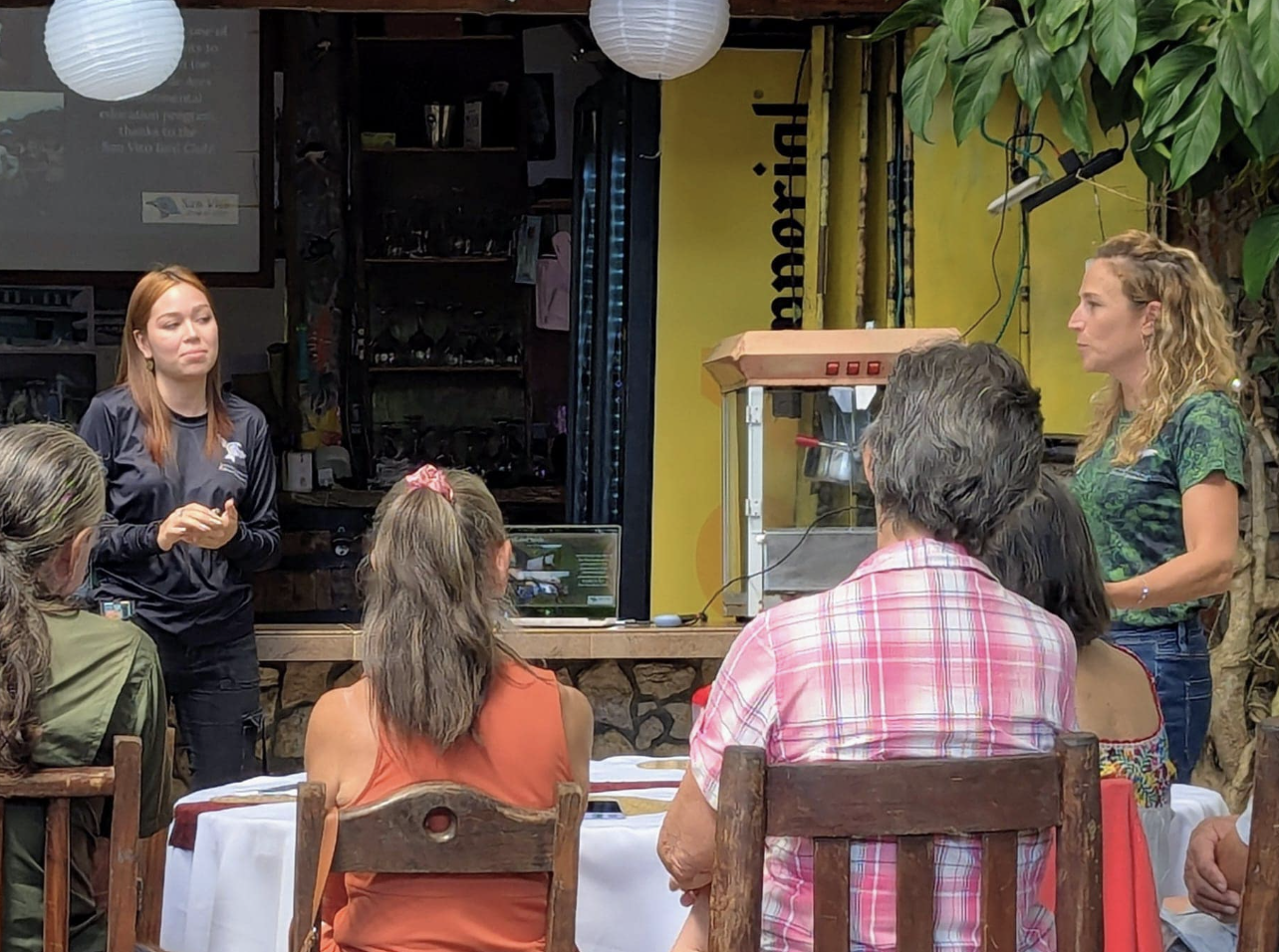
Maria Sandi (shown below) and Dr. Lilly Briggs shared with us the excitement that comes with learning the art/science of bird banding and of reminding us about the importance of Citizen Science.
The wonderful…amazing…skillful Aleman family!
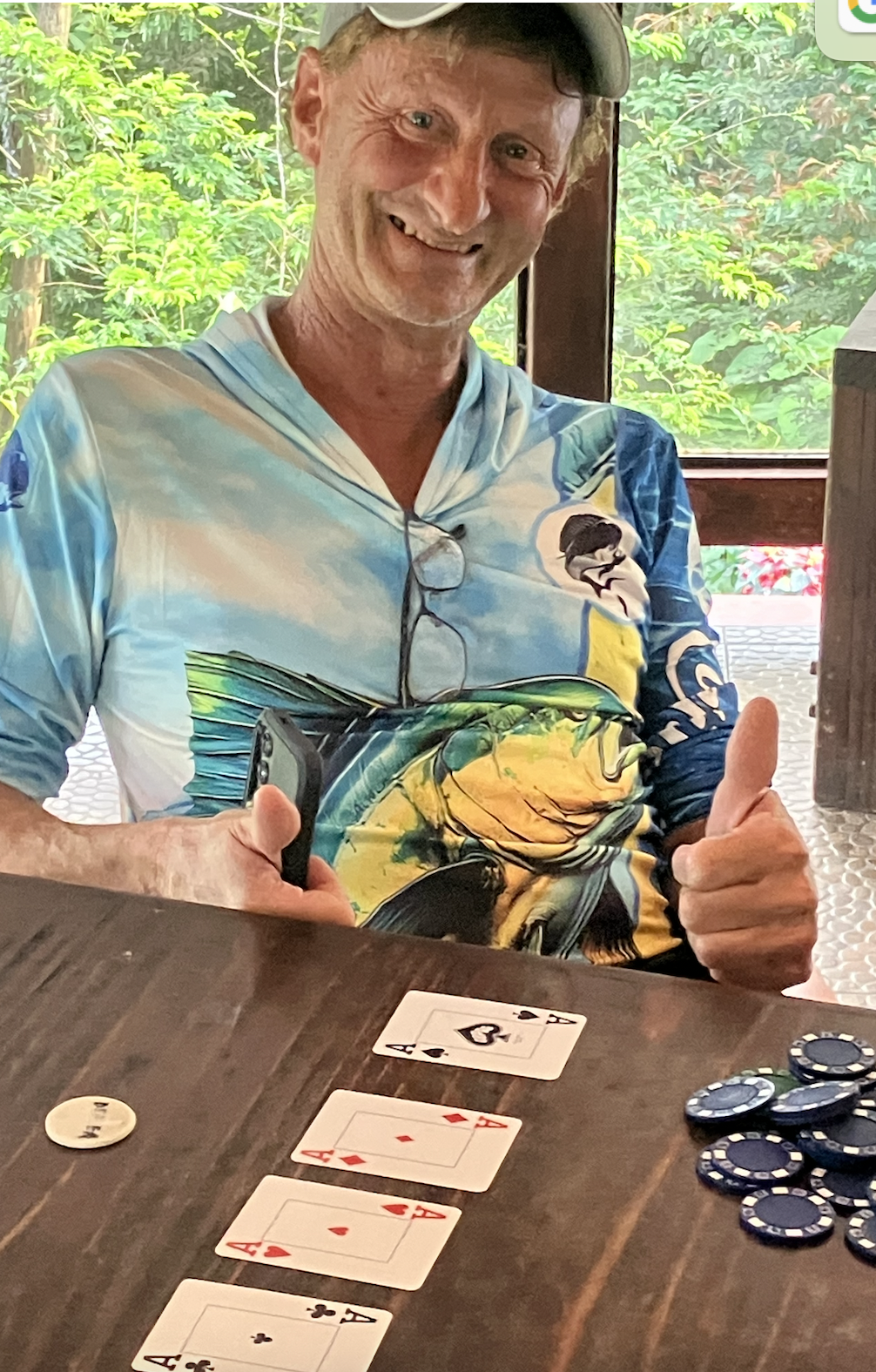
Bonus Photo (totally unrelated to the San Vito Bird Club)
The speedy and powerful Paul Guindon, proudly displays his four aces during our regular Sunday afternoon poker game.
We are now within the confines of the of week Feb. 23-March 2.
A WEEK UNLIKE ANY OTHER.
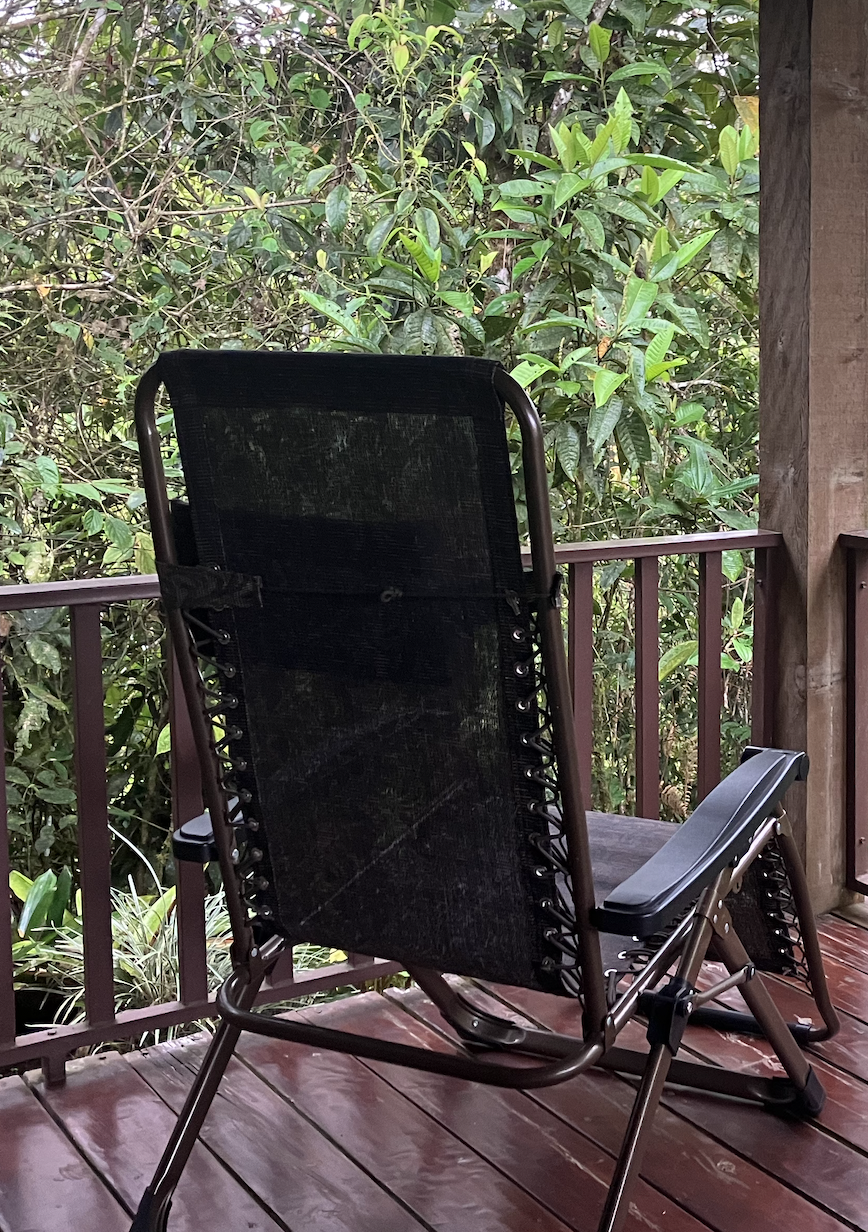
During this very week the San Vito Bird Club asks all members to count bird species they see while sitting on their porch.
Sure, this sounds exhausting but…
…if you come to our Annual Meeting (Sunday March 2nd from 7:30am to around noon at Cascata del Bosco) AND if your list of porch birds has the most species, AND if you get that list turned in to Alison, Peter, Lydia or Greg before 8:00am, AND if we can read it, AND if you stick around till the end of the meeting (right before your complimentary brunch!)………
You’ll win a PRIZE! Perhaps not a devastatingly exotic or life-changing prize but a prize nonetheless.
Have you ever purchased any San Vito Bird Club merchandise? Ever logged onto the sanvitobirdclub.org website? Of course you have…that’s how you got here. The San Vito Bird Club ‘Logo Bird’ was there…staring back at you (see below).
Back some years ago when the speedy and powerful Alison Olivieri formed the San Vito Bird Club, she and some close colleagues were trying to determine, ‘…which of the many San Vito bird species should we choose to represent our Club.’
The Turquoise Cotinga became the ultimate choice; a bird of rare beauty and even rarer number of sitings. The Turquoise Cotinga lives around here, yes it does. Personally, I have seen it only once in Coto Brus…on the Magic Road.
And so, when an opportunity to view a Turquoise Cotinga presented itself, we braved the one-hour bus ride to Palmira (with Sur Trips) and the 6am departure time and took off.
There is no reason to delay the payoff any longer. We had great viewings of both male and female Turquoise Cotingas. As you can see, the Turquoise Cotinga is primarily a fruit-eating bird and is very partial to Aguacatillo (little avocados) fruits.
We also viewed 44 other species of birds before sitting down to our wonderful breakfast.
Even where they live, the Turquoise Cotinga is not a common bird; but if you’d like a good chance to see one and experience a very nice outing to the scenic Palmira site please contact Sur Trips:
surtrips.com
Or if you know our good friend and local supporter of the San Vito Bird Club, Henry Barrantes, ask about this trip. Or any of his other great excursions.
ps: Here’s one way to know your hosts are very dedicated to birding.
Our good friend Karina Lopez and her staff at Los Chocuacos Tourist Center are hosting an informative and important lecture from author Maria Alejandra Maglianesi. Information included below:
During the past 20 years, the SVBC has gradually and naturally changed. We still lead Bird Walks and regular forays to birdy spots like the rice fields near Cuidad Neilly and the Tres Ríos River. But we also have a ‘How Can We Help You?” sensibility, especially if your concern will help birds and people of the local community.
Along those lines, we have some history of contributing to educaton and project enhancement for our volunteer mist netters — many of you will remember the Avian Monitoring Project that ran from 2003-2013. Back then we encouraged — and financially supported — participants to travel to other countries to take part in a bird banding training workshop in Peru and an international bird conference in El Salvador.
Now Finca Cántaros Environmental Association (FCEA) has begun a new bird banding program which combines nicely with projects that emerged as a result of installing Costa Rica’s second Motus Station on site in 2020 (motus.org).
Coming up this year, we have an exciting opportunity to help fund travel and education for two young women who are being trained as banders at Finca Cántaros.
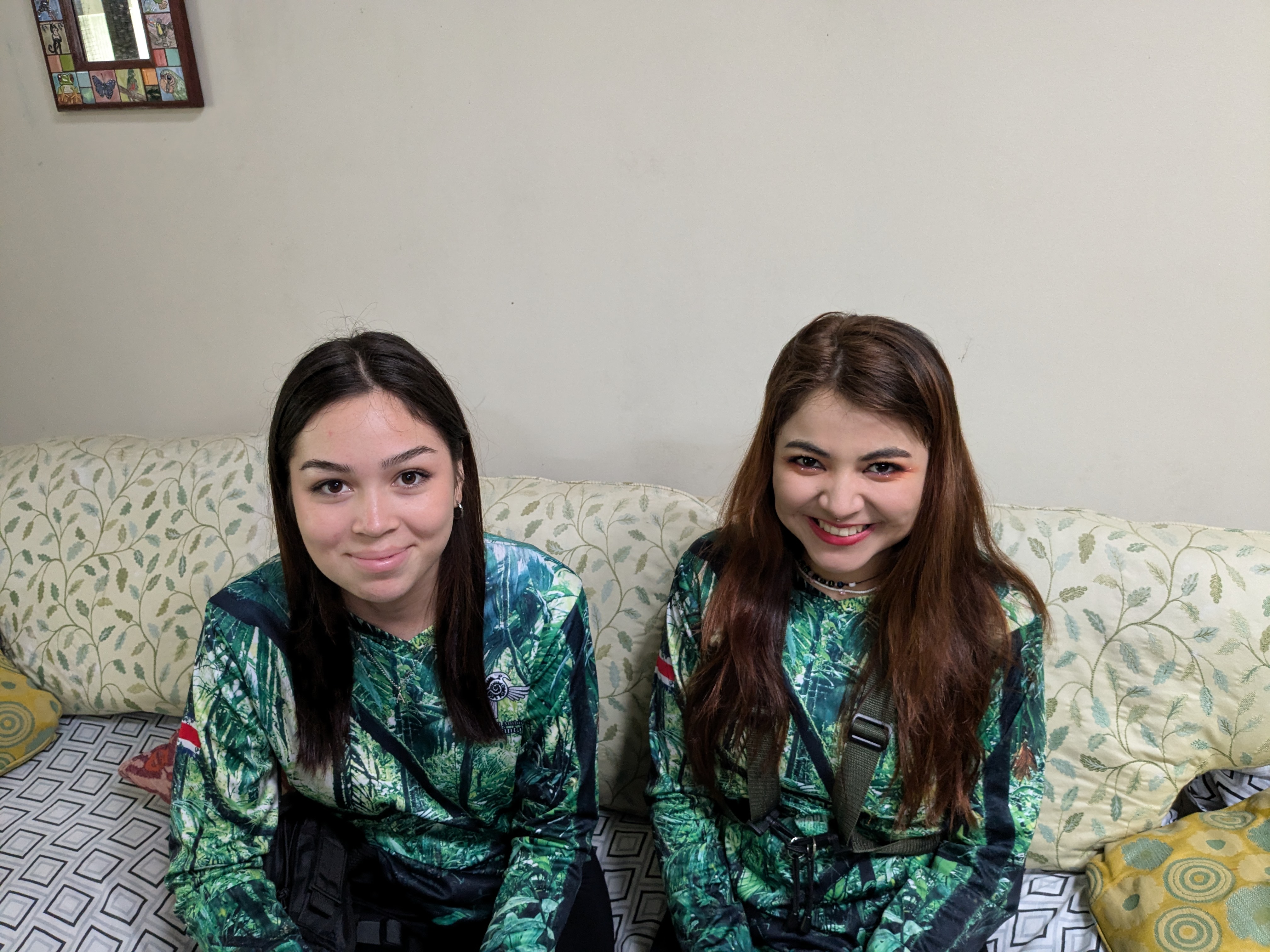
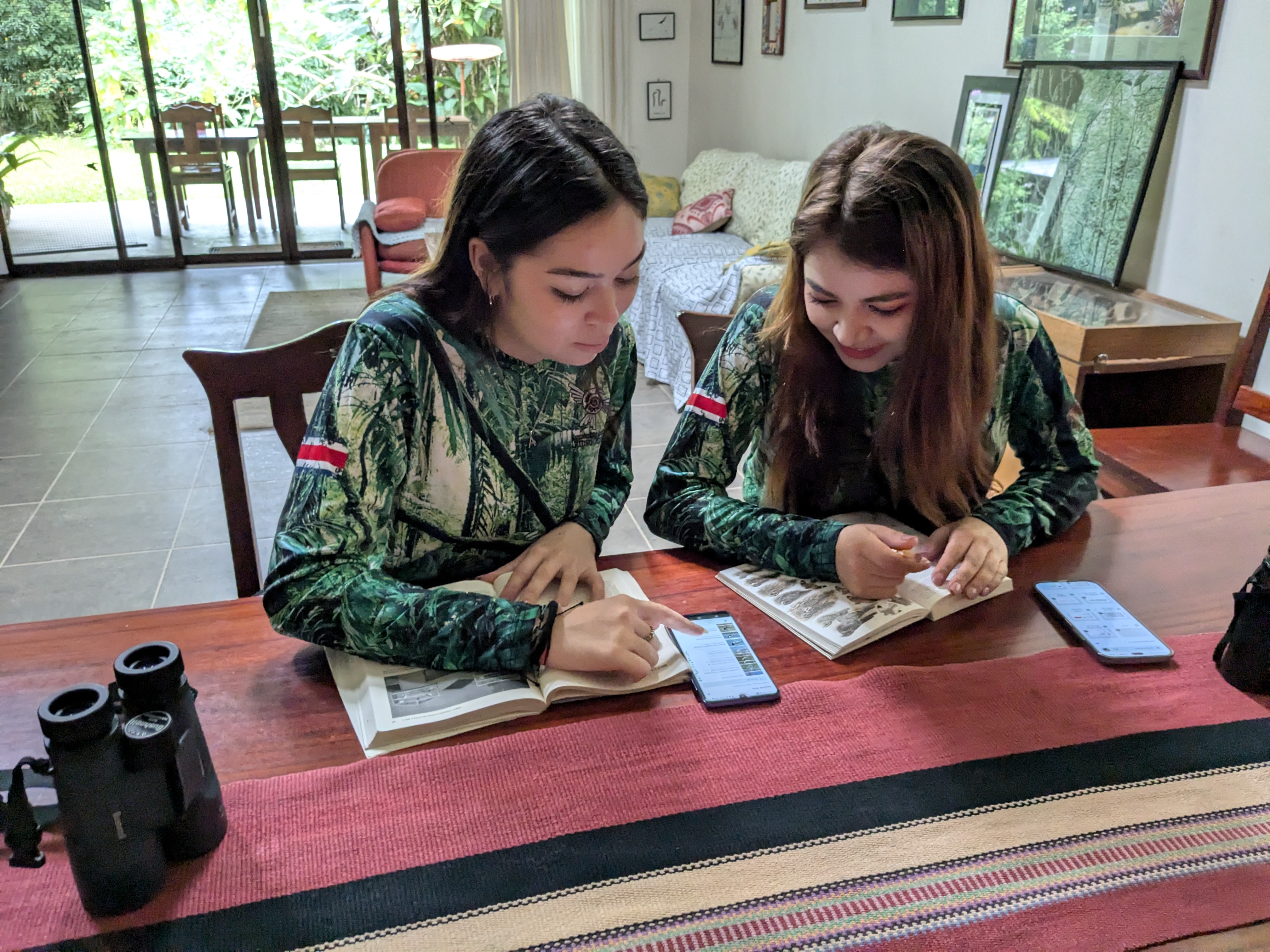
Meet María Sandí and Alisson Vargas, dedicated naturalists who have also been trained to teach Detectives de Aves classes and want to do more — and know more.
In February 2025, NABC certified bander and ornithologist Holly Garrod (who has been leading the banding trainings at FCEA this year) will offer intensive training in the Dominican Republic — this is our chance to help María and Alisson. If we can provide a stipend of $1,000 each, they are off — off to a world of ornitholgical collaboration, new colleagues, international sensibility and professional skills enhancement.
Academics and practicitioners in the field of conservation have repeatedly highlighted the importance of engaging young people in the local community and creating jobs for rural youth. Longtime loyal SVBC (and Detectives de Aves) supporters can feel proud that our investment is really achieving this goal. María Sandí was one of the first students in the Detectives de Aves classes when we launched the program in 2013 — she credits this experience with inspiring her interest in nature and her motivation to pursue this path, personally and professionally. Flash forward 10 years and she is actively involved in many programs at FECA in additional to the bird banding and Women Committed to the Earth.
Are you reaching for your wallet? Before you make your contribution, please know that Finca Cántaros now has tax deductible status in the US. To make a tax deductible donation, please visit their website: http://fincacantaros.org/donate/
Remember a while back…a lengthy article we posted about taxonomic name changes involving getting rid of bird names that were named after people–people who might be flawed? Remember that?
This ain’t it.
But hey…the House Wren getting turned in to seven different species is rather cunning.
The title of this article is also a multiple choice question.
WHY DO BIRDS SUDDENLY APPEAR?
a. Just like me, they long to be close to you.
b . They get sucked into a mini-black hole and are deposited at random locations.
c. They just get lost sometimes.
It is possible any of the three answers above is the correct answer but the MOST likely answer is ‘c’. They just get lost sometime.
An American Flamingo got lost out over the Gulf of Mexico or the Caribbean Sea recently and showed up on a beach in Costa Rica.
This American Flamingo showed up on a Caribbean beach, near Cahuita, about two and a half weeks ago. Since that time almost every birder in Costa Rica has made the trek out to see it. (A Cahuita entrepreneur has become Costa Rica’s latest millionaire, selling hot dogs, soda, those little camera batteries and sunscreen to the throng.)
Any ‘first time ever’ bird showing up in Costa Rica becomes a big event; but when that bird is massive and bright PINK!!!! Well, you can imagine the excitement.
Why did this American Flamingo get lost? Maybe it just made a wrong turn somewhere but most likely those massive tropical storms and hurricanes out in the Gulf had a lot to do with it.
The Flamingo has been with us for over two weeks and seems quite content feeding along our Caribbean mudflat beaches. If you want to give it a look, I suggest you drive to the Cahuita area and look for a pod of people all carrying binoculars and cameras…eating hot dogs and drinking soda. Tell them hi.
Author John Boorman’s great book ‘Deliverance’ gives us some wonderful advice:
“Sometimes you’ve got to lose yourself before you find anything.
Well, I didn’t get lost this morning, exactly–but I did take a walk along a stretch of road that I’ve zipped past in my car no doubt hundreds of times before…and so have you, I’ll bet. On that stretch of road grows an epic Ceiba tree. This tree lives in a small patch of greenery near a jolly little stream with a burbling cascade. Fruiting trees grows there, as do Cecropia trees, ferns, vines and epiphytes. As you’re heading down to Sabalito, you’ll see this spot (see below) on the left side of the road about 40 meters past the Pali and Frio Sur..
Photos courtesy of Greg Homer. Oct. 2, 2024
There are no signs announcing this place; no benches…no trails. But the hour I spent birding there this morning proved to be one of the better birding experiences I’ve had.
My point? We have great birding spots ALL OVER Coto Brus; and not limited to the well known National Parks, Gardens and Reserves. These diamond-in-the-rough spots can be most enjoyable and may give you some never-to-forget natural history moments.
If you have the time, check out the spot I have just described. You know what? We should get some benches put out there and give it a name.
Please share with me any Diamond in the Rough spots you enjoy.
A sizable wire cage containing 206 white doves, with each of the doves representing a country competing in the 2024 Summer Olympic Games in Paris, was prepared for the Opening Ceremonies. At a given signal all 206 of the white doves were to burst out of the cage and majestically fly around.
‘Hey,’ said one of the doves to the other 205 of his colleagues. ‘My father-in-law had this gig four years ago at the Olympics in Tokyo.’
‘What did he have to say?’ queried another white dove.
‘He said, it’s horrible! Apparently, Peregrin Falcons, Merlins and other birds of prey have figured out that the opening ceremony of the Olympics is like a full-course buffet.’
‘A what?’
‘Us, don’t you get it! We fly out of this cage and they just pick us off.’
The thought of this sent shivers down the snow-white spines of the doves.
And so, when it came time for the doves to burst out of the cage and majestically fly around, they all just..sat still.
The world viewed this as an omen of great import; and collectively decided to stop all aggression, fighting, meanness and even harsh language…which was good. (unlike this joke which doesn’t even have a punchline)






 San Vito Bird Club
You must be logged in to post a comment.