The San Vito Bird Club sends our congratulations and best wishes to a new neighbor and new player in eco-tourism and habitat restoration in the southern zone neighbor–Cielo Lodge.
Located about 300 meters ABOVE the town of Golfito, Cielo Lodge is the dream culmination of Nicole and Keith Goldstein. But dreams rarely culminate (if that is even a word) without many hours of planning and even more hours of hard, hard work. Nicole and Keith can attest to this fact and the results are most apparent.
But there is far too much about this remarkable business for me to describe here…so please have a look at their website (above). Be assured…Cielo Lodge, the management and staff, are dedicated to providing a rare variety of nature experiences to their guests and with a minimum of impact (footprint).
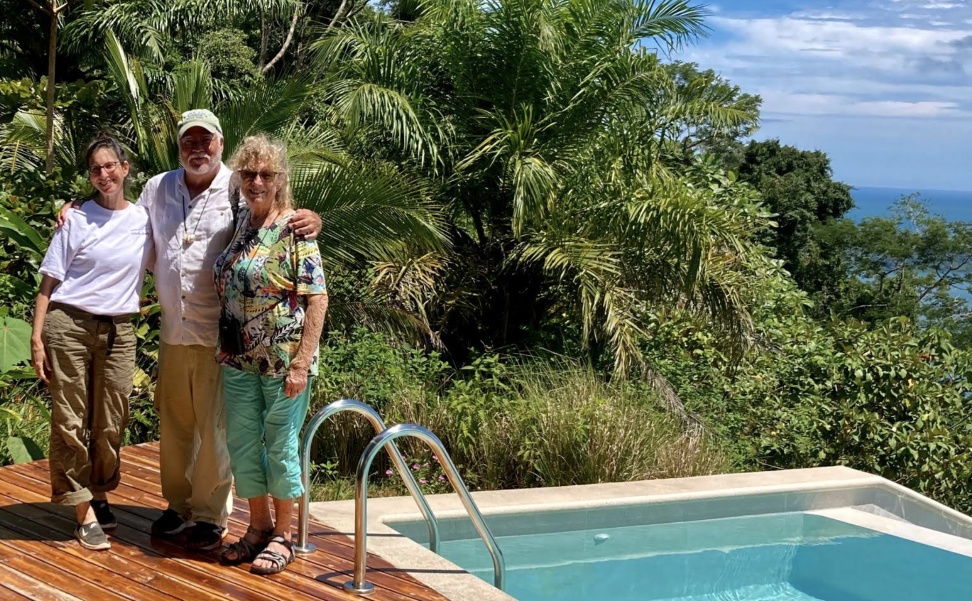
How do I know? See photo below (taken by Helen LeVasseur) of Lydia Vogt, Nicole Goldstein (owner/proprietor of Cielo Lodge) and me during a recent visit/chat/lunch.
We, the San Vito Bird Club, will also be pleased to assist Cielo Lodge with their reforestation plans.
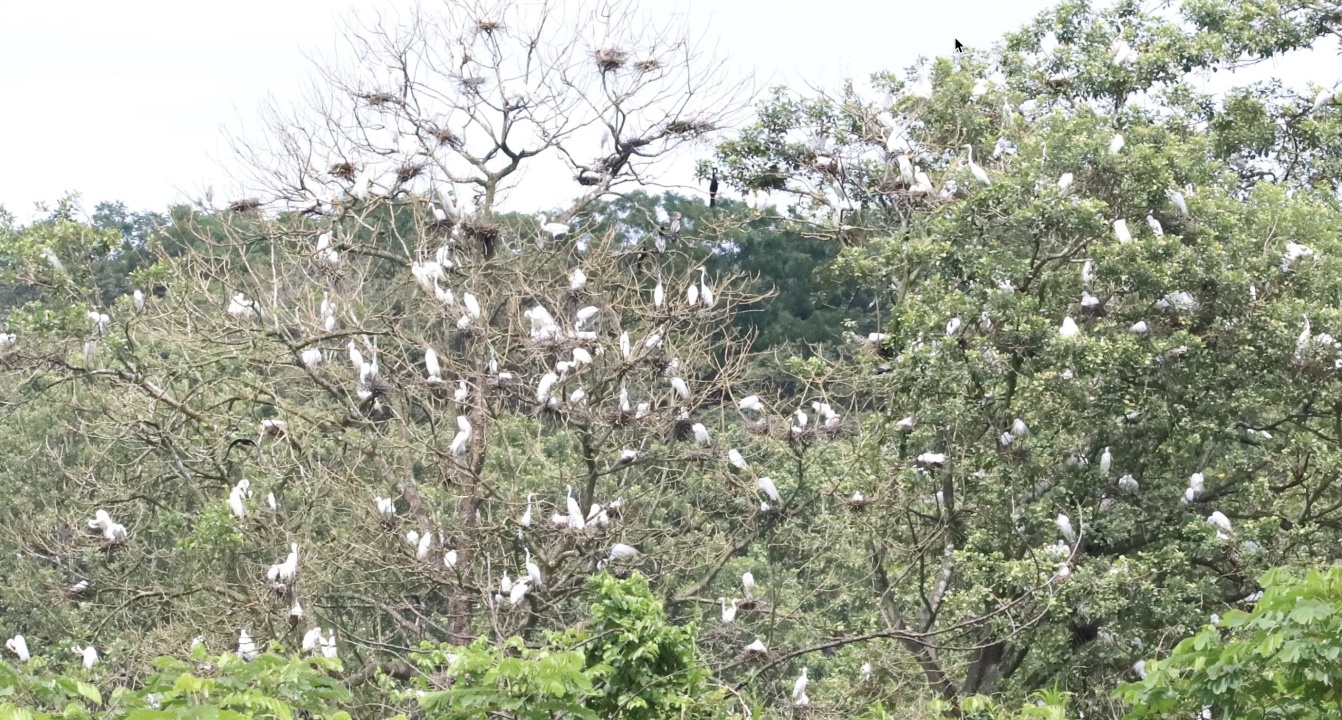
Past Ciudad Neily, out in the palm oil and rice country (around Coto 47), is a stand of tall trees. In this stand of trees is a quite amazing HERONRY (also known as a rookery).
Perhaps over 300 Great Egret nests are progressing quite nicely in these trees (this is a very low estimate on my part). Each nest when completed will contain from 3-5 eggs/chicks.
Any guesses as to what percentage of these baby egrets will survive to to adulthood and start their own families?
This percentage is quite low. Eggs break before hatching, ants, parasitic flies, snakes, squirrels and other birds take quite a few of the eggs/young. Many young birds fall or get pushed out of the nest before they are ready to fly. For predators, such as caiman, crocodiles, snakes and small mammals, living below a heronry such as the one shown below must be like an all-you-can-eat buffet.
Before you give out with an, ‘Ah, those poor baby egrets‘; just think (or do the math) as to where the rest of world would be if all those 3-5 baby egrets in those hundreds of nests survived…and then they all successfully raised 3-5 babies and then those…ad infinitum. In no time at all, things would get quite EGRET-Y on this world.
Nature pretty much always knows what it is doing. And as Alfred, Lord Tennyson popularized, ‘Nature is red, in tooth and claw.‘
For those of us with a passion for nature observation, this heronry is a sight to behold!
Heronry near Coto 47: photo courtesy of Jimmy New.
If you look closely you might see some dark-colored birds in there as well. These are nesting Anhingas (also known as Snake Birds, in the cormorant family). So I guess this makes the site a Heronry/Anhingary. Which is nice.
We’re often scornful of bird taxonomists. Most often this is due their use of nomenclature…the bird names they come up with. These bird names can frequently be counter-intuitive. We find bird names that do not appear to describe what our eyes tell us. We even see bird names that use obscure (even bizarre) terminology. For example:
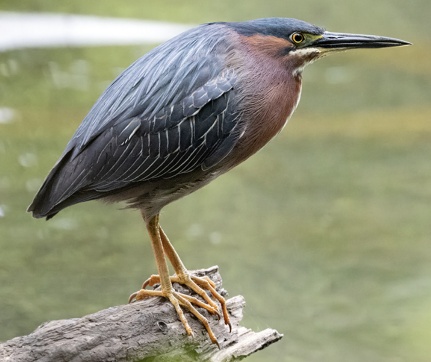
The Green Heron isn’t really green; at least no one would ever say, ‘Hey, look at that green heron over there.’
Green Heron: photo from public domain
The Mistletoe-Paltry-Mistletoe Tyrannulet; Taxonomists changed the perfectly named Mistletoe Tyrannulet (so named because this little bird is often found eating Mistletoe/Mata Palo berries) to the bizarrely named Paltry Tyrannulet. Paltry? Isn’t that a term most often associated with a weekly salary? ‘How am I supposed to live on this paltry sum?’ To their credit, the taxonomists changed it back a couple of years ago!
The Gartered Trogon? Gartered? Aren’t garters something from the era of Jane Austin and Arthur Conan Doyle? What was wrong with Violaceous Trogon?
Yes, taxonomist decisions often vex us. In return we give them a lot of heat. So maybe it’s time we turn down the heat…let’s now give these troubled (and possibly lonely) souls some love. Please join me and raise a glass of cheer to some of the wonderful bird names the taxonomists have come up with over the years. Here are a few bird names that fit that particular bird to a TEE!
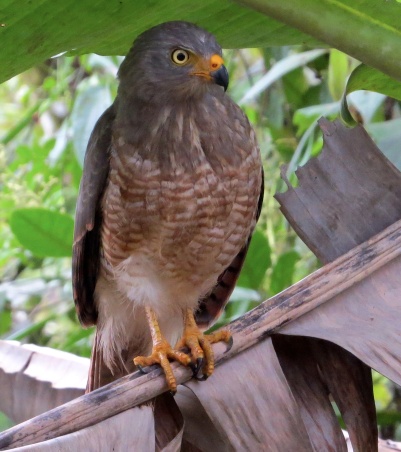
Roadside Hawk: My guess is the office-bound taxonomists were staring down at the skin of this bird but were stumped to come up with a name. The head taxonomist probably decided to ask a field biologist for some insight; ‘Hey,’ they asked. ‘Where do you find these hawks?’ and the simple answer from the field biologist came back, ‘We always find them alongside a road.’ Hence, the perfect name was born…a name based on the bird’s behavior. This same process likely occurred with our next bird.
Roadside Hawk: photo courtesy of Helen LeVasseur
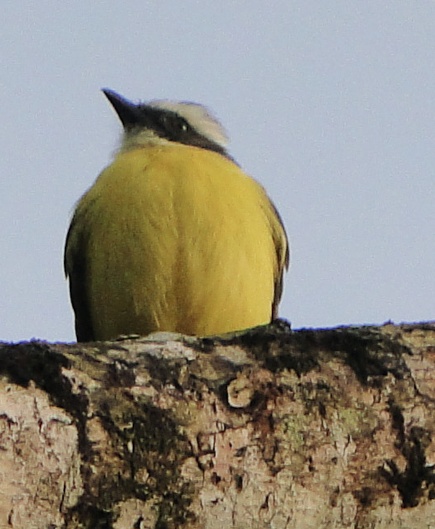
Social Flycatcher: ‘’These birds’ replied the field biologist when asked by the taxonomist, ‘like to hang out around people and with other members of their clan.’ And a great name was born.
Social Flycatcher: photo courtesy of Julie Girard
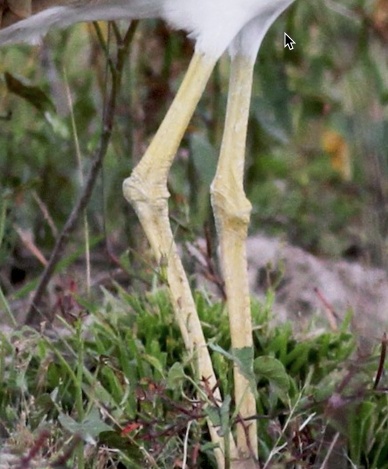
Double-striped Thick-knee: Looks like a giant Plover or shore bird with a couple of stripes but it has tremendously thick knees. Voila, a great name.
Double-striped Thickknee: photo from public domain
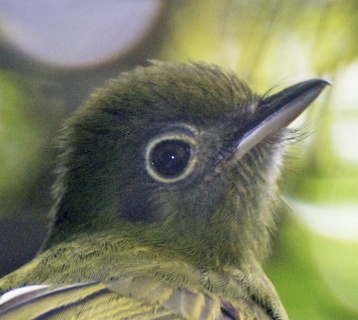
And my favorite of all taxonomist christened bird names: the Eye-ringed Flatbill. The entire name is a perfect descriptor of this otherwise bland appearing bird. Both the eye ring and the flat shaped bill are quite prominent. Here’s my theory as to how such a perfect name was able to get through the traditional taxonomist sticky nomenclature web……..It was about 10 minutes to 5pm on a Friday. The annual Bird Taxonomists’ Ball and Cotillion was scheduled to begin at 7pm. So, rather than come up with an obscure, counter-intuitive name for this bird the head taxonomist just threw up his hands and said, ‘Oh hell, just called it an Eye-ringed Flatbill and let’s go to the party.’
Eye-ringed Flatbill: photo from public domain
Bird Taxonomists…here’s to you! Who else could come up with over a dozen different names for the color RED.
Crimson-fronted Parakeet (Crimsy): photo by Pepe Castiblanco
I think I know why we like parrots so much.
They are colorful and pretty birds.
They are good family birds, many mating for life with each parent providing for the young.
They just LOVE TO TALK!
And so for your approval, I present some photos of our southern zone parrots; all taken by our local SBVC photographers.
We have three true ‘parrots’ around San Vito and all three are quite common. Parrots have a short, squared tail, as opposed to parakeets who have a pointy tail. The first parrot is the Brown-hooded Parrot. Look for that bright-white eye-ring.
Brown-hooded Parrot: photo by Alison Olivieri
Next is my personal favorite, the Blue-headed Parrot.
Blue-headed Parrot: photo by Jo Davidson
The last of this triad is the White-crowned Parrot; quite similar to the Blue-head above.
White-crowned Parrot: photo by Jo Davidson
Next, we have two members of the Amazon Parrot group. Amazons are big, stocky parrots. Almost always green and always noisy. The Mealy Parrot (below) is the largest of all the Amazon parrots. It’s call is ‘YAK-YAK-YAK’.
Mealy Parrot: photo by Jo Davidson
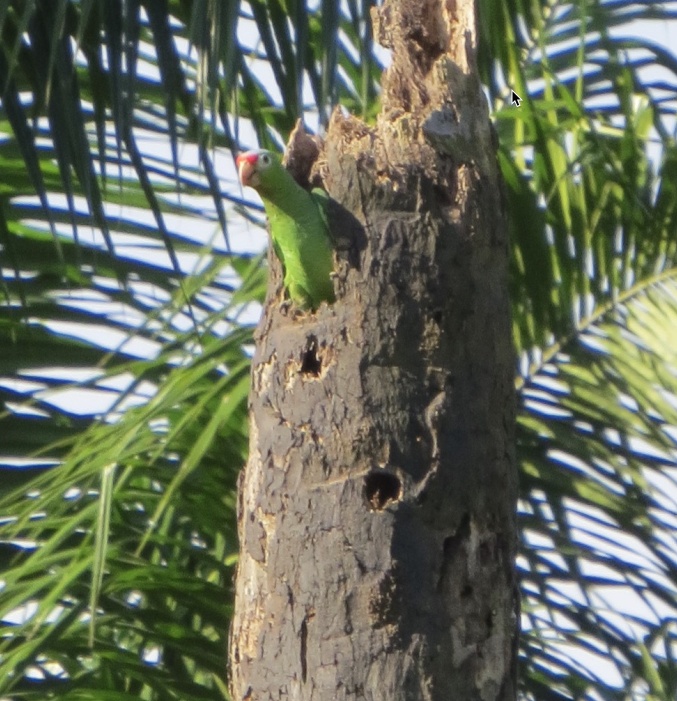
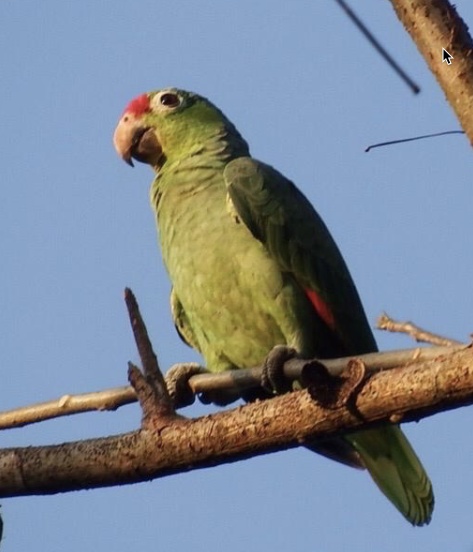
A little smaller and somewhat more common, the Red-lored Parrot is a frequent inhabitant of the palm plantations. It’s call is ‘SO-QUICK SO-QUICK’.
Red-lored Parrot: photo by Helen LeVasseurRed-lored Parrot: photo by Helen LeVasseur
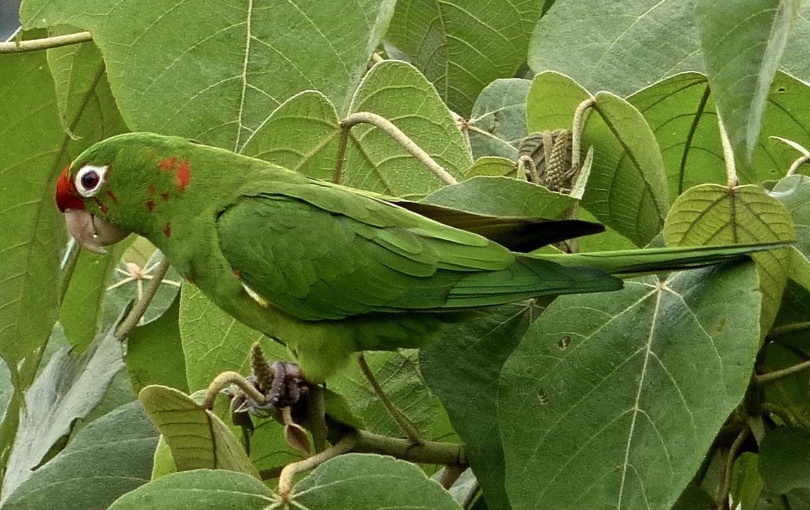
Seemingly everyone’s first parrot family sighting in the southern zone, the Crimson-fronted Parakeet is almost always seen flying or roosting communally. There are few guarantees in bird watching but finding these guys in the Botanical Garden palm tree by the back gate comes pretty close.
Crimson-fronted Parakeet: photo by Jo Davidson
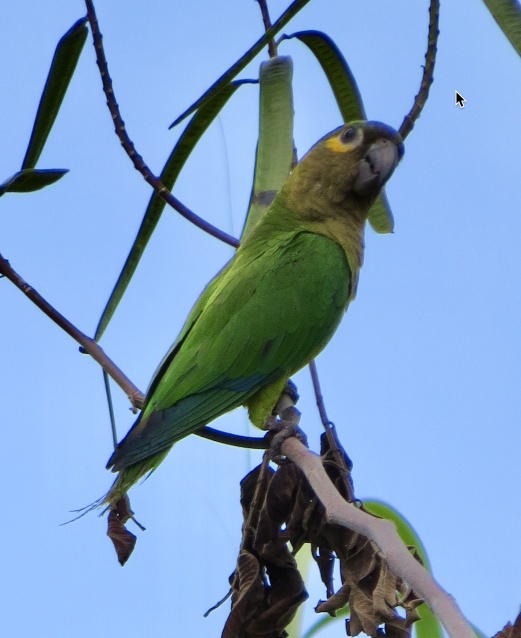
We have a couple of specialty parakeets found in the southern zone; one up high, one down low. Let’s start with lowland one; the Brown-throated Parakeet. Once again, big white eye-ring.
Brown-throated Parakeet: photo by Helen LeVasseur
Up in the highlands (Las Tablas for example) is the beautiful Sulpher-winged Parakeet.
Sulpher-winged Parakeets: photo by Pepe Castiblanco
A tiny little parakeet, gregarious in nature and sounding like a flock of Budgies, the Orange-chinned Parakeet can be found in downtown San Vito feeding on flowering trees. The orange chin can be hard to see…but it’s there.
Orange-chinned Parakeet: photo by Helen LeVasseur
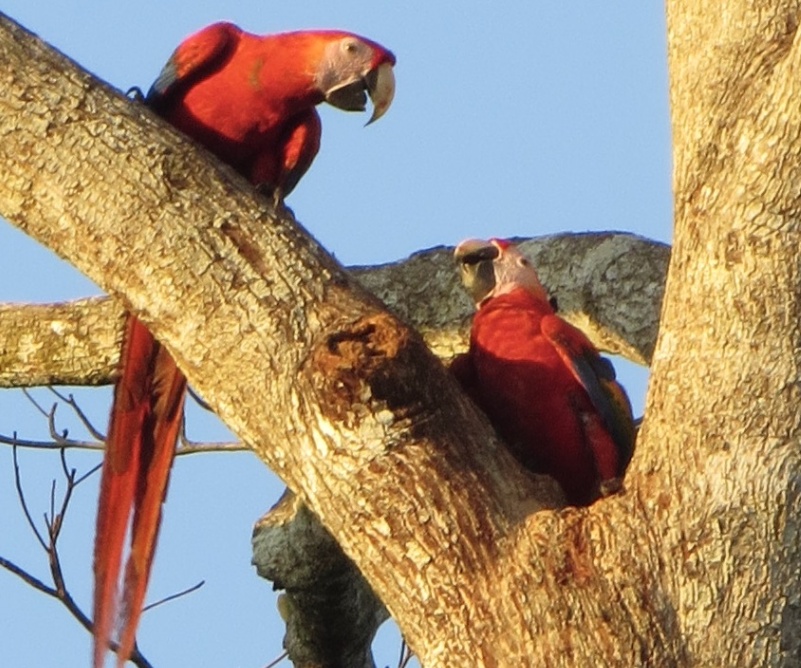
From the smallest to the biggest; Scarlet Macaw populations have thankfully made a profound comeback in the last 25 years. Unmistakable when seen but surprisingly, the Scarlet Macaw can almost disappear within the leaves of an Almendro (almond) tree. Their call? Think of a bronchitis clinic.
Scarlet Macaw: photo by Helen LeVasseur
There is one more member of the parrot family found in the southern zone; the Barred Parakeet. Living in the extreme highlands, the Barred Parakeet is a specialist feeder, dining on the seeds of our native bamboo. The next time our native bamboo flowers and then produces seeds, we should see them up on the Paraguas ridge. When that happens please take some pictures…I don’t have a single one!
The San Vito Bird Club does not condone keeping any parrot as a pet or cage bird.
Now let’s have a look at some more of our local birds; those with subtile and clandestine coloration.
Ruddy Foliage-gleaner: photo courtesy of David Rodriguez Arias.
A lot of birders come down to Coto Brus to see rarities and localized species. These species are often referred to as ‘target birds’. The Ruddy Foliage-gleaner (above) is definitely one of our most targeted. You’ll hear it more often than see it; and almost always in the lower stratum of the forest.
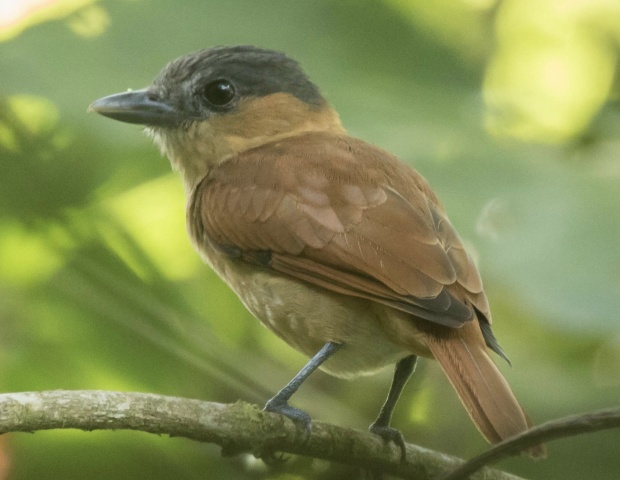
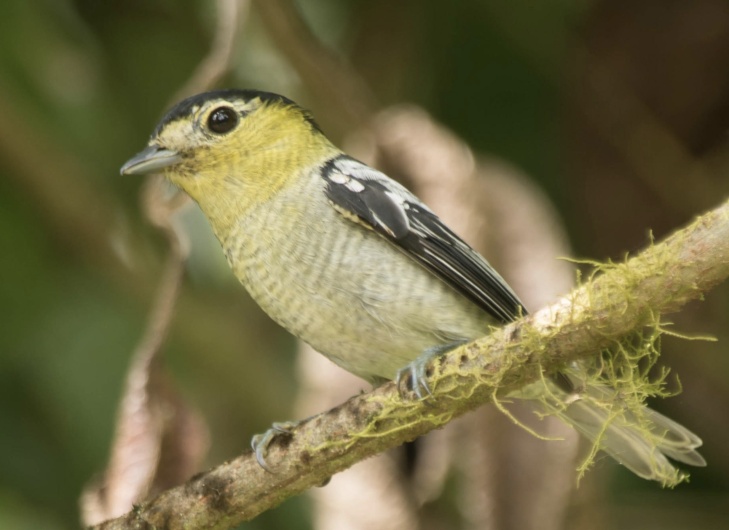
Rose-throated Becard (female): photo courtesy of Randall JimenezBarred Becard (male): photo courtesy of Randall Jimenez
A bit like Cotingas, a bit like Flycatchers the Becards are an interesting family. Dressed in subtile and elegant earth-tones you’ll find them (if you’re lucky and quick) in the upper middle to canopy level of our forests. Both the Rose-throated Becard (the first one above) and the Barred Becard (just above) have distinct sexual dimorphism; meaning males and females look different. But all Becards seem to have heads just a little too big for their bodies.
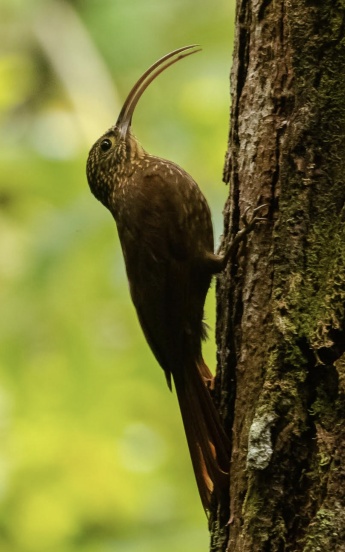
Brown-billed Scythebill: photo courtesy of David Rodriguez Arias
If you ever need a bird to retrieve the last olive out of the olive jar, may I suggest the Brown-billed Scythebill (above). One of our many Woodcreeper species; all having a shadowy brown coloration and robust calls.
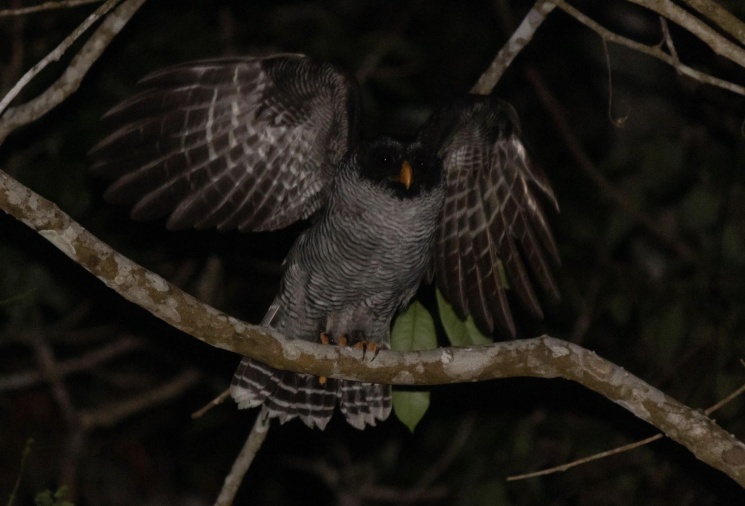
Black-and-White Owl: photo courtesy of Randall Jimenez
For the gloriously-marked Black-and-Whitle Owl (above), a bright street light on a clear, dark night has all the attraction of a full buffet to a hungry tourist. Big moths and other nocturnal insects are irresistibly attracted to bright lights…Black-and-White Owls are irresistibly attracted to big moths (and bats!). As Walt Disney taught us; IT’S THE CIRCLE…THE CIRCLE OF LIFE.
Do birders like colorful birds more than drab birds? That’s a tough question…but the answer is clearly a YES! However, when two or more birders get together you will often hear them waxing rhapsodic about such features as ‘…that subtile bran-colored wash on the primaries‘ ‘…a slight pinkish tinge on the lower mandible‘ and especially ‘…wing bars‘; we just LOVE talking about wing bars.
But when beautiful, colorful, charismatic birds (like the ones below) show up, birders turn into little kids who have been let into an ice cream shop.
So, yes; we like pretty birds more than drab birds just like everyone else.
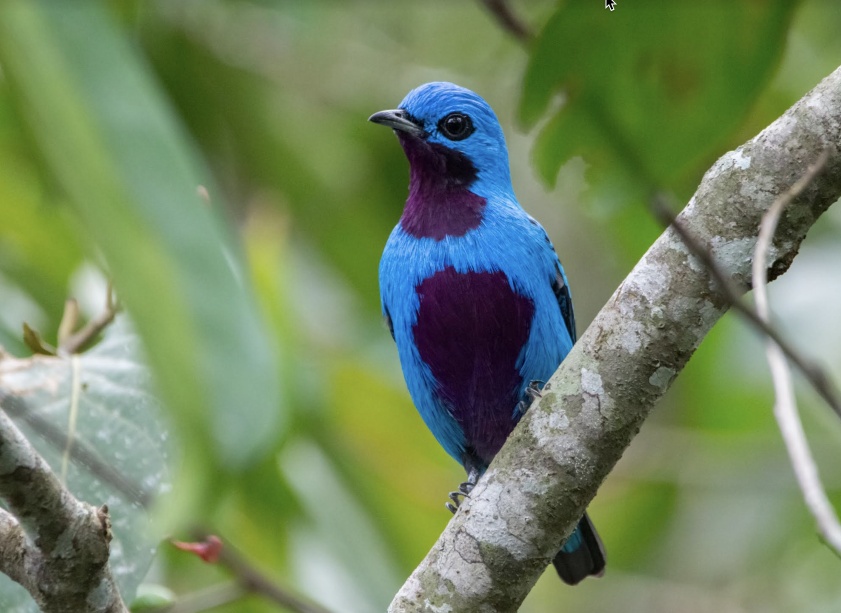
The photos below, all submitted by our good friend Pepe Castiblanco, are examples of colorful, beautiful and charismatic birds that we rarely see but would like to see more often.
Turquoise Cotinga: photo by Pepe CastiblancoResplendent Quetzal: photo by Pepe CastiblancoRosy Thrush Tanager: photo by Pepe CastiblancoGolden-browed Chlorophonia: photo by Pepe Castiblanco
Next week, on ‘Birds We Rarely See‘ the focus will be on some of those bird species that are less brightly colored and with more subtile beauty…and possibly wing bars.
ps: If I ever open a saloon for birders I’m going to call it ‘The Wing Bar’.
I’m not recommending you should drop everything you’re doing and speed out to this spot; but our Bonus Where We Bird location does have a couple of nice birds you can add to your list. The location is the Rio Java Gas Station (between the BM supermarket and Grupo Materiales). These two species are not your typical stand-offish, I-must-have-privacy, please be quiet birds. These two species seem to just LOVE being around us humans…with all of our noises and smells and dropped potato chips.
The House Sparrow and the Gray-breasted Martin.
Please enjoy watching these two species when you are there. They are as worthy of our time and admiration as any of the other 900 bird species in Costa Rica.
A very warm and enthusiastic San Vito Bird Club welcome to Tom Johnson and Kimberly Dawson; new members and new neighbors. These two great birders have settled into their new home in Santa Teresa de Sabalito and plan to become active in the San Vito Bird Club.
Tom and Kim are both long time birders; Tom for over 30 years and Kim for over 8 years. Kim is also a skilled photographer (see her work below). They hail from west and southern Texas (a great birding area) and have participated in many birding tours including Belize. But, as with us all, they have fallen and fallen hard for Coto Brus.
Please join me in welcoming them.
(Hopefully, we’ll be doing some bird walks very soon!)
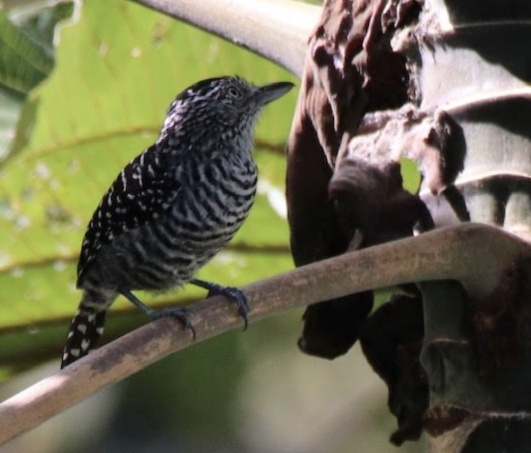
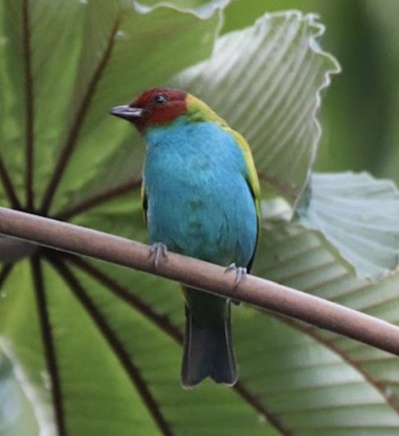
Photos from Kim Dawson:
Barred Antshrike-male. Taken on the Magic Road, March 17th.Yellow-throated Toucan in nest. Tres Rios, March 17th.Bay-headed TanagerScarlet-thighed Dacnis-male.
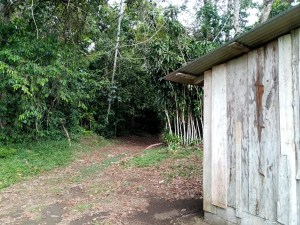
The trail entrance at Rio Negro. Photo by Alison Olivieri
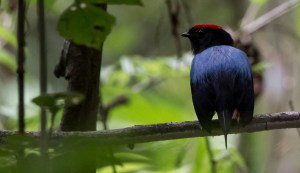
Walk with us into the tunnel of ‘To-le-do’, the song of the Lance-tailed Manakin. A superstar of San Vito birding, this active and beautiful bird also makes a mewing, catlike call. The red cap, blue back, tiny tail and orange legs make males unmistakeable; females are greenish, as are all the lady manakins, but she does have that tail! Here, they are only found at our southern Pacific border with western Panama but their range extends from Costa Rica to
See the tail? Photo by Pepe Castiblanco
Venezuela. Inhabiting the humid and second growth forests, Chiroxiphia lanceolata males are active at leks from Janury to March. Excellent and acrobatic dancers, you can find them on YouTube but, really, why not come here and see for yourself?
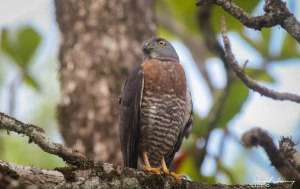
Bicolored Hawks can be found all around Costa Rica but they are categorized as ‘rare’. Luckily for us, they are regularly seen at this site or from the car on the way! The rufous thighs are diagnostic in adults but the juveniles are easily confused with forest-falcon species.
Juvenile Bicolored Hawk, Accipiter bicolor, photo by Jo Davidson
These raptors prey on birds, diving after them from perches at any height in mature, wet forests and tall secondary growth — even forest edges and gardens. They are in the same genus with Sharp-shinned and Cooper’s Hawks in the north.
Finally, we come to a bird found at lower levels of the forest following ant swarms: Bicolored Antbird. Plump and endearing with a big, blue eye-ring, it’s hard not to want to scurry after them. This species is said to have been the favorite of Dr. Alexander Skutch, author of ‘A Guide to the Birds of Costa Rica’ with F. Gary Stiles.
Bicolored Antbird, Gymnopithys leucaspis, photo by David A. Rodriguez Arias
Riverside Wren with nesting material. Photo by Sarah Beeson-Jones
Thanks to Julie Girard-Woolley, the SVBC has been birding this hidden road for a few years and found some pretty great birds there. Julie is a ‘walker’ (and an SVBC founder) and this spot is spectacular in March with a huge grove of blooming Poro trees. But we are not there for the trees — so let’s start with a bang: the Riverside Wren.
Endemic to southern Costa Rica and western Panama, Cantorchilus semibadius is one of many very loud wrens.
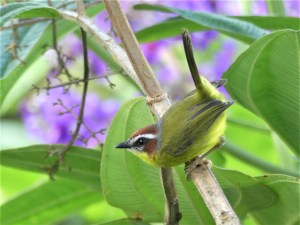
Rufous-capped Warbler. Photo by Jo Davidson
Next up, we have not a migrant but a resident, Rufous-capped Warbler. Although ‘common’ in the northern Pacific, Central Valley and southern Pacific, it’s always a jolt to see that red head, white eyebrow and cocked up tail. Basileuterus rufifrons shares its genus with three other resident Tico warblers.
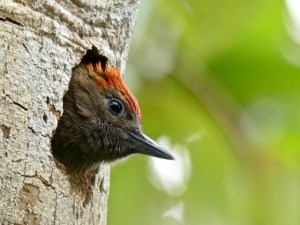
Here is another photo from Jo who has documented so many species in San Vito from her porch, she is admired far and wide. This is her Smoky-brown Woodpecker — just the head, but that is enough. Who doesn’t love woodpeckers? These are found in the northern half of the Caribbean slope and on the Pacific slope but are ‘uncommon’ in both locations. How did she get this photo? See below for a view you would be lucky to see in the field. Picoides fumigatus shares its genus with the Hairy Woodpecker, the Costa Rican race of which is smaller and darker than those in North America.
Smoky-brown Woodpecker by Jo Davidson
By now you will have noticed the photos are all out of synch with the text but it’s hard to resist including all these birds because obviously we are trying to entice you to visit us in San Vito, when you feel safe, and we will be here to welcome you.
One last bird — yes, we saved the best for last — and then the local spot where we go for breakfast when our walk is over.
The last bird photo is a Double-toothed Kite and we saw two, building a nest, on one of our excursions to the Poro Road. It was pretty exciting! See below for a photo by Randall Jiménez Borbón who works as the Community Outreach Coordinator at the Asociación Ambiental Finca Cántaros.
Double-toothed Kites often perch in the forest waiting for a troop of monkey to follow. They fly low to pick off any tasty critters the monkeys spook, like lizards and large insects.
See below for another photo we hope will be of interest: the Soda La Negra where we often go for breakfast after a Poro Road bird walk. Highly recommended are the scrambled eggs, rice and beans, sausages, tortillas and the coffee. The interior of this welcoming place is full of plants for sale, too, so you can augment your garden or your porch with some nicely potted flowers after breakfast.
Soda La Negra, just below the San Vito Hospital. Photo by Alison Olivieri



















You must be logged in to post a comment.