‘Butterflies and Spheres’ Trip Report

Written by Pat Morgan

Participants: Naturalist Guide Eugenio Garcia, Escort Guide Alison Olivieri, Judith and Joe Ippolito, Barbara Keeler and Wally Barton, Caroline Torres, Veronica Torres, Terry Farling, Pat Morgan and Steve Allen.

After a slightly disjointed start, with missed ‘rendezvouses’ in San Vito, our three­-car expedition finally met up at the Bomba in Palmar Norte. After filling up (on drinks and munchies), we set off for Big Wave Dave’s Butterfly Paradise in nearby Osa Mountain Village.  Getting there presented one minor obstacle for the Ippolito’s front­wheel drive van:  a mas empinada mountain road.  Spinning to a stop, unable to go further, passengers clambered into Wally’s truck and Alison’s SUV.  Not quite a Keystone Cops scene, but a little touch and go as we watched Wally “try” to slide into a ditch and then slip and slide back toward Alison’s car. He finally prevailed in moving uphill and forward without further incident and we sallied forth juntos.

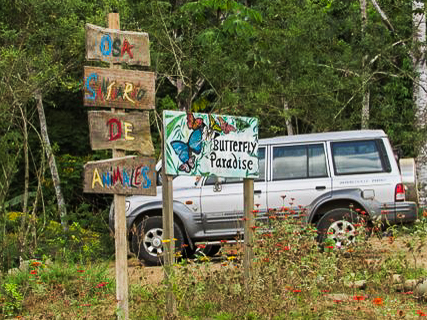
Butterfly Paradise (Photo by Pat Morgan)

Butterfly Paradise (Photo by Pat Morgan)

Big Wave Dave, a transplant from Ocean City, Maryland, has built Butterfly Paradise “from scratch.”  He now has about 30 species of butterflies in his enclosure, fed and nurtured by specific plant species. A talkative chap, Dave gave an excellent presentation, moving throughout the enclosure, showing Morpho pupae at their dinner leaves, pupae emerging from cocoons, along with an abundance of information on butterfly diets, habitat in the wild, and life cycles.  Eugenio and others also provided tidbits of information, i.e., the fact that only one group of butterflies — “cracker” or “brush-footed butterflies” (all in in the genus Hamadryas) — can make a clicking sound used in territorial displays. Dave, using dead and dried butterflies, explained and demonstrated their flight mechanism while some of us, ears still listening, were chasing butterflies with our cameras.
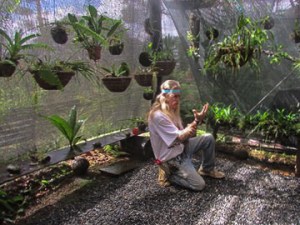
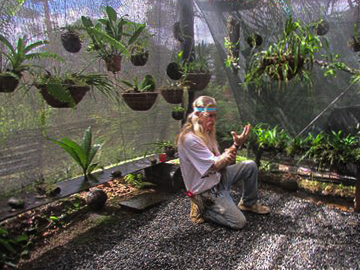
Dave in the Orchid Enclosure (Photo by Pat Morgan)

Dave in the Orchid Enclosure (Photo by Pat Morgan)

Several Scarlet Macaws, high up in the flaming yellow Colorados that had showered us with a flower storm of yellow petals, squawked a farewell before we departed back down the mountain to enjoy an excellent lunch at the Heladeria Diquis in Palmar Norte.

Afterwards, having lost a bit more time to chasing butterflies than anticipated, we chose to go to the close-by Parque de Esferas in Palma Sur to view a collection of Stone Spheres (instead of journeying further to Finca Seis closer to Sierpe where the giant spheres are allegedly left in situ). Eugenio Garcia shared all his archeological knowledge and experience about these mysterious rocks, suggesting a future trip to Bolas near Buenas Aires where it is believed the granite from which these stones were hand-chiseled was quarried some 1500 years ago.
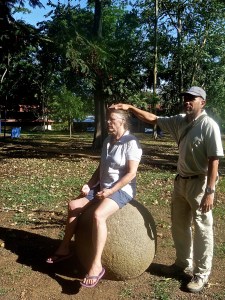
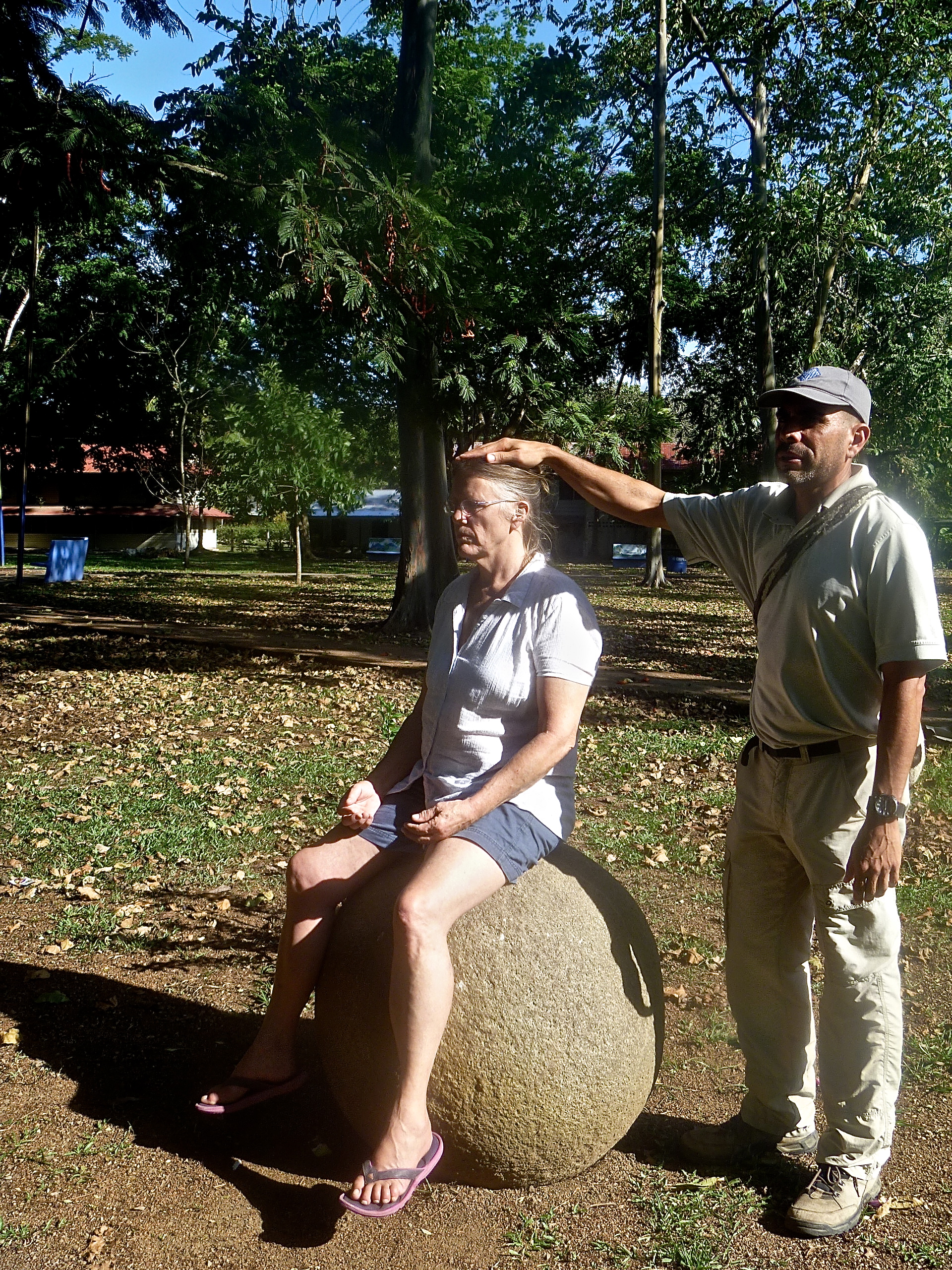
Pat's Healing Ceremony (Photo by Barbara Keeler Barton)

Pat’s Healing Ceremony (Photo by Barbara Keeler Barton)

Also, Eugenio facilitated a healing ceremony on one of the spheres, Pat Morgan being the recipient, after explaining it is believed the spheres hold and channel a lot of power.  Whether it was the power of suggestion or the power of the spheres, Pat felt a little less pain afterwards.

Hot and sweaty after being down at sea level, the expeditioners returned to the fresh air of San Vito, all in agreement that it was indeed a fun and informative day of learning and camaraderie.  Those who did not jump on the invitation to come missed out on a great trip.

Spheres, Butterflies and Maybe a Bat Falcon

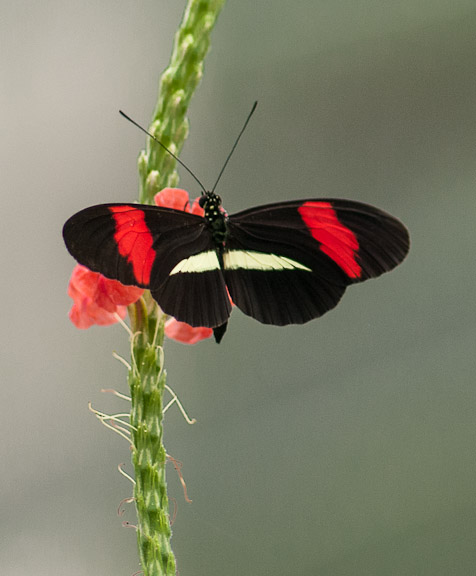
Heliconius erato petiverana

Heliconius erato petiverana. Photo by Harry Hull.

Please join us next Saturday, Jan. 4, for a Day Trip to nearby Palmar Sur and Palmar Norte. In Palmar Sur our leader, Eugenio Garcia, will show us a good spot to see the mysterious, ancient stone spheres of Costa Rica and discuss several current theories about their creation and use. We’ll also visit Butterfly Paradise at Osa Mountain Village and have lunch in Palmar Norte.

Although this is not a real ‘birding trip’, we could see some interesting species along the way. Frankly, we’re operating on the assumption that birders are curious folk and hope this trip will be of interest to many of you.

Costs include a $15 (or C7,500) per person admittance fee to the butterfly enclosure (children 5 and under are free) plus gas sharing, lunch money and an optional gift for Eugenio’s time and effort. Other necessities include binoculars, camera, sunscreen, water, etc.

Photo of stone spheres from www.templeilluminatus.com.

Photo of stone spheres from http://www.templeilluminatus.com.

The limit is 15 participants so please let us know ASAP if you would like to come along and if you are willing to drive by sending an email to: sanvitobirdclub@gmail.com. We’ll send out an itinerary and arrange carpooling. Hope to see you there!

If you have not renewed your membership or joined for 2014, this is perfect opportunity to do so! Resident Memberships are C10,000 per person; International Memberships are C7,500.

Big Birdfeeder Competition Closing Dec. 31, 2013

Tropical Mockingbird, Julie Girard's ace of trump. (Photo by Julie Girard)

Tropical Mockingbird, Julie Girard’s ace of trump. (Photo by Julie Girard)

Don’t forget to send us your Birdfeeder List for the Big Birdfeeder Competition by the end of this month — December 31, 2013. We’ll have a nice prize waiting for you at the SVBC Annual Meeting in February!

So far, we have three ‘official’ entries and two ‘unofficial’ entries so please send us your completed list TODAY!

You have only SIX days left to submit your list to us at: sanvitobirdclub@gmail.com


Our New ‘Education’ Pages

BirdSleuth logo simpleWe invite you to visit our two new website pages: “Education” and “Detectives de Pajaros Videos”.

The Education page–click here–is where you will find an up-to-date summary of our collaboration with the Cornell Laboratory of Ornithology Education Program “BirdSleuth-International” or, in Latin America, “Detectives de Pajaros”. We hope it will pique your interest and galvanize you to get involved by visiting a class, donating materials, or sponsoring the program in a local school.

And we hope you will have fun visiting the “Detectives de Pajaros Videos” page–here— where you can watch parts of the program in action. We have written a brief summary of each lesson to introduce the accompanying video. Special thanks are extended to member Andrew England who donated his time and talents creating all the videos.

Note that you can always get to the Education page and its sub-page, “Detectives de Pajaros Videos”,  by clicking on the “Education” tab on the navigation bar under the banner photo of any page or simply by clicking on the “Detectives de Pajaros” logo (illustrated above) in the right-hand column of the home page.

Contact us by clicking here to provide your always-welcome feedback!

Join the Big Birdfeeder Competition 2013!

From now until December 31, we’re having a Big Birdfeeder Competition: count all the species of birds visiting your feeder between now and then and send us your list by clicking here.

The rules are simple! You can count any species you are able to identify with certainty that lands on your feeder or on the ground under the feeder provided it is eating fallen scraps and not insects or something else. In the interests of fairness, the birding experts of the Club will review the final lists and remove species they feel have been mis-identified based on their knowledge of the birds of our area.

Just to get your competitive juices flowing here’s the current score, as of this post: Finca Cantaros is in the lead with 22 species, Pat Morgan claims second place with 21 and our own Finca Corteza is in third place with 15.

But, we have a month and a half to go so put on your binos, grab a pencil and paper, take out your field guide and get to work!

Please submit your completed entry by midnight on December 31st via email by clicking here. The winner will be announced by January 7, 2014. A prize (or prizes in case of a tie) will be awarded at the Annual Meeting in February 2014.

A Birder’s Bird

A guest “Viewpoint” written by Greg Homer, a birder’s birder who has led many trips to Costa Rica over the years. Greg and his wife Helen are our newest members. . . . .

It’s possible — even probable — that in the entire history of the world no non-birder has ever uttered the phrase “Ooh look, a Thrushlike Schiffornis!”.  But this wonderful creature, described by field guide author Richard Garrigues as “. . . a non-descript olive-brown bird . . . ” and somewhat more generously by the great Alexander Skutch as ” . . . not brightly colored”, is most definitely a joy to behold when seen by a birder.

Greg Homer, on deck at his new digs near the Wilson Botanical Garden.

Greg Homer, on deck at his new digs near the Wilson Botanical Garden.

Toucans, motmots, most parrots and many tanagers fall into a category of birds often referred to as Charismatic Avifauna (C.A.).  These birds are so colorful and/or charming that both birders and non-birders alike stop what they’re doing to give them a look. It’s extremely easy to love a Bay-headed Tanager or Fiery-billed Aracari.

But the Thrushlike Schiffornis most certainly does NOT fall into the C.A. category.  Not only is the Thrushlike Schiffornis non-descript and not brightly colored, it does not live a particularly exciting or charismatic lifestyle (at least not to all of us non-Thrushlike Schiffornises).  The terms ‘sluggish’ and ‘secretive’ and ‘solitary’ are often used to describe its behavior.  The song of the Thrushlike Schiffornis is unlikely to ever become a Top 10 ringtone.  And, on top of all that, there is the name — to me, ‘Thrushlike Schiffornis’ sounds more like a medical diagnosis than a bird.

“Mrs. Hartoonian, we have the results back on that culture we did on your eye.  You have thrushlike schiffornis.”

 “Is that bad?”

“Well, it isn’t good; but these days it is treatable with antibiotics.”

And get this. . . in my copy of A Guide to the Birds of Costa Rica by F. Gary Stiles and Alexander Skutch (first edition 1989), the Thrushlike Schiffornis isn’t even called a Thrushlike Schiffornis.  Back then it was listed as a “Thrushlike Manakin . . . which may possibly be a Thrushlike Mourner.”

When I was a kid back in the citrus belt of California, family, friends and neighbors used to look at me, smile and then tell my parents, “Well, there’s a face only a mother could love.”  And so it goes for the Thrushlike Schiffornis — a bird only a birder could love.

Wilson Walk Washout!

The Bird Walk scheduled for last Saturday, Nov. 2, was rained out — the first time this has happened since we began leading regular bird walks years ago. With all the rain we get annually in San Vito, it’s surprising this doesn’t happen more often!

Raining, pouring and heading your way. (Photo by Michael Olivieri.)

Raining, pouring and heading your way. (Photo by Michael Olivieri.)

We will reschedule for this coming Saturday, Nov. 9 and hope for better luck.

In the meantime, it might be fun to start listing the species that are visiting your bird feeders. Migratory species that spend the spring and summer in North America are back. Species like Baltimore Orioles, Summer Tanagers and Tennessee Warblers all readily come to fruit feeders so you should be seeing them regularly now.

Spending a few minutes each morning jotting down the birds on your bananas will sharpen your ID skills and, if we start a little competition, might encourage getting more feeders into action.

Here’s my list from the weekend, a total of 15 species including 7 tanagers (Blue-Gray, Golden-hooded, Silver-throated, Cherrie’s, Summer, Speckled and Palm), 2 toucans (Fiery-billed Aracari, Emerald Toucanet), 1 saltator (Buff-throated), 1 euphonia (Thick-billed), 1 honeycreeper (Green), 1 woodpecker (Red-crowned), 1 thrush (Clay-colored), and Blue-crowned Motmot,

We’ll be waiting for your list, so send it along by clicking here to contact us!

English Language Students Attend Bird Walk

We were happily overrun with students from the CaRob Instituto de Ingles in San Vito on a recent Bird Walk at Finca Cantaros, a change in venue from our regular twice-monthly outings at the Wilson Botanical Garden.

Lush trails at Finca Cantaros. Photo by Barbara Barton.

Lush trails at Finca Cantaros. Photo by Barb Keeler-Barton.

Alma Dionisi, one of the Instituto’s English teachers, brought her class of 10 via minibus for a two-hour bird walk followed by an English language practice session. Wendy Russell Bernstein, Barb Keeler-Barton, Roni Chernin, Caroline Torres, Susan England and Judith and Joe Ippolito were all on hand to help out – both with bird spotting and practicing conversational English.

The idea for this walk came from Wilkin, one of Alma’s students. Wilkin is a passionate birder, a friend of SVBC Member Cecilia Sansonetti’s and has birded with us several times in the past. Unfortunately he cannot attend more of our walks at the moment because his Saturday mornings are occupied with learning English!

Chatting in English in the Rancho Grande. Photo by Barbara Barton.

Chatting in English in the Rancho Grande. Photo by Barb Keeler-Barton.

It was a large group but we nonetheless managed to see 28 species of birds including one neotropical migrant, a Black-and-white Warbler, sighted by Susan England. Thanks to Alma for organizing this fun morning and also to our loyal volunteer helpers.

Birding from the Canopy Tower

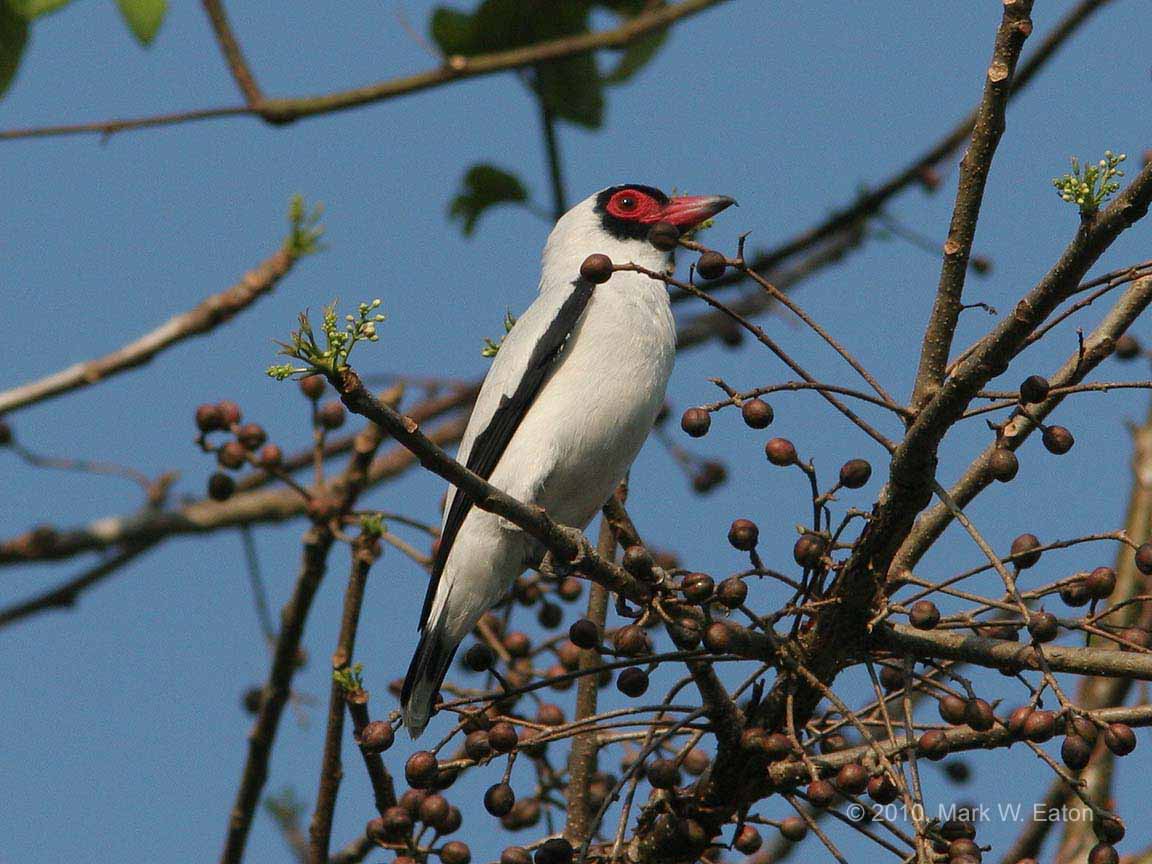
On a recent Bird Walk at the Wilson Botanical Garden, our group of 10 climbed the Canopy Tower to look for returning migrants. Although we did not see any of those, we did see two Masked Tityras, spotted by Caroline Torres.

Masked Tityra. Photo by Mark W. Eaton.

Masked Tityra (Photo by Mark W. Eaton)

I’m not sure why but these birds always give me a jolt of surprise. Maybe it’s the incredible white plumage or perhaps it’s the bright pink orbital skin around the eye and face? Being close to them in the canopy was a thrill as their size is often diminished when they’re seen – typically high in the trees — from the ground. Here, on the Tower, we had the chance to view them at slightly lower than eye level, allowing us to experience them as striking-looking, big, white flycatchers.

When the Tower was inaugurated in May 2011 (click here to read more about this event), we decided to keep a list of all species seen and/or heard in the immediate vicinity. On our recent visit we added add two new ones to the Canopy Tower Bird List: Laughing Falcon (heard not seen) and Spot-crowned Euphonia.

Laughing Falcon (Photo by Alison Olivieri)

Laughing Falcon (Photo by Alison Olivieri)

The falcon’s resonant, slightly eerie call is described by F. Gary Stiles and Alexander F. Skutch in A Guide to the Birds of Costa Rica, as “. . . . a long, rhythmic series of loud, hollow notes with somewhat the quality of a child’s shout.”  The local name of this raptor, Guaco, is synchronous with its call so once you learn and hear it, you can be certain it’s a Laughing Falcon. It is well known that this bird of prey’s favorite food item is any kind of snake so they are cherished by local people and those of us who wish they would visit often and eat their fill.

Our female Spot-crowned Euphonia perched quite close to the Tower, affording some of the group excellent looks at her distinctive field marks of rufous forecrown and belly. Identifying this species is easy if you are prepared to do a little work with your field guide. The males are the only euphonia with yellow spots on the crown patch but, if you are looking from below, it is often easier to identify the female. This is a puzzle where the range maps in the Garrigues and Dean field guide (The Birds of Costa Rica) really come in handy. You’ll quickly see another species with similar markings on the female, Olive-backed Euphonia, but a glance at the map will tell you the Olive-backed is found on the Caribbean side and Spot-crowned is the bird you see here.

To date we have 67 species on this list and 10 birders have contributed sightings. If you are curious and would like a copy, don’t hesitate to contact us. Likewise, please let us know if you see or hear a species we are missing.

Thanks to Caroline Torres, Roni Chernin, Jeff Wick, Barb Barton, Judith and Joe Ippolito, Donna and Tony Pagano and their surrogate grandson Rolando for joining us on this walk.

Festival Eco-Cultural 2013

Rock Art rocks!

Rock Art rocks!

A big THANK YOU to all the SVBC volunteers who helped organize and implement all the children’s activities during the recent Festival Eco-Cultural at OTS Las Cruces Biological Station/Wilson Botanical Garden.

Rock Art with Wendy Bernstein and Face Painting by Kata Ulaenars, Barbara Barton, Pat Morgan and Liz Allen are always popular at this annual event and we try to introduce new crafts and other activities each year.

Lantern finished!

Lantern finished!

This year Roni Chernin led a craft table transforming recycled material into flower vases and Kelley Rasch and her neighbor Rosemari helped kids make gaily decorated lanterns.

Held in June during Environmental Awareness Week, Las Cruces is transformed into a hubbub of activities including musical events, videos, guided walks, local food, crafts, artwork, demonstrations, plant and seed exchanges and more. Traditionally, members of the SVBC have volunteered to run the children’s programs for both days of this much-anticipated celebration.

Please enjoy these pictures by Alison Olivieri from a two-day “photo op” and plan to join us next year!

Beautiful painted faces.

Beautiful painted faces.

Below is a report of this year’s Festival, in Spanish only, by Ariadna Sanchez, Environmental Education Coordinator at Las Cruces.