SVBC ANNUAL MEETING TAXONOMY FOLLOW-UP

(This article courtesy of SVBC Taxonomy Tsar, Jo Davidson)

Thanks to all of you who attended the recent San Vito Bird Club annual meeting. This post provides the basic information and links to some excellent resources that were included in the presentation on Taxonomy.

TAXONOMIC UPDATES 2016

Plain Wren has been split into three separate species.

  • Isthmian Wren (Cantorchilus elutus).
  • Cabanis’s Wren (Cantorchilus modestus)
  • Canebrake Wren (Cantorchilus zeledoni)

Gray-necked Wood-Rail is now Gray-cowled Wood-Rail

Three-striped Warbler is now Costa Rican Warbler (Basileuterus melanotis).

Blue-crowned Motmot is now Lesson’s Motmot (Momotus lessoni).

Green Violetear. is now Lesser Violetear (Colibri cyanotus).

Only the scientific names of the following species have been changed.

  • Pink-footed Shearwater (Puffinus creatopus) is now Ardenna creators
  • Wedge-tailed Shearwater (Puffinus pacificus) is now Ardenna pacifica
  • Sooty Shearwater (Puffinus griseus) is now Ardenna grisea
  • Short-tailed Shearwater (Puffinus tenuirostris) is now Ardenna tenuirostris
  • Dusky Antbird (Cercomacra tyrannina) is now Cercomacroides tyrannina
  • Tawny-crowned Greenlet (Hylophilus ochraceiceps) is now Tunchiornis ochraceiceps
  • Lesser Greenlet (Hylophilus decurtatus) is now Pachysylvia decurtata
LINKS TO RESOURCES:
 
Official List of Birds of Costa Rica –
Online Excel file including Order, Family, Scientific name, English name and Spanish name(s). This will come in very handy if you post information or inquiries to the AOCR Facebook page (link below).
 
Asociación Ornitológica de Costa Rica (AOCR)
Dues are 10,000 colones per year, for which you receive their newsletter, access to monthly seminars, and discounts on products and tours.
 
Asociación Ornitológica de Costa Rica (AOCR) – Facebook
This is truly a worthwhile group to join. If you don’t currently “do” Facebook, you may want to set up a profile just to access this incredible resource. In addition to truly wonderful pictures and details about our Costa Rican birds, there is much information on events and conservation efforts throughout the country.
 
American Ornithological Society (AOS) –
This is the group responsible for the annual taxonomy changes, which are actually published in July, not March. You will find the yearly supplements under “Publications and Checklists.”
 
Atlantic article on Taxonomists
Lighthearted and informative!
 
Rebecca’s e-mail address –
For those who did not have a pencil ready.
If any of you have questions regarding taxonomy issues, please e-mail them to the following address: jo@induna.us
Felicidades a Gail Hull: Campeon de comedor de aves!/Congratulations to Gail Hull: Bird Feeder Champion!

Nuestra buen amiga y la duena de Finca Cantaros Gail Hull es el campeon del Concurso de Comedor de aves por 2017.  Por la primera vez, en la historia del concurso tuvimos mas que 30 espeicas.  Gail tuve 31 especias de aves!

******

Our good friend and owner of Finca Cantaros, Gail Hull is the 2017 Bird Feeder Contest Champion.  For the first time in the history of the contest more than 30 species were recorded.  Gail had 31 species.

Lesson’s Motmot

Cherrie’s Tanager

Yellow-throated Toucan

Golden-hooded Tanager

Silver-throated Tanager


Summer Tanager

Blue-grey Tanager

Speckled Tanager

Buff-throated Saltator

Palm Tanager


Clay-colored Thrush

Chachalaca

Gray-necked Woodrail

Orange-billed Sparrow

Costa Rican Brush-Finch


Bay-headed Tanager

Green Honeycreeper

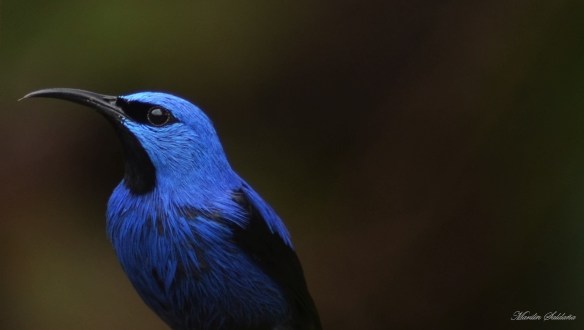
Red-legged Honeycreeper

Thick-billed Euphonia

Gray-headed Tanager


Streaked Saltator

Black-striped Sparrow

Gray-chested Dove

Red-crowned Woodpecker

Yellow-crowned Euphonia


Yellow-faced Grassquit

Great Kiskadee

Orange-billed Nightingale Thrush

Ruddy Pigeon

Fiery-billed Aracari

Gray-tipped Dove

(photo courtesy of Jeff Worman)

Bay-headed Tanager (Photo by Jeff Worman)

Bay-headed Tanager (photo by Jeff Worman)

SVBC Bird Feeder Contest: Reminder

I will announce the winners of the 2017 San Vito Bird Club Bird Feeder Contest this coming Saturday morning at our Annual Meeting.  These are birds you have seen feeding ON or immediately BELOW your feeder–from Feb. 1-28, 2017.

To be eligible, you may give me a paper copy of your list at the meeting no later than 8:55 am on Saturday; or you mail email it to me no later than 6am on Saturday.

Email to:

president@sanvitobirdclub.org

Good luck.

(photo courtesy of Helen LeVasseur)

IMG_3036

Pigeons and Doves of Coto Brus: ID by Song

Pigeons and Doves of Coto Brus: Identification by Song

Bird Name Description Song
Short-billed Pigeon Upright, reddish-brown. 4-5 syllables long. Think, ‘dos tontos son’.
Ruddy Pigeon Similar to previous; a little darker. Think, ‘what’s the matter’; sometimes ‘hey, what’s the matter’.
Scaled Pigeon Big and stocky, thick neck. Scaly neck and chest, light-colored. Deep pitched ‘wooo-oo-hoo’. The baritone of pigeons.
Pale-vented Pigeon Light-colored pigeon; soft colors on head, dark bill. Think ‘here we goooo’ or maybe ‘what the hell’.
White-tipped Dove Our most common dove. White head and white tips on tail. Sad sounding ‘wooooooooh’. Grey-headed Dove looks and sounds similar.
Ruddy Ground-Dove Little guys; light-colored head, reddish-brown body. Two distinct notes; think ‘woo-HOOT, woo-HOOT’ repeated several times.
Blue Ground-Dove Male is actually BLUE! Female brown. Single note ‘BOOP’.

(Scaled Pigeon photo courtesy of Luis Fallas)

SVBC-luisfalas-561849389208-scaledpigeon-R

Leucistic Black Vultures in Tres Rios/Zopilotes negro con leucismo en Tres Rios

On a recent outing down the Tres Rios road (across from the San Vito Hosptial) we spotted not one but TWO…TWO…leucistic Black Vultures.  Leucism is a recessive genetic trait that manifests itself by a lack of normal pigmentation.  This condition is very rare.

*********

En una caminata reciente, vimos DOS…DOS…Zopilotes negro con una condition que se llama leucismo.  El leucismo es un raro rasgo genetico recesivo donde no hay pigmentacion.

(photos courtesy of Jeff Worman)

svbc_jeffw_leucisticvulture1_svbc.jpg

svbc_jeffw_leucisticvulture2_svbc.jpg

P.O.W.-Week #22/F.D.L.S.-Semana #22

Congratulations/Felicidades a Gail Hull y Helen LeVasseur!

Theme: Birds eating colorful food/Aves comiendo cominda colorida

Photo #1: Crimson-fronted Parakeet in Poro flowers. (photo by Gail Hull)

svbc_gailhull_crimsonfrontedpkeet_jpg.jpg

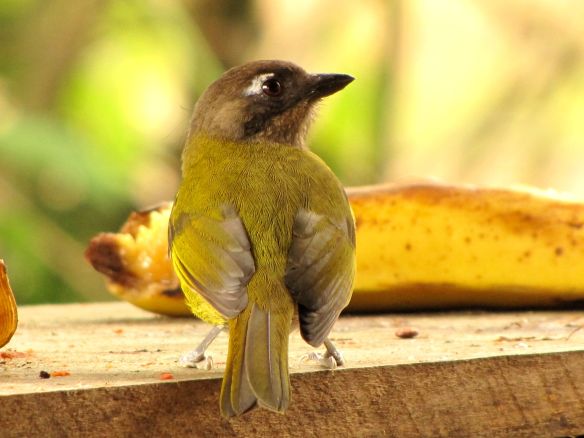
Photo #2: Common Chlorspingus on feeder. (photo by Helen LeVasseur)

svbc_helenl_chlorospingus_jpg.jpg

SVBC Bird Feeder Contest 2017/Concurso de comedor de aves 2017

February 1-28: Make a list of the bird species that come to your bird feeder.  Whoever has the most species of birds…WINS!

Rules:

  1. Bird must actually eat something on or directly under your bird feeder.
  2. Your bird feeders must be viewable from ONE SPOT.  You can’t have one by your kitchen and one WAAAAY out in a potrero.

Good luck.  Winner to be announced at the SVBC annual meeting in early March.

*************

Febrero 1-28: Hacer una list de las aves que vienen a su comedor de aves.  Quien tiene mas es el GANADOR!

Reglas:

  1. Las aves nesesitan comer algo directament en el comedor or abajo del comedor.
  2. Usted nesecita ver sus comedores desde un lugar.  No puede tener un comedor en frente de su cocina and una otra en su potrero.

Buena suerte!  Ganador sera anunciado en la primera semana de marzo a nuestra reunion anual.

(photo courtesy of Helen LeVasseur)

IMG_3034

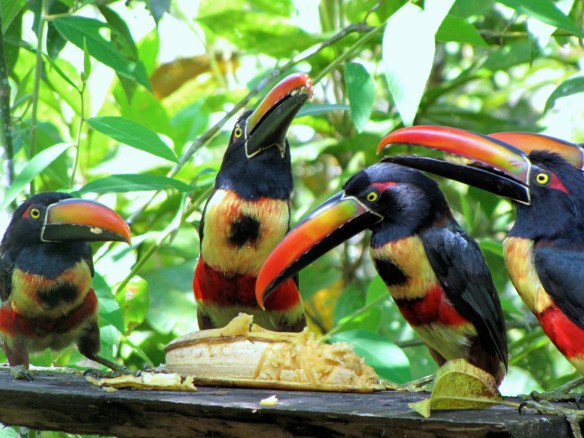
Cusingos (Fiery-billed Aracaris)

P.O.W.-Week #21/F.D.L.S.-Semana #21

Congratulations/Felicidades a Troy Edson-Smith y Tom Wilkinson!

Theme: Strange Views/Extrana perspectivas

Photo #1: Two-headed vulture / Zopilote con dos cabezas (photo by Tom Wilkinson)

svbc_tomwilkinson_zopilote-jpg.jpg

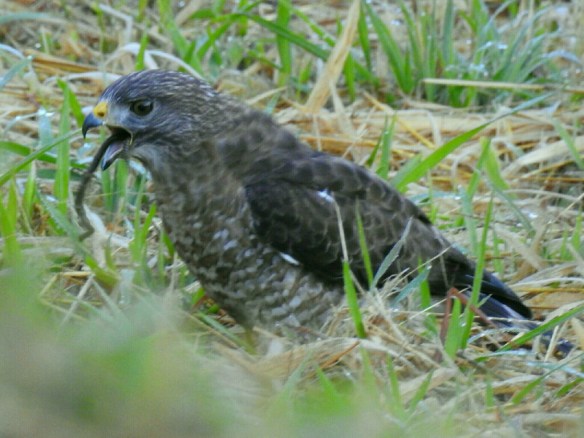
Photo #2: A worm for breakfast / Un gusano por el desayuno. (photo by Troy Edson-Smith)

svbc_troys_roadsidehawk_jpg.jpg

Click here to learn how members can submit their own photos for the Photos of the Week feature.

A Little Citizen Science?

On three different occasions and locations this week I have noticed Baltimore Orioles sharing a tree with Gray-headed Chachalacas.

Could there be a commensal* relationship going on?  Are the Baltimore Orioles benefitting as the big, sometimes clumsy Chachalacas stir up arboreal insects and other invertebrates?  We see a similar type of relationship with cattle and cattle egrets, monkey troops and Gray-headed Tanagers.

Please contact me if you notice this Gray-headed Chachalaca/Baltimore Oriole affiliation:

president@sanvitobirdclub.org

Thanks everyone; Greg.

*Commensal–a relationship between two different organisms, where one benefits and the other is (seemingly) not affected.