Congratulations/Felicidades a Marilin Saldana Zuniga y Yeimiri Badilla!
Theme: Hot, hot colors!/Colores caliente!
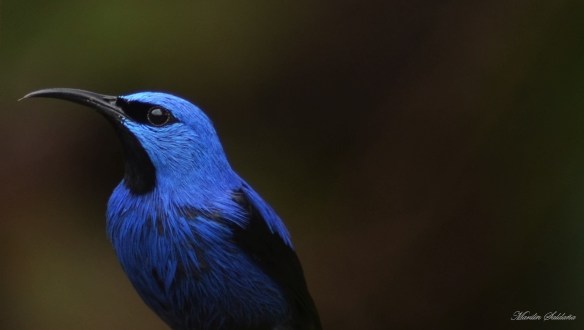
Photo #1: Red-legged Honeycreeper (by Marilin Saldana Zuniga)

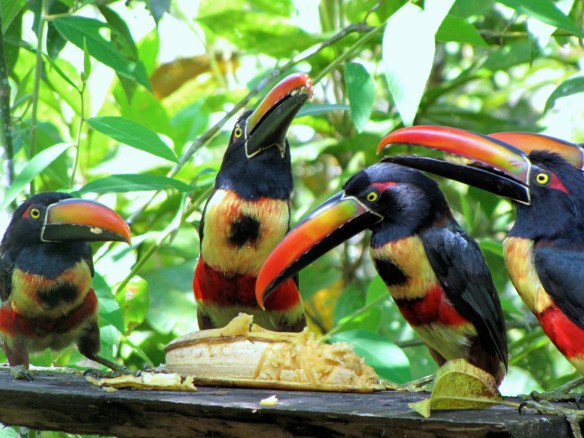
Photo #2: Fiery-billed Aracari (by Yeimiri Badilla)

Theme: Hot, hot colors!/Colores caliente!
Photo #1: Red-legged Honeycreeper (by Marilin Saldana Zuniga)

Photo #2: Fiery-billed Aracari (by Yeimiri Badilla)

On three different occasions and locations this week I have noticed Baltimore Orioles sharing a tree with Gray-headed Chachalacas.
Could there be a commensal* relationship going on? Are the Baltimore Orioles benefitting as the big, sometimes clumsy Chachalacas stir up arboreal insects and other invertebrates? We see a similar type of relationship with cattle and cattle egrets, monkey troops and Gray-headed Tanagers.
Please contact me if you notice this Gray-headed Chachalaca/Baltimore Oriole affiliation:
president@sanvitobirdclub.org
Thanks everyone; Greg.
*Commensal–a relationship between two different organisms, where one benefits and the other is (seemingly) not affected.
Theme: Gold and Emerald!/Oro y esmeralda
Photo/foto #1: Golden-olive Woodpecker (Gail Hull: taken at Wilson Garden)

Photo/foto #2: Garden Emerald (Jo Davidson: taken from her porch)

A very happy New Year to all of our San Vito Bird Club members, family and friends.
Please continue to follow our activities and please remember to send us your bird photos for our Photos of the Week (POW) feature.
You may send photos (and also pay your 2017 SVBC membership dues) by following the links on our SVBC homepage.
I hope 2017 is a great year for all of you!
And as always, your donations are appreciated.
**********************
Prospero y feliz ano nuevo a todos de nuestras San Vito Bird Club amigos, miembros y familia.
Y por favor…continua a enviar sus fotos por Fotos de la Semana (POW) contesta.
Y ustedes puenden pagar sus duedas aqui en el website.
Espero que 2017 es un ano magnifico!
Saludos.
Greg Homer/President SVBC

Helen LeVasseur with Greg Homer, photo by Jo Davidson
Theme: A Mouse’s Nightmare/Sueños malos por un ratón
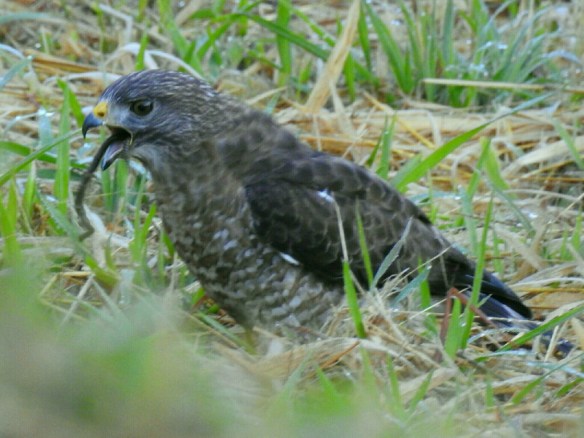
Photo/foto #1: Roadside Hawk (from Bley Fernandez)

Photo/foto #2: Crested Owl (from Gail Hull)

Song/cancion2. The closely related Spotted Woodcreeper with a very different song./Muy simlar, es el Spotted Woodcreeper con una canción muy diferente.

3. The remarkable Brown-billed Scythebill./El woodcreeper increible; Brown-billed Scythebill.

4. The very active Olivaceous Woodcreeper./El Woodcreeper con mucho energía; Olivaceous Woodcreeper.

http://www.hbw.com/ibc/sound/olivaceous-woodcreeper-sittasomus-griseicapillus/solitary
5. The Wedge-billed Woodcreeper./El Wedge-billed Woodcreeper.

6. The very similar Plain Xenops. El Plain Xenops, muy similar.

Theme: Migrant Warblers
Photo/foto #1: Black and White Warbler (Zebra)

Photo/foto #2: Wilson’s Warbler

San Vito Bird Club bird walks are changing from Saturday mornings to Sunday mornings. This change is to accommodate the every increasing popularity of our wonderful San Vito Saturday morning Farmer’s Market. Our next walk is SUNDAY, Dec. 4th at the Wilson Botanical Garden (Las Cruces).
Please join us for this, hopefully dry and sunny, bird walk. Following the walk we will be collecting your 2017 SVBC dues. Dues have not been increased for several years but this year they are going up, slightly. The new membership fees are:
You may also pay your dues from the PayPal button below.
We also have some exciting new San Vito Bird Club merchandise you can order!
We look forward to seeing you at our new Sunday bird walk—Dec. 4th. And don’t forget to take home your FREE-FREE-FREE San Vito Bird Club window sticker.
////////////
Las caminatas del Club de Aves de San Vito pasan de sábados en la mañana a los domingos en la mañana. Este cambio es para ajustarnos a la creciente popularidad de nuestra Feria del Agricultor los sábados en la mañana en San Vito. Nuestra próxima caminata es el DOMINGO 4 de diciembre en el Jardín Botánico Wilson (Las Cruces).
Por favor acompáñenos en esta, ojalá seca y soleada, caminata para pajarear. Después de la caminata, recolectaremos las cuotas de membresía del SVBC de 2017. El costo de la membresía no ha incrementado por varios años, pero este año será un poco mayor. Los nuevos costos de membresía son:
Usted puede también cancelar su membresía desde el botón de PayPal abajo.
¡También tenemos noticias emocionantes sobre mercadería del Club de Aves de San Vito que usted puede ordenar!
Esperamos verles en nuestra nueva caminata para pajarear – el domingo 4 de diciembre. No olvide llevarse a casa su pegatina del Club de Pájaros de San Vito GRATIS-GRATIS-GRATIS.

Ever held a hummingbird in your hand and felt it’s heart beating at close to 1000 beats per minute? This week students from Santa Cecilia School had that very experience under the watchful and experienced eye of Pablo ‘Chespi’ Elizondo and his team of skilled mist netters from the Costa Rica Bird Observatory (CRBO).
Chespi Elizondo and CRBO conduct regular monitoring of bird species throughout the country using a technique known as mist netting. In mist netting, birds are humanely captured and collected after they become entangled in delicate and lightweight 10-meter long nets. The birds are gently removed from the nets and then taken back to a data collection station where they are weighed and measured. Santa Cecilia school students not only watched these scientific endeavors but also took part!
The young scholars also helped the CRBO crew in gathering more scientific data, such as each bird’s age, sex (if possible), breeding status and general health. The birds are also given a numbered band, which is attached to the leg. Not surprisingly, a significant number of the mist netted birds show up with a numbered band already in place! Collection of data from these previously tagged birds can provide great insight into bird migration patterns and longevity.
Earlier this year these same Santa Cecilia School students successfully completed the Detectives de Aves curriculum with instructor Eugenio Garcia and assistant Helen LeVasseur. But mist netting with CRBO has allowed the students that rare opportunity to get up close and personal with some of Costa Rica’s most beautiful and delicate bird species and to be a part of actual science in action.
A rare opportunity was also afforded the San Vito Bird Club, Pablo ‘Chespi’ Elizondo and his CRBO team of mist netters…the opportunity to observe that look of awe and wonder that shines in the eyes of a child.
***************************
¿Alguna vez sostuvo un colibrí en sus manos y sintió que su corazón palpitaba a 1000 latidos por minuto? Esta semana, estudiantes de la Escuela de Santa Cecilia tuvieron esa misma experiencia bajo la mirada experta y vigilante de Pablo ‘Chespi’ Elizondo y su equipo de hábiles colocadores de redes del Costa Rica Bird Observatory (CRBO).
Chespi Elizondo y CRBO condujeron un monitoreo regular de las especies en el país utilizando una técnica conocida como “redes de niebla”. En las redes, los pájaros son capturados de manera humana y recolectados cuando quedan atrapados en la delicada y liviana red de 10 metros. Las aves son gentilmente liberadas de las redes y luego llevadas a una estación de recolección de datos, donde son medidas y pesadas. Los estudiantes de la Escuela de Santa Cecilia no solamente observaron estos esfuerzos, sino que ¡además tomaron parte en ellos!
Los jóvenes intelectuales ayudaron también al equipo de CRBO a recoger más datos científicos, como la edad de las aves, el sexo (cuando fue posible identificarlo), status reproductivo y salud general. Las aves fueron identificadas con un brazalete numerado, que se coloca en una de sus patas. Como era de esperar, ¡una cantidad significante de pájaros aparecían con un brazalete ya en su pata! La recolección de datos sobre estas aves previamente catalogadas puede aportar información sobre patrones de migración y longevidad.
Más temprano este año, estos mismos estudiantes de la Escuela de Santa Cecilia finalizaron exitosamente el currículo de Detectives de Aves con el instructor Eugenio García y su asistente Helen LeVasseur. Pero trabajar con las redes de niebla ayudó a los estudiantes a tener un acercamiento personal con algunas de las especies de aves más bellas y delicadas de Costa Rica, a la vez que toman parte de una empresa científica.
Una experiencia poco común fue también dada al San Vito Bird Club por Pablo ‘Chespi’ Elizondo y su equipo de CRBO, la oportunidad de observar esa mirada de sobrecogimiento y el brillo en los ojos de un niño.

You must be logged in to post a comment.