Can you identify this bird from a highly pixilated and close-up photo?
(photo courtesy of Donna Goodwin)

Let me know—
eltangaral@gmail.com
–if this is any fun or just stupid.

Can you identify this bird from a highly pixilated and close-up photo?
(photo courtesy of Donna Goodwin)
Let me know—
eltangaral@gmail.com
–if this is any fun or just stupid.
Please join the San Vito Bird Club in supporting a new business in our area: PRC (Plastico-Reciclando-Concreto). Recycled plastics are used in the construction of beautiful and durable furniture and now even bird feeders! See link below.
https://www.facebook.com/plasticorecicladoconcreto/

Please join the San Vito Bird Club for a 7:30am bird walk at the Wilson Botanical Garden (Las Cruces Station). Meet at Reception for a brief update on SVBC activities then a walk through the lower gardens where many of the trees are filled with fruit and hopefully many birds!
Binoculars available as needed.
(photo courtesy of Helen LeVasseur)
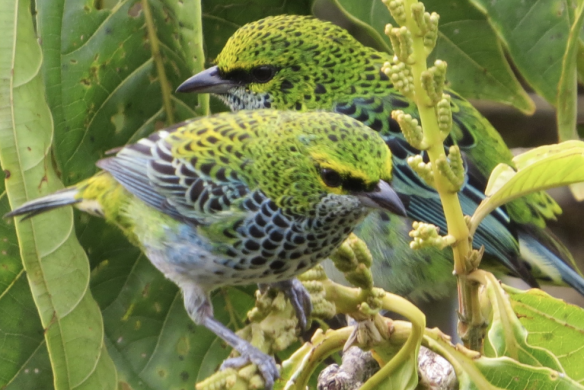
As soon as you read this you may begin the 2019 San Vito Bird Club Bird Feeder Contest!
Here are the ridiculously simple rules for this year’s contest:
There will be three winners this year:
Good luck all. More to come about the annual meeting very soon.
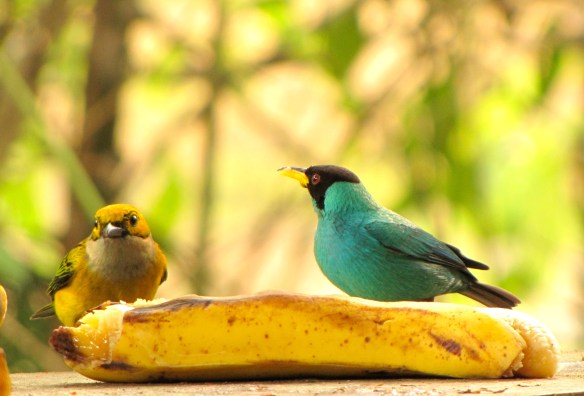
(photo courtesy of Helen LeVasseur)
Many, MANY thanks to Bley Fernandez, Paula Mesen and Jeisson Figueroa (from the Pajareros del Sur) and all who attended last Sunday’s bird walk at the Wilson Botanical Garden (Las Cruces). Many new birders, many young birders and some regular birders joined in! More collaboration to come.
Be a part!

(Photos courtesy of Randall Jimenez)
There’s a term in sports photography, nature photography, current event photography and probably all photography–The MONEY Shot. In sports, the money shot could be the wide receiver catching the game-winning pass; in nature photography, something like the Humpback whale breeching up out of the sea; in current events, a fireman walking out of a burning building holding a child.
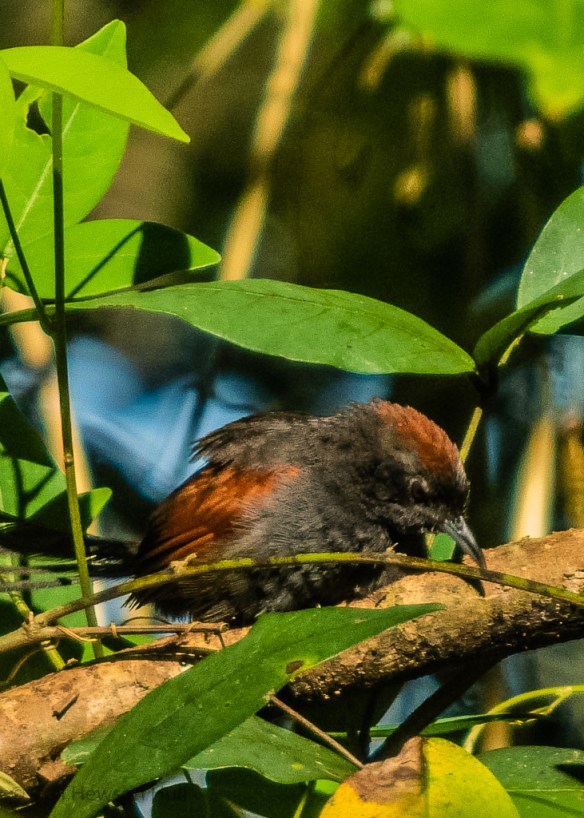
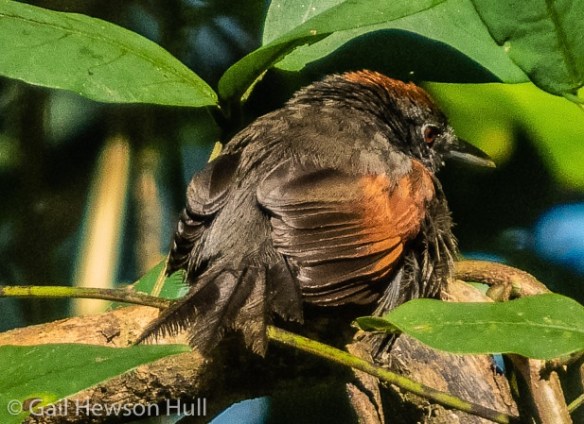
Bird photography is the same. When photographing a Slaty Spinetail, the ‘money shot’, as you might imagine, comes in capturing the distinctive spiny tail! Gail Hull, of Finca Cantaros, has done just that. In photo #1 below, we see the bold rusty and black coloration of the Slaty Spinetail as it is facing us. In photo #2 we get the Slaty Spinetail ‘money shot’…a good, close look at that distinctive spiny tail as the bird is facing the other direction. Well done.
We have three different spinetail species down here in the south; the Slaty Spinetail, the Pale-breasted Spinetail and the Red-faced Spinetail. All three are quite secretive.
(both photos taken at Finca Cantaros, Sept. 2018 by Gail Hull)
Dear SVBC members and friends. We have gathered on this web page to mourn the loss of two beloved species which recently died at the hands of the North American Classification Committee (NACC). The American Ornithology Union (AOU) has published the list of taxonomy changes for 2018, and we in the Southern Zone have lost two species. They are still around, thank goodness, but have been reclassified as members of another species.
Our local Cherrie’s Tanager and the Passerini’s Tanager are once again lumped together as one species. They are both known again as the Scarlet-rumped Tanager (Rampocelus passerinii).
The Masked Yellowthroat, which we have seen during our walks at the San Joaquin wetlands, is now lumped together with, and now known as, the Olive-crowned Yellowthroat (Geothlypis semiflava).
Fortunately, we also have two new species to celebrate. The Buff-throated Foliage-gleaner was split, and the species in our area, the Chiriqui Foliage-gleaner (Automolus exertus), is named for the Panamanian canton which is a large portion of the range of this new species. The White-collared Seedeater was also split, and the Costa Rican species is Morelet’s Seedeater (Sporophila morelleti), named for the person who first found the original species in 1885. The species that occurs in areas north of Costa Rica is now the Cinnamon-rumped Seedeater.
Three of our Costa Rican Woodpeckers have been placed in a new genus – Dryobates. Their previous and new scientific names are as follows:
Hairy Woodpecker – Picoides villosus is now Dryobates villosus
Smoky-brown Woodpecker – Picoides fumigatus is now Dryobates fumigatus
Red-rumped Woodpecker – Veniliornis kirkii is now Dryobates kirkii
Additionally, the Mouse-colored Tyrannulet has had its scientific name changed from Phaeomyias murina to Necotriccus murinus.
Finally, I implore the AOU and the NACC to stop picking on the Red-breasted Blackbird. Last year they changed its scientific name to Leistes militaris, and this year they have changed its English common name to Red-breasted Meadowlark.
Please update your field guides to reflect these changes. Happy birding to you all!


Antbirds–Ant Tanagers–Antvireos–Antshrikes–Antpittas–Antwrens–Antthrushes? Why are so many Costa Rican bird species modified with the word ‘Ant’ in from of them?
Most people have the misconception that all of these various species of ‘Ant’ birds are consumers of…ants! This is not the case (although some birds, like the Northern Flicker woodpecker, do consume ants with gusto). These birds are called ‘Ant’ birds for another reason.
‘Ant’ birds are given this prefix not because they eat ants; but rather because they FOLLOW ants, in particular Army Ants ( most often Eciton burchellii). If you live or have visited the neo-tropics you may have had the opportunity to observe Army Ants on the move. Hundreds of thousands, perhaps millions of these tiny marauders will sweep through an area not unlike…an army! Along their march the Army Ants attack and kill pretty much anything they encounter.
***No, they are not as fierce and aggressive as those ants in that great movie with Charlton Heston, ‘The Naked Jungle’. In that movie the ants could ‘..clean a bull down to the bones in less than an hour.’ Great movie!***

Invertebrates and even small vertebrates probably fear nothing more than being swarmed over, torn apart and ultimately eaten by Army Ants. And so, when an army of Army Ants is discovered by the beetles, crickets, worms, centipedes, lizards and even small snakes of the forest floor they do exactly what you or I would do; GET THE HELL OUTTA THERE!
And guess who takes of advantage of this Army Ant-induced mass-panic? Correct; our ‘Ant’ birds! A swarm of Army Ants creates a delicious and nutritious movable feast of beetles, crickets, etc. for the ‘Ant’ birds who hover above the swarm and simply wait for movement.
FYI: If ever you find yourself in swarm of Army Ants…do not panic; simply move out of their way. Army Ants are blind and stay in contact with their kin through a pheromone trail left by the ant in front of them. But they can bite! Also, take some time to look and listen for some bird species you rarely get the opportunity to see; the ‘Ant’ birds.
(photo courtesy of Greg Homer, taken at El Tangaral in San Vito de Coto Brus)

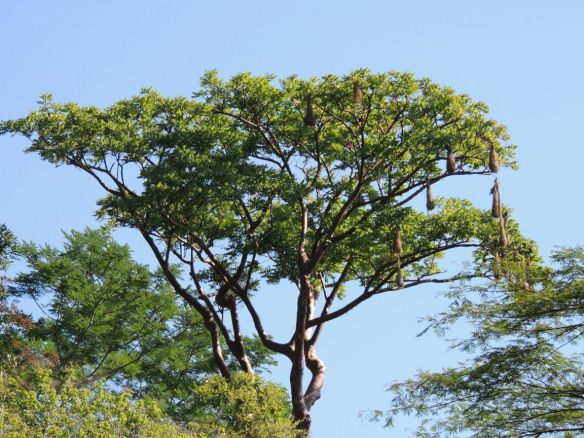
Observing the photo at the bottom of this page, courtesy of young Hellen Hidalgo, we see a sizable tree near Campo Dos y Media in the southern zone of Costa Rica. In this tree we can also see about 14 or 15 spectacular long pendulous nests built and maintained by Crested Oropendolas (shown here, courtesy of Monique Girard):
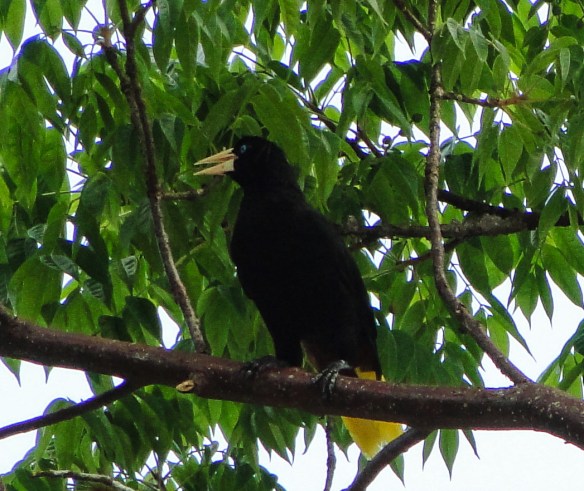
Crested Oropendola. Photo by Monique Girard
As we observe the photo below more closely we notice a few interesting features of these Oropendola nests. Let’s put on our Deductive Reasoning Caps and ask ourselves, ‘Why?’.
Over countless generations, Crested Oropendolas have found this particular lifestyle to be the most successful for them; the best way ensure that their genes are passed on to another generation. All organisms do the same; we call this Population Dynamics or Population Ecology.
FYI: These questions are merely rhetorical and posed just for fun. No homemade cookies for the best answers.
(photo courtesy of young Hellen Hidalgo)
Be the first to correctly identify this Quiz Bird and win one dozen of Helen LeVasseur’s homemade cookies (they cannot be shipped; you must pick them up).
Send your ID to:
eltangaral@gmail.com
Photo taken by young Hellen Hidalgo in Campo Dos y Media in June of 2018. Good luck!
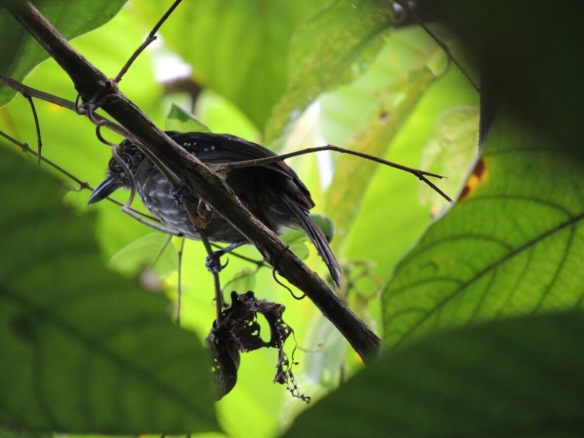
(photo courtesy of Hellen Hidalgo)
 San Vito Bird Club
You must be logged in to post a comment.