Please join the San Vito Bird Club for a low impact (but high diversity) Big Sit birding event on Sunday, Aug. 21st, starting at 7:00am and ending when we reach 50 or so bird species.
This Big Sit is easy to get to:
Park on the Magic Road, near the highway.
The Nacientes Encantada trail, a Cantaros property, is about 50 meters down the Magic Road on the left side.
Walk down the Nacientes Encantada trail about 25 meters to a nice open flat spot on the right.
Sit down in your comfortable folding chair. I will have extra chairs if you don’t have one. Also, binoculars available.
Enjoy the nature and the good fellowship.
This is a BYO-coffee event.
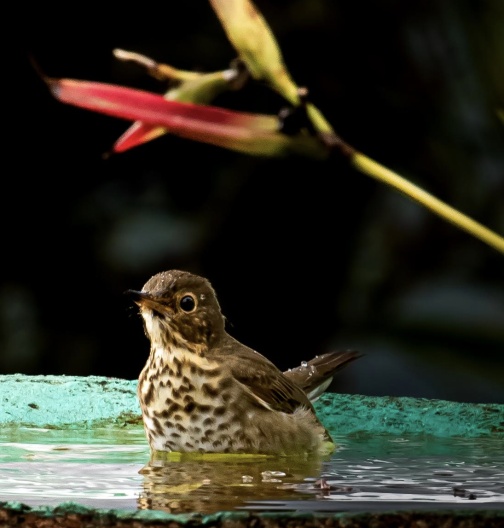
Low Impact birding photo courtesy of Helen LeVasseur
For many of us who are not full-time residents of San Vito, the many bird interactions we enjoy in Costa Rica can feel like a great loss during the months in our non-tropical homes. We settle for less colorful and abundant birds that are usually more prosaic, not as showy, and seldom spectacular. But Tiny Moments do still occur, and if we’re persistent we stay aware and find our lives peppered with avian interactions that can provide joy during our daily mundane existence. Here are a few that I have noted this summer in the hot, dry chaparral of the back country in San Diego county.
An early morning walk, before the temperature rises to drive you indoors, flushes a covey of a dozen California Quail from the sage bushes beside the trail. Their wings thrum as they flee their hiding place and disappear into nearby plants.
A White-breasted Nuthatch, one of the more unique visitors to the sunflower seed feeder, gains access by walking straight down the side of the large camphor tree, flitting across to the feeder where he grabs one seed from the dish, and then rushes back up into the tree to ferociously hammer at the shell until the tender reward is pried out. Repeated endlessly, with time-outs for occasional bug searches in the deep furrows of the tree bark.
The arrival of the migrant Lesser Goldfinch, joining their year-round cousins, brings seating reservations at the Nyjer Cafe to a premium. As the level of seed plummets in the feeder, it is obvious the Maitre d’ has fled, and opening seating, with shoving and pushing encouraged, has ensued. The tube feeders become battlegrounds.
The winner of the oddest behavior has to go to a small flock of European Starlings in non-breeding plumage, trying to find an afternoon meal in the parched grass of my lawn. With the thermometer stuck at 100º all are hot and thirsty, and the starlings are panting with their long pointy beaks wide open. So every dive into the grass looks more like a Nightjar than a songbird. If they are lucky and find a grub, the beak is closed as they bring their head up. The unlucky fellows straighten up with beak still wide open, giving the birds the look of a group of mad seamstresses attacking the grass with open scissors.
Living in the altiplano of Southern Colorado at 8500 feet, there wasn’t much for birds to eat, so I grew some berry and seedy things inside a deer-proof fence, and had a hummingbird feeder in a juniper tree about 5 feet from the front door, visible from the dining room windows.
One day, my black dog Jessie started barking in a very different way, long, deep menacing barks – not just the normal “hey human, somebody’s here” announcement. I went to the door and opened it, and standing 5 feet away, helping himself to the feeder, was an adult brown (sic: black) bear.
Backing away slowly, closing (and locking) the door, I realized I needed to find my bird buds a new solution. We set up a stop point further up the tree with a rope and pulley system. The Ruby Throats and Rufous were happy again.
It was Alfred Lord Tennyson who said “Nature, red in tooth and claw”.
My sister invited me over to her property in Santa Fe County, NM, just a couple of miles from our home, to see and photograph two Northern Harrier chicks that have been enjoying constant parental oversight since the nest was constructed in April. Sue thought they were about to fledge, so on Saturday morning I was there at 8:15 am. Alas, Sue met me with an anguished face. There had been an attack overnight, and it appeared at least one chick was ravaged with its body and one wing hanging over the side of the nest about 20 feet high in a pinyon pine. There was no sign of the other fledgling.
Suddenly a hawk flew to a tree just 15- 20 feet away from us. We thought at first it was the female Northern Harrier. I took the photo you will see below. She looked at us, and then looked at the nest. Clearly, she had not adjusted to the abrupt change in her daily devotion to her chicks. Or so we thought. (The male was nowhere in sight).
However, when I sent the photo to my birding friend, Bob, he said, “Hold on. That is an adult female Northern Goshawk, not a Harrier! The Goshawks had made a nest on Sue’s property last year!! Our current hypothesis is that the Goshawks did not like the Northern Harriers invading their territory, and attacked the fledglings just before they were ready to leave the nest and start learning to hunt. Or, as Bob suggested, it might have been an Great Horned Owl attack. Or Ravens.
So it doesn’t feel like a tiny moment at all, but it is a lesson once again about how few nests, even that of a medium sized hawk, produce healthy fledglings that survive on their own. From Google:
The average overall nesting survival rate of baby birds is only about 56% but this can range between 46% and 73% for most birds. Birds of prey like Red-Tailed Hawks have high nesting survival rates of 88.9% but smaller songbirds like House Sparrows have only 11.6%.My sister was so sad; we hugged, and I went on my way. But it has been hard to shake the wish to know exactly what happened to those birds on the brink of exploring the world.
Northern Goshawk: courtesy of Gail Hewson Hull
FYI: Please keep sending your Tiny Moments. Starting next week, a Tiny Moment will be published each Wednesday and Sunday.
*Author’s note: These ‘Tiny Moments’ are just that; tiny slices of life that may not be exciting…may not be hilarious…may not even be memorable. The ‘Tiny Moment’ below certainly fits that description. But I like really it.*
From SVBC member Greg Mellon.
For some reason a Northern Mockingbird had selected my front porch barbecue for its observation, singing and…alas…excretory perch. I liked the first two activities but I sure didn’t like the last.
I moved a potted Agave cactus plant in front of the barbecue and guess what? It worked out for both of us! The barbecue is mine again.
Please join the San Vito Bird Club for our bird walk on SUNDAY, JULY 31.
Meet at the gate of the beautiful FINCA CANTAROS at 7:30am. We will explore the trails, view the lake and who knows…find a northern migrant bird? It is very early for migrants to appear down here in the southern zone but there are always a few bold and intrepid birds who leave the north early as they just can’t wait to get back; and who could blame them.
Binoculars available as needed. Hope to see you there.
From SVBC charter member and Master Birdbander Judy Richardson
While weeding around a Boxwood bush something popped out the back door, if Boxwood bushes had back doors! She didn’t fly but headed straight to the ground to cover. Being the nature nerd that I am, I started to check out the Boxwood; only 3 feet high, but very dense with tiny branches and leaves. Right at the top and well disguised I saw some long bits of brown grasses. An even closer look revealed a darling nest with 3 mottled eggs in it. A few days later I returned to find two more eggs! Again, the bird abandoned ship through the back door, straight to cover. Both parents sang out with gusto but never seemed overly frightened of me..
Three weeks passed. Once again I checked and found two tiny babies with 3 more unhatched eggs. Such an exciting find…such fun to watch!
The new parents? A pair for Song Sparrows, the second to choose my low Boxwoods. Both had 5 eggs. The first left the nest two weeks ago!
Amazing isn’t it? Last week’s ‘Tiny Moment’ included a reference to a Cary Grant/Alfred Hitchcock movie. This week’s ‘Tiny Moment’ does the same. What are the odds?
Actually, the odds are quite good. Last week my friend Marisol Glassport submitted a ‘Tiny Moment’ that cleverly referenced the crop dusting scene from the movie ‘North By Northwest’.
This week I am submitting a new ‘Tiny Moment’ that, after a bit of revery brought to mind the Cary Grant/Alfred Hitchcock collaboration, ‘To Catch a Thief’, wherein Grant’s character makes his living as a charming cat burglar, stealing jewels in most clever and clandestine way.
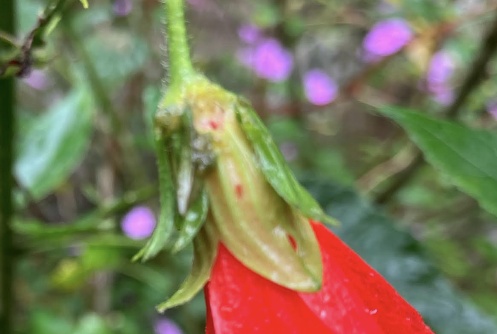
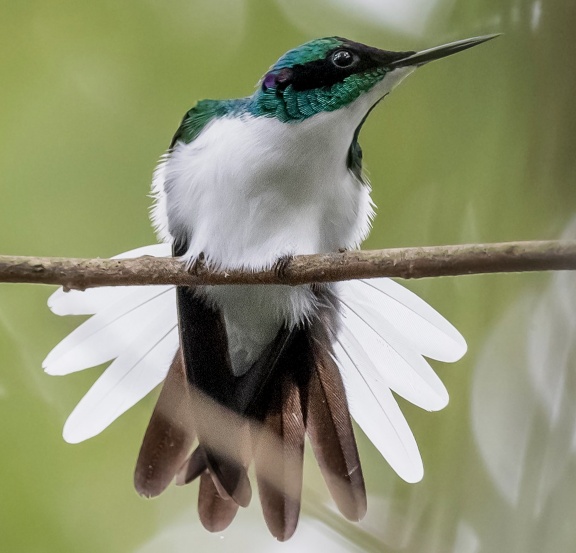
Yesterday, my wife Helen and I observed the fantastic and unique Purple-crowned Fairy hummingbird as it buzzed about some Hibiscus flowers (see below) just outside my front door. We noticed that the hummer approached each flower, not using the typical ‘front door’ method but instead seemed to focus on the back end of the flower; the ‘back door’ method if you will.
This is a technique well known to science as ‘Nectar Thievery’ and is not uncommon. Some birds, bees, moths or other insects obtain a nectar meal by poking a hole in base of the flower; bypassing the front of the flower and going straight to the source. Alas, for the flower, this method allows for no pollination of the reproductive organs…which is a really big deal if you’re a flower. (Remember hearing about the birds and bees?)
Anyway, I never knew the Purple-crowned Fairy did this. In nature sometimes it takes a thief.
Three holes in the sepal of this Hibiscus flower; an entryway for a nectar thief.Purple-crowned Fairy: photo courtesy of eBird.
From SVBC member Marisol Glassport from Winters, California.
This Tiny Moment was ‘tiny’ only in a temporal sense…the moment lasted less than a minute. But in scope the moment was VAST!
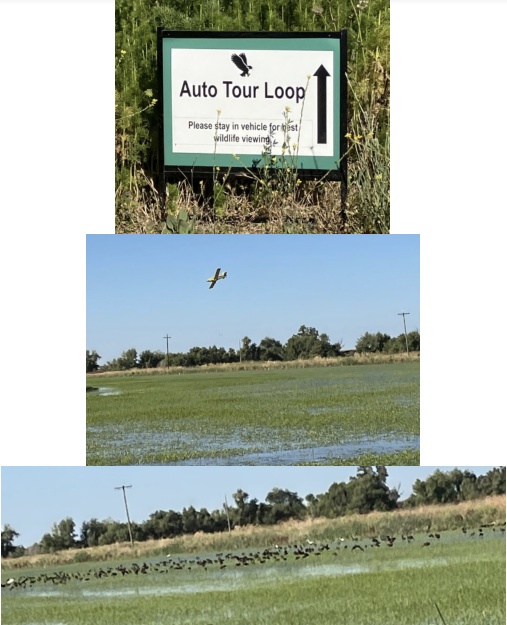
I was birding in rice fields near Davis, California. As I drove the Auto Tour Loop, suddenly over 200 White-Faced Ibises lifted off from the fields. ‘Odd,’ I thought. Then I saw what caused the lift-off…one of those very cool little single-seater airplanes buzzed by, maybe 50 feet overhead. The plane wasn’t crop-dusting; it was dropping rice for the next crop.
To quote a line from the great film ‘North By Northwest’…‘Some of them crop-duster fellers git rich, if’n they live long enough.’
FYI: The central valley of California grows about 85% of the world’s sushi rice!
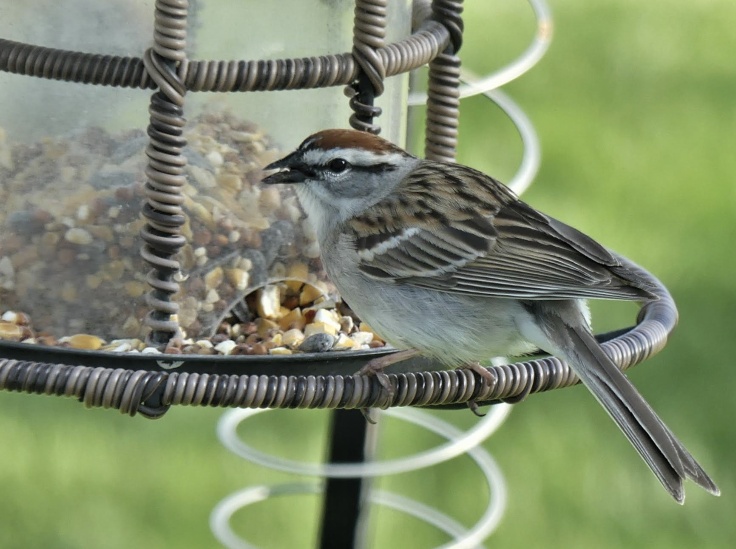
It was rainy this morning, so I sat inside watching the birds through the window. The seed feeder is in perfect view from my usual seat in the family room. Northern Cardinals, House Finches, House Sparrows, greedy European Starlings and even greedier Common Grackles were making short work of finishing off the seeds. A tiny Chipping Sparrow was also trying very hard to find a spot to grab a morsel or two. Just then I saw the squirrel guard (a slinky is highly efficient for the purpose) bouncing up and down, and the Chipping Sparrow stuck its head between the feeder and the circular perch that surrounds it, perhaps to relish the fact that the squirrel in question was having even less luck getting to a meal. I chuckled momentarily, and then gasped as I realized that the bird wasn’t moving any more. Its head was down and its tiny tail was upright and quivering. I quickly ran outside, and slowly approached the feeder to see for myself. Sure enough, the poor little thing was well and truly stuck! I carefully put two finders under that tiny little bird belly and gently pushed upward until the wings cleared their constraints. In a split second, all was well.
I never considered that bird feeders could be dangerous. To make sure that can’t happen again, I will shop for a seed feeder that either has far less room between the container and the perch or dowel perches. I hope you all will do the same.




 San Vito Bird Club
You must be logged in to post a comment.