ESPANOL SIGUE
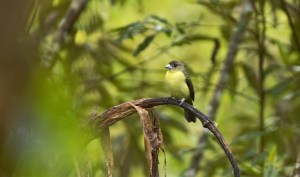
Female Flame-rumped Tanager, a new record for Costa Rica. Photo by Pepe Castiblanco
On a sunny morning in early November, Pepe Castiblanco and I went to look for a bird that had never been recorded in Costa Rica until it was discovered in October. Most followers of this website know Pepe but, in case you do not, he is a birder, natural history guide, musician, raconteur, photographer, baker, restaurateur and co-owner – with his wife Kata Ulenaers — of a nearby B&B.
Pepe’s friend, Juan Abel, who is dashing and works at the Organization for Tropical Studies as a forest guard, found this bird – a Flame-rumped Tanager – on his finca, consorting with a group of Cherrie’s Tanagers. He called some friends, extraordinary birders, to come take a look and so it went. Because this is private property, the search becomes a question of permission. We were grateful to have a chance to go look and got lucky with the bird.
Juan and his wife Ruth have a large, enthusiastic dog that lunged through the door as we pulled into the driveway. Before we were able to get out of the car, the dog clipped one of Juan’s sons’ legs, sending coffee dribbling all over its back, and climbed into the car onto my lap. It was an auspicious start.
We walked around the house, through a guava orchard. The trees look odd because each round, fat fruit is sequestered in a bag to stymie insects and birds. The Abels have chicken coops and banana feeders and a ring of old trees around their farm. We saw four Rose-breasted Grosbeaks taking the sun in a pine tree and heard woodpeckers and Slaty Spinetails churring from the woods.
After a bit, Hafjeth Abel, 19, joined our search party while he fed the chickens, steering us away from making hopeful glances at their banana feeder. The group of tanagers we were after apparently does not frequent the feeder but hangs around the other side of the property near the forest edge. Over we went and suddenly they arrived, sputtering and squeaking, with the Flame-rumped female in plain view, perched for Pepe’s camera. Two Yellow-billed Caciques came out of the forest — an uncommon sighting as they are more often heard than seen.
The new tanager comes with some confusing taxonomy. It has three common names: Flame-rumped, Lemon-rumped and Yellow-rumped. And two scientific names: Ramphocelus flammigerus and R. icteronotus plus a subspecies indicator like this: Ramphocelus flammigerus icternotus. You can consult the authority of your choice, but the Asociación Ornitológica de Costa Rica follows the American Ornithologists Union checklist so this one is being presented to the Rare Records Committee as Flame-rumped Tanager, Ramphocelus flammigerus.
Maybe another one will join it or show up elsewhere. We will try to keep ourselves updated and report back from time to time.
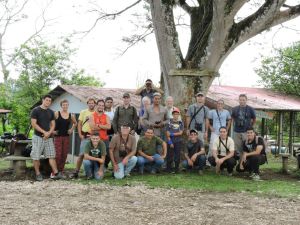
Juan Abel, standing back row center, found a new bird for Costa Rica in October 2017. Also pictured Pepe Castiblanco, standing right. Photographer unknown.
ESPANOL AQUI
Una mañana soleada de noviembre, Pepe Castiblanco y yo salimos a buscar un ave que nunca había sido registrada en Costa Rica, hasta que fue descubierta en octubre. La mayoría de quienes siguen este sitio web conocen a Pepe, pero en caso de que usted no lo conozcan, él es un pajarero, guía de historia natural, músico, anecdotista, fotógrafo, panadero, restaurador y co-propietario – con su esposa, Kata Ulenaers, — de un B&B de la localidad.
El amigo de Pepe, Juan Abel, quien es gallardo y trabaja para la Organización para Estudios Tropicales como guarda, encontró esta ave, Flame-rumped Tanager, en su finca, compartiendo con un grupo local de sargentos. Juan llamó a unos amigos, pajareros extraordinarios, para que vinieran a ver. Dado que esta es una propiedad privada, la búsqueda se convierte en una cuestión de permiso. Tuvimos la suerte de tener la oportunidad de ir a observar y encontrar el ave.
Juan y su esposa, Ruth, tienen un perro grande y entusiasta que se lanzó a través de la puerta mientras nos parquéabamos. Antes de que pudiéramos salir del carro, el perro atrapó una de las piernas de un hijo de Juan, echándose el café sobre el lomo, y se encaramó en el carro hasta llegar a mi regazo. Un prometedor comienzo.
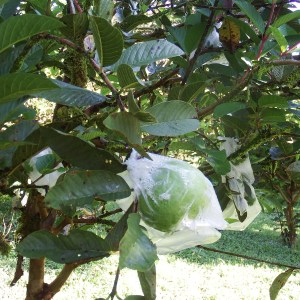
A guava, bagged to exclude insects and birds. Photo by Alison Olivieri
Caminamos por la casa, hasta llegar a una plantación de guava. Los árboles se ven extraños porque secuestran su fruto en una vaina, para protegerlos de aves e insectos. Los Abels tienen gallineros y alimentadores de aves, y un anillo de árboles viejos alrededor de su granja. Vimos varios Picogrueso Pechirrosado (Calandrias) tomando el sol en un pino y escuchamos carpinteros y Arquitectos Plomizos en el bosque.
Después de un rato, Hafjeth Abel, de 19 años, se unió a nuestra búsqueda mientras alimentaba las gallinas, alejándonos de echar miradas esperanzadas al alimentador. Aparentemente, el grupo de tangaras que estábamos buscando no frecuenta el alimentador, sino el otro lado de la propiedad, cerca del lindero del bosque. Fuimos ahí y llegaron, chillando y revoloteando, con la hembra Flame-rumped a plena vista, en una posición privilegiada para la cámara de Pepe. Dos Caciques Picoplata salieron del bosque, una observación entraña, ya que frecuentemente se los escucha más de lo que se los ve.
La nueva tangara viene con una taxonomía confusa. Tiene tres nombres comunes: Flame-rumped, Lemon-rumped y Yellow-rumped; dos nombres científicos: Ramphocelus flammigerus y R. icteronotus; y un indicador de subespecie: Ramphocelus flammigerus icteronotus. Usted puede consultar con la autoridad de su escogencia, pero la Asociación Ornitológica de Costa Rica sigue el listado de la American Ornithologists Union, así que esta especie está presente en el Comité de Registros Raros como Flame-rumped Tanager, Ramphocelus flammigerus.
Quizá otra se le unirá o aparecerá en otro lugar. Trataremos de mantenernos al tanto y reportarle de cuando en cuando.



You must be logged in to post a comment.