SVBC Member Questions: #1/Preguntas a los miembros del SVBC: #1

Do you have a birding or nature question?  Send it on and we’ll try to get it answered (see below for where to send your questions).

Our first question comes from SVBC member Barbara Keeler-Barton:

Question:  I notice Kiskadee flycatchers swallowing entire palm fruits, each of which has an enormous round seed (or nut) with a very thin fleshy coating.  My question is, do they let the seed pass through their digestive system or do they regurgitate the seed after the fleshy skin has been removed?  I noticed that they only gulp a maximum of three nuts at one sitting.

Answer: Large seeds, like those found in the oil-rich palm fruits, are most likely regurgitated and do not pass completely through the digestive system.  Most birds have a crop; which is an enlarged ‘storage area’ between the esophagus and the stomach.  The palm seeds most likely pass into the crop where the digestive process begins on the edible bits.  The edible material then passes into the stomach and intestines and becomes energy for the bird.  Since the seeds are so large (compared to the size of the bird) they are then regurgitated from the crop.  Many fruits with smaller seeds, like figs, do pass completely through the bird’s digestive system.

Did you know?  Some fruits have seeds that are adapted to only sprout after they have passed through the gut of an animal.  Passing through the digestive tract softens and thins the wall of the seed.  This process is called scarification.  The large ear-shaped seeds of the Guanacaste tree will only germinate after they have passed through the gut of a large mammal.  Can you think of any mammals large enough to swallow and pass a Guanacaste tree seed?  Hint: They are not native wild animals.

Please send your birding or nature questions to:

Greg Homer

eltangaral@gmail.com

or:

Alison Olivieri

Sanvitobirdclub@gmail.com

Thanks!

 ¿Tiene usted una pregunta sobre pájaros o naturaleza? Envíenosla e intentaremos responderla (vea abajo a dónde puede enviar sus preguntas).

Nuestra primera pregunta es de la miembro del SVBC Barbara Keeler-Barton:

Pregunta: He visto bienteveos grandes tragando frutos enteros de palma, cada uno de los cuales posee una enorme semilla redonda (o nuez) con una muy delgada piel carnosa. Mi pregunta es, ¿dejan ellos pasar la semilla a través de su sistema digestivo o regurgitan la semilla después de remover la piel carnosa? Noté que ellos tragan un máximo de tres frutos en cada ocasión.

Respuesta: Las semillas grandes, como aquellas que se encuentran en los frutos ricos en aceite de las palmas, son muy probablemente regurgitados y no atraviesan completamente el sistema digestivo. La mayoría de las aves tienen un buche; que es un “área de almacenamiento” alargada entre el esófago y el estómago. Las semillas de palma muy probablemente ingresan al buche cuando el proceso digestivo comienza para las partes comestibles. El material comestible pasa luego al estómago y a los intestinos y se convierte en energía para el ave. Dado que las semillas son tan grandes (en comparación con el tamaño del ave), éstas son luego regurgitadas desde el buche. Muchos frutos con semillas más pequeñas, como los higos, atraviesan completamente el sistema digestivo del ave.

¿Sabía usted que? Algunas frutas tienen semillas que están adaptadas a germinar solamente después de haber pasado a través del sistema digestivo de un animal. Atravesar el sistema digestivo suaviza y adelgaza las paredes de la semilla. Este proceso es conocido como escarificación. Las grandes semillas del árbol de Guanacaste, con forma de oreja, solamente germinarán después de haber atravesado el sistema digestivo de un mamífero grande. ¿Puede usted pensar en algún animal suficientemente grande para tragar y dejar pasar una semilla de árbol de Guanacaste? Pista: No son animales salvajes nativos.

Por favor envíe sus preguntas sobre aves o naturaleza a:

Greg Homer

eltangaral@gmail.com

o

Alison Olivieri

Sanvitobirdclub@gmail.com

¡Gracias!

kiskadee

Get to Know Your Coto Brus Birds #1: The Rufous-tailed Jacamar//Conozca a sus aves de Coto Brus #1: El jacamar rabirrufo (gorrión de montaña)

Imagine this:

An Amazon Kingfisher gets married to a Rufous-tailed Hummingbird and they have kids.

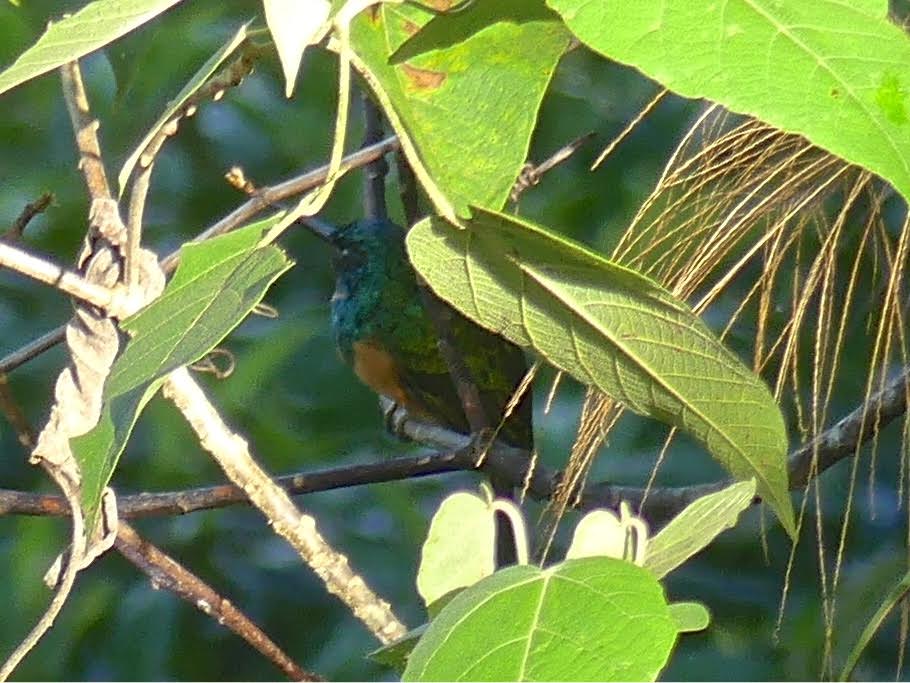
The Rufous-tailed Jacamar (Galbula ruficauda) might be what the offspring would look like.

This beautiful bird eats nothing but flying insects, acrobatically grabbing them out of the air. A fairly common site is a Rufous-tailed Jacamar sitting on an exposed branch with a large moth, dragonfly or butterfly in its long, sharp beak…whacking the insect on a branch, not only to stun the creature but also to remove the wings and other inedible bits.

Researchers have discovered that young jacamars quickly learn the difference between those butterfly species that taste good and those that don’t taste good. That makes the Rufous-tailed Jacamar a pretty smart bird!

The Jacamar nests in an earth burrow about 30-40 cm deep. If you are lucky enough to find an active Rufous-tailed Jacamar burrow nest, please us know! But, as always, be careful not to disturb the birds.

Here is a photo from Jo Davidson (SVBC member) of the Rufous-tailed Jacamar. **************************************************************************************************************Imagine esto:

Un martín pescador amazónico se casa con una amazilia rabirrufa y tienen hijos.

La descendencia se vería como el jacamar rabirrufo (Galbula ruficauda).

Esta bella ave se alimenta solamente de insectos voladores, atrapándolos acrobáticamente en el aire. Una situación bastante común de observar es el jacamar rabirrufo posado en una rama expuesta con una polilla grande, una libélula o una mariposa en su largo y puntiagudo pico… golpeando al insecto contra una rama, no solamente para aturdir a la criatura sino también para remover sus alas y otras porciones no comestibles.

Los investigadores han descubierto que los jacamares jóvenes aprenden rápidamente a diferenciar entre aquellas especies de mariposa que saben bien y aquellas que no. ¡Eso hace al jacamar rabirrufo un pájaro bastante inteligente!

El jacamar anida en una madriguera terrestre de unos 30-40 cm de profundidad. Si usted es suficientemente afortunado para encontrar un nido de jacamar rabirrufo, ¡por favor déjenos saber! Pero, como siempre, sea cuidadoso para no molestar a las aves.

Esta es una foto de Jo Davidson (miembro del SVBC) del jacamar rabirrufo.

Rufous-tailed Jacamar 11/2015 Photo by Jo Davidson

Rufous-tailed Jacamar
11/2015
Photo by Jo Davidson

First Publication from the Avian Monitoring Project

Sigue en espanol

As the holiday lull draws to a close, we are pleased to ramp up to 2013 by posting the first publication resulting from our Avian Monitoring Project.

After seven years of work, we have had some interesting captures and re-captures but none as exciting as finding a Black-cheeked Ant-tanager in San Vito.

Please read our short paper, published in the Boletin Zeledonia 16:2 under “Comunicaciones” (http://avesdecostarica.org/page27.html). The Zeledonia is the ornithological journal published twice a year by the Asociacion Ornitologica de Costa Rica. You can find both English and Spanish versions, by clicking here.

En vista que los días festivos están llegando a su fin, estamos complacidos en comenzar el 2013 con nuevos bríos mostrándoles nuestra primera publicación del proyecto de anillado de aves del club de aves de San Vito.

Después de 7 años de trabajo, tenemos algunas capturas y recapturas  muy interesantes, pero ninguna tan única como el encontrarnos a un Black-cheeked Ant-tanager en San Vito.

Por favor lea nuestra pequeña publicación en el Boletin Zeledonia 16:2 bajo “Comunicaciones” (http://avesdecostarica.org/page27.html). Zeledonia es una revista de ornitología publicada dos veces al año por la Asociacion Ornitologica de Costa Rica. Ud podrá encontrar ambas versiones en ingles y español: haga click aqui.

Let the Breeding Bird Surveys Begin!

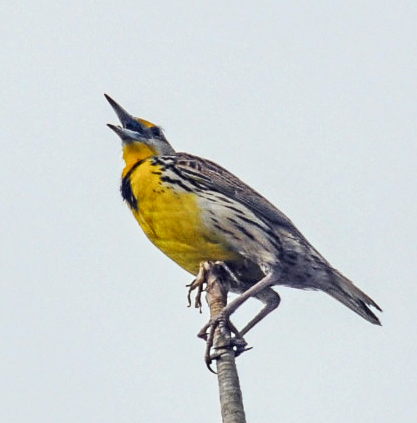
Eastern Meadowlark (Photo by Julie Girard)

In the mid-1960s, the US Geological Survey initiated a long-term, large-scale international avian monitoring program with the Canadian Wildlife Service called the North American Breeding Bird Survey (BBS). It was undertaken in response to the noted decline of songbird populations accompanying the widespread use of DDT for mosquito control at that time. (To learn more about this effort in North America, please click here.) Continuing to this day, the BBS is run out of the Patuxent Wildlife Research Center in Maryland, home to the Bird Banding Laboratory where records of all birds banded in the US are stored. Although rampant use of DDT has declined as a cause of songbird mortality, bird populations continued to be subjected to numerous omnipresent threats including habitat loss, habitat fragmentation, land-use changes, chemical contaminants and other problems. These issues occur worldwide and need to be closely monitored so that local populations are not lost and species do not become extinct simply because no one is paying attention.

In addition to North America, many other countries around the world use bird monitoring surveys to estimate populations, understand species’ distributions and discern decline. Although many professional ornithologists and biologists take part in these surveys, the vast majority of participants are local birders practicing citizen science.

Laughing Falcon (Photo by Alison Olivieri)

This year, Gerardo Obando of the Asociacion de Ornitologica de Costa Rica (AOCR) has taken the initiative and begun a national program of Breeding Bird Surveys! These surveys can be either a single place survey, like a garden, or a route with at least 10 stops, 200 m apart, for five-minute bird counts. The surveys must be completed between May 15 and June 30, the height of many of our resident birds’ breeding season.

Your bird club completed three surveys in mid-June consisting of one privately-owned garden, a route through Finca Cantaros (one of our Avian Monitoring Project field stations) and a route through the Wilson Botanical Garden. Very special thanks go out to Mauricio Sarmiento of the OTS Las Cruces Biological Station for helping record the GPS coordinates of each point along both of the routes. Next year we need to add more routes and we will need more volunteers to accomplish this! “Ace Birders” of the SVBC: please come join us in 2013 — we need your help!

You can read about this new effort — and practice your Spanish if you are not a native speaker — by clicking here.  We are proud to be a new Institutional Member of the AOCR, about which you can read more by clicking here.