Tiny Moments: Dudes in Durica

Birding is sometimes a team sport. And remember…there is no ‘I’ in ‘team’. (Of course there is an ‘I’ in the Spanish word for team…’equipo’.)

Today, four of us went birding up in Durica; a grassland ecosystem near Buenos Aires. One of our target birds was the illusive Oscillated Crake. As you can see, below, our team effort to create this tiny moment proved successful!

Our team assignments:

Jim Zook-Elite and long time Costa Rica ornithologist: Organize the trip. Identify the specific habitat and direct us to it.

Jeissom Figueroa-Naturalist Guide for Las Cruces/Wilson Botanical Garden. Dallas Levey-PhD candidate from Stanford. Hike up onto the grassy ridge…hunker down in the grass for a real long time while calling the Crake. Stay there (hunkered down) until it showed itself; something Crakes and Rails are ill-disposed to do. Take a perfect photo of it.

Greg Homer (me)-Drive the car.

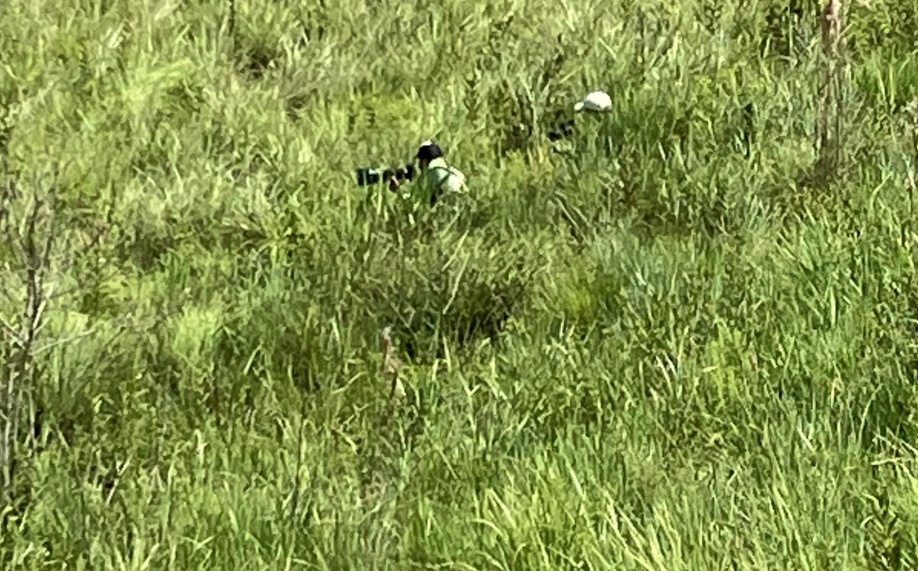
Jeissom and Dallas, hunkered down in the bunch grass. Photo by Greg Homer.

The illusive Oscillated Crake; photo by Dallas Levey.

Bird Walk Sunday: Wilson Garden

Please join the San Vito Bird Club for our Sunday morning bird walk at Wilson Botanical Garden (OTS Las Cruces). This walk will be led by the charming, whimsical and insightful Greg Homer.

Meet at the Wilson Recepcion office at 7:00am on Sunday July 16th. Coffee at the comedor to follow.

Hey, let’s ID some butterflies while we’re at it. This is a big time of year for butterflies. I’ll bring a couple of butterfly guide books.

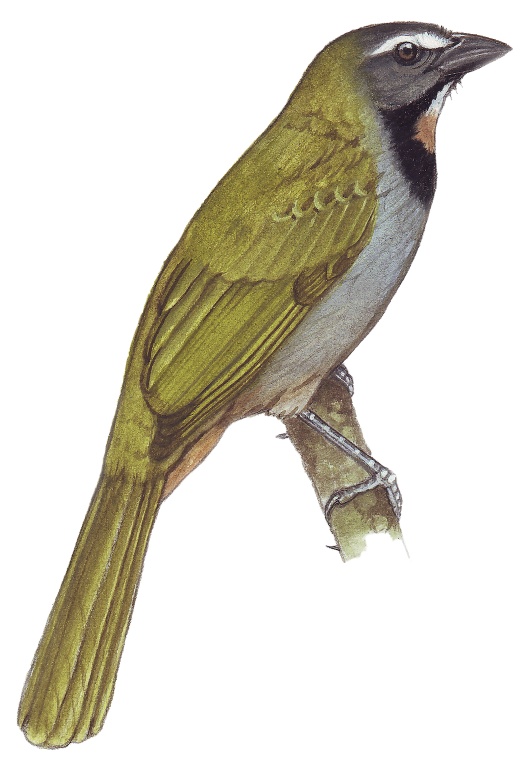
Drawing of a bird, by Greg Homer.

A Coto Brus Farewell

The San Vito Bird Club wishes to bid a fond ‘adieu’ to our longtime member and friend, Tom Wilkinson; who died recently while in his beloved home state of Michigan. Tom was surrounded by four generations of his family and his lovely wife Portia.

Tom…my boy, you will be missed. You never failed to bring something new to the conversational table.

Tom Wilkinson

Tiny Moments: ‘The Secret is Out’

From SVBC member Judy Richardson.

It’s 6:30 pm;  the door bell rings and two neighborhood girls, age 6 and 7, are standing on my porch.

Their usual request is; ‘Can we pet Maggie?’, my pug dog. But today they hold out half a pale blue egg shell and ask ‘What kind of bird laid that?’ I wax poetic about how the mother bird doesn’t want anyone knowing where her nest is, so she carries the egg shells away. That’s why you found it on your lawn, I tell them.

I then tell them that I have a book where they might find out what type it is. I pull out my Nests, Eggs, and Nestlings book (do you have it??) It shows all the eggs life size and in color…as well as nests and babies. All three of us sat on the couch while they paged through the plates. There was much chatter about whose egg it was.

‘That one?’ ‘No, too white, big and spotty.’

And then, to the delight of my little scientists, it seemed to fit the Veery egg! There was another conversation about it’s being the right choice and off they ran to tell their mothers the good news!!

I have become not only the crazy granny that wears a Halloween costume with my pug dog, but also keeper of all the secrets about the birds in the neighborhood! The secret is indeed out!

Photo courtesy of eBird.

Tiny Moments: ‘Nature is red in tooth and claw’.

From SVBC charter member Lydia Vogt.

There are many reasons we are warned to be prudent with bird feeders. Are we interrupting migration? Could the food become rotten or contaminated? Are there laws against feeding wild animals? The danger of cats becoming aware of a steady food source is one of the most common for those of us residing in suburban areas.

I have been happy that none of my neighbors seem to have any outdoor cats, and so my seed feeders under a huge old camphor tree which is in front of my studio window have drawn an interesting assortment of both common and occasionally more exotic species for almost five years now, with impunity, or so I thought.

Today I had a Wild Kingdom moment.  It began with a cat- new to the neighborhood- who managed to grab one of the abundant House finches that typically eat the majority of any seeds put out. Luckily the finch managed to get away, but two alert Scrub jays nearby saw the action and soon had the poor finch in their beaks.  I ran out and rescued him, but they were sharp-eyed and managed to grab the finch again from the low branch I had hidden him on. I thought that was the end of him, and headed back indoors.  But they dropped their prize into the grass.  The cat came back, but a sharp knock on the window was enough to scare away.  Just then a crow took over the hunt.  He flew in, cautiously scouted out the views from various nearby branches, and finally made a quick pounce and flew off, the winner of the lengthy battle.  

I only hope the finch was, by that time, dispatched and no longer feeling anything. I’m reconsidering my feeder options.

Tiny Moments: Rabbit Season

(from SVBC member Judy Richardson)

Does Flopsy, Mopsy, Cottontail and Peter ring any bells?

I’m back in CT, and raring to go! One look at the weeds,  already six inches tall,  reminds me that I returned two weeks later this year. I’m already that much behind with my Lettuce seeds and the other cold hearty veggies. I arrived to summer- like temps in the 80s and couldn’t wait to get things started.

While enjoying the Daffodils and Tulips in bloom, I turned over the beds and planted my seeds. it’s been dry and rain was expected.  Exhausted but happy I got the job done, I went down to the end of the raised bed where the Thyme and Marjoram were. I wanted to trim them back.

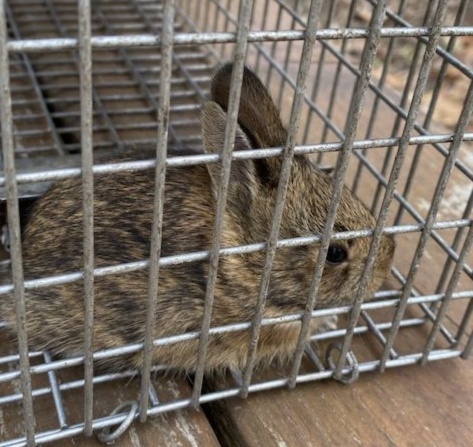
To my surprise, I lifted the dead bits and found a nest with the four baby rabbits ! I caught two and one raced out and hid in the garden. The fourth, must have been Peter, stayed put.
I found my have- a -heart trap and put them in jail! It sounds heartless, but each spring we have bunnies about,  and these were big enough for their next adventure. I returned to collect the one who ran to the flower garden and added him to the trap. Back at the den, Peter had made a run for it and I couldn’t find him anywhere.

I jumped in the car with a brown paper bag covering the trap,  a bowl for water, a piece of lettuce, and the nesting material from their den. Off we drove to CT Audubon Birdcraft Museum where I band birds. There is splendid rabbit habitat  in a protected tract of land that is  too small for Fox or Coyotes and is fenced for deer. I found a nice tangle, set up their new residence in the paper bag with the nest,  and bade them farewell. I checked this morning and they are all gone , pruning the tangle and tasting spring grass, I assume. The Easter bunnies who stayed!

(photo courtesy of Judy Richardson)

(courtesy of Warner Brothers)

Tiny Moments: Tody Activity

(from SVBC member Judy Richardson)

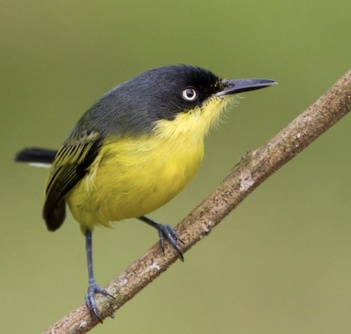
I’ve been waiting anxiously for Mrs.Common Tody Flycatcher to take up residence in the nest that took ages to build. Last week, all went quiet,  no action for several days. I was sad, and kept looking as they are such adorable birds, so busy and friendly.

I was rewarded as I saw them back, but working on a new nest just 6 feet away. This time the nest is hanging in plain view from the arbor at the pool!

I figure it must be the same pair, birds being territorial when it comes to breeding. Could it be that Mrs. didn’t like the first nest? I know Wrens make several from which the female chooses. Is it another pair and the first abandoned the site?
For sure a mystery that could only be solved if the bird was banded. This Bird Bander is frustrated!

I will have to be happy watching the action from here on!

Common Tody Flycatcher: (eBird)

Tiny Moments: Flies and Fruits

You may have seen me, Greg Homer, along with a whole bunch of other folks sitting and standing along the highway lately…between the Pina Colina gate and the Las Cruces bus stop.

Why?

There is a very special tree leaning out over the highway and it is just full of fruit; aguacatillos, to be exact. These fruits (little avocados) are very desirable to many different kinds of birds. The larger variety of aguacatillo fruit found up in the cloud forests is often a good place to fine the Resplendent Quetzal.

The aguacatillo tree in question is just FULL of small (about the size of a green Skittle) fruits. And so…many of us have been camped out in front of this tree to view the feeding frenzy. A wonderfully diverse birding experience.

By far, the most common bird family feeding on these aguacatillo fruits are the Flycatchers (pecho amarillos). Flycatchers are challenging to identify; due to the great number of species and the similarity of their markings.

Bird watching at this aguacatillo tree has been a wonderful classroom; an invaluable opportunity to differentiate many of the flycatcher species. Subtle differences between:

*Streaked Flycatcher and Supher-bellied Flycatcher

*Social Flycatcher and Gray-capped Flycatcher

*Great Kiskadee and Boat-billed Flycatcher

*Piratic Flycatcher and Streaked or Sulpher-bellied Flycatcher

Somewhat of a paradox, eh? Flycatchers gorging of little avocados.

A good lesson for all us perhaps. Eat a varied and well-balanced diet.

Aquacatillo tree in fruit. Photo courtesy of Greg Homer.

Be careful flying home and be sure to come back.

Every September we look forward to the many species of migratory birds as they begin to arrive in San Vito. Their arrival helps us mark the passage of time. (In years past, the Sports Illustrated Swim Suit edition was another such marker of time’s passage.)

Now, it is April and so we must say ‘adios’, ‘goodbye’, ‘adieu’, ‘arrivederci’, ‘sayonara’, and ‘aloha’ to our avian chums as they head north (and some of them south) to raise their families; a long and perilous journey.

Be assured, we will keep the metaphorical ‘Welcome’ sign in the metaphorical window as we look forward to their return next September.

Tempus fugit (time flies).

Cedar Waxwings, northern migrant birds. Photo courtesy of Helen LeVasseur.

Tiny Moments: ‘That’s no hummingbird!’

(from SVBC members David and Audrey Fielding)

Five of us were birding together along the dirt roads of a tiny Mexican village near
the town of San Blas—three to four blocks of makeshift houses, dusty yards,
scruffy trees, blossoming grasses and bushes with the promise of maybe a painted
bunting. Suddenly, one of the group let out a cry, “HUMMER!” We all converged
to peek around a bush in the backyard of one of the houses in search of the flutter
of a close-by hummer. Jane was the one who called it out. And for the rest of her
life, Jane has never lived down the ignominy and spirited laughter of the rest of us
when we rounded the bush and there found a contented pig, nuzzling a pile of
garbage while gently snorting, sounding not unlike the familiar wingbeat of a
hummingbird.

Photo courtesy of David and Audrey Fielding.