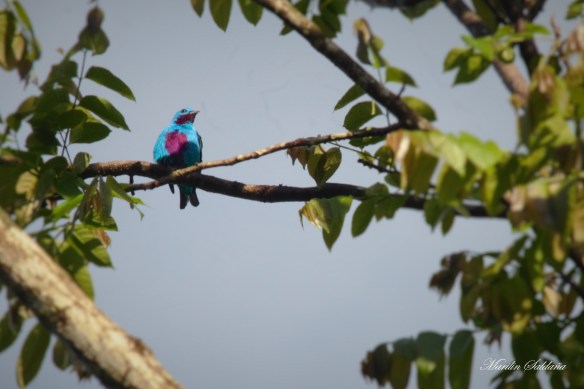
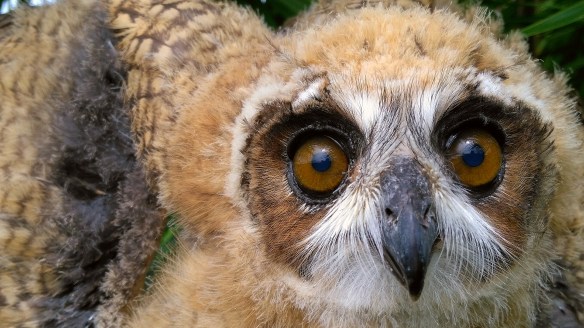
POW for June 19: Parakeet and Woodpecker!

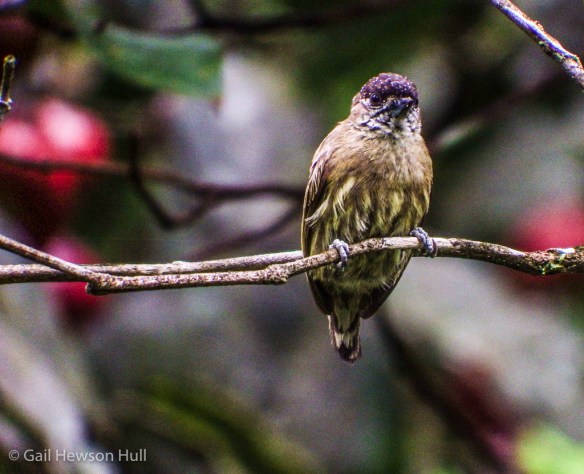
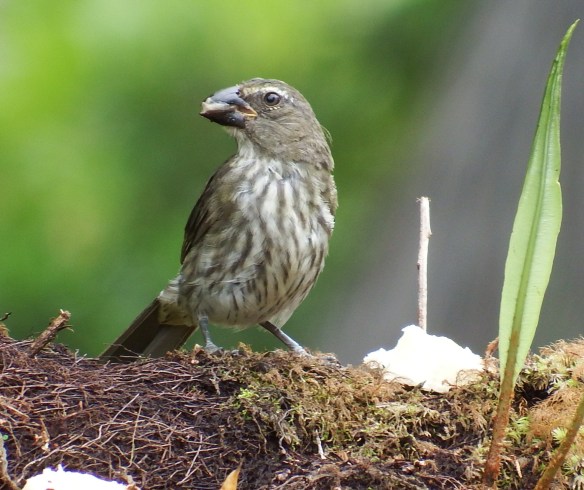
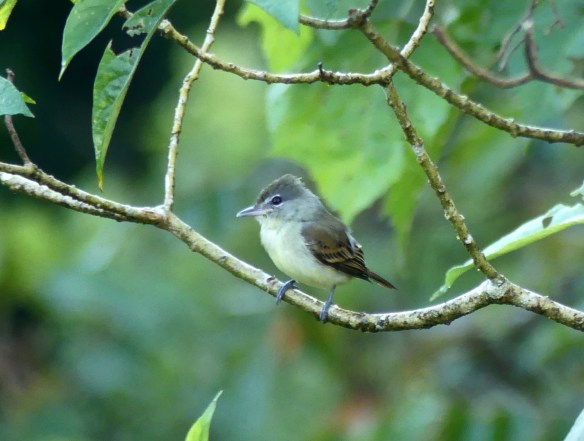
Normally, our two Photos of the Week (POW) are somehow connected.  (See last week…both birds have streaked breasts.)  This week I’m challenged to find a clever connection between these two birds; Olivaceous Piculet and Sulpher-winged Parakeet.  Sure, they both have feathers, a cloaca and lay eggs but I’m looking for a CLEVER connection!  Your help appreciated.

Photo #1: Olivaceous Piculet.  Courtesy of Gail Hewson-Hull

Olivaceious Piculet ghh

Photo #2: Sulpher-winged Parakeet.   Courtesy of Alison Wickwire Olivieri (taken at Las Tablas)

Sulphur-winged Parakeet LA Feb 8 2018

The Streakers! POW for June 2018

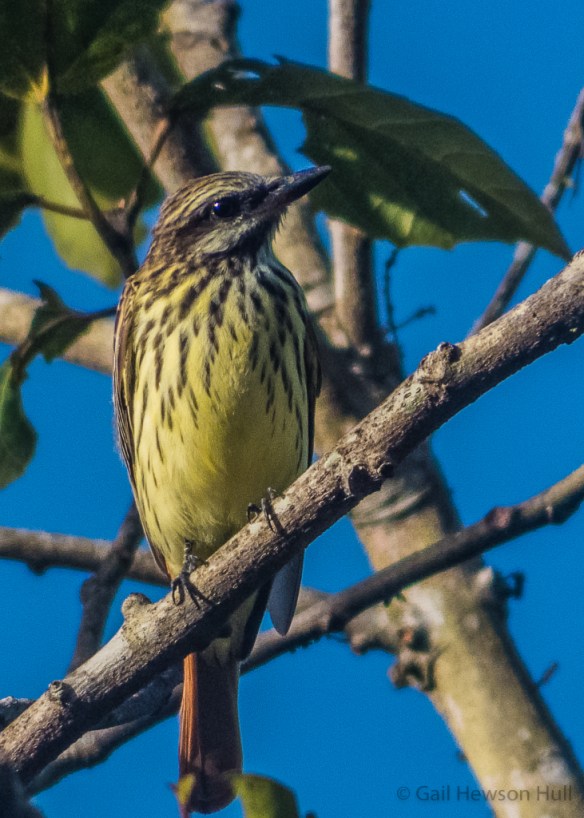
Our first streaky Photo of the Week comes from Finca Cantaros duena Gail Hewson-Hull.  This streaky-breasted bird is a Sulpher-bellied Flycatcher.  One of our larger tyrant flycatchers, the Sulpher-bellied is more often seen feeding on fruits than catching flies.

Sulpher B FC gail

Our second streaker comes from SVBC President Emeritus Alison Wickwire-Olivieri.  Many birders who come down to the southern zone have this bird, the Streaked Saltator, on their must-see list.  FYI: that bill is heavy and powerful!  Distinctive and musical song.

Streaked S alison

Kids Learning to Use Binoculars!

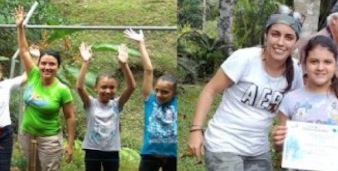
Few things inspire greater optimism for a healthy future than observing excited school kids learn how to use binoculars (see below).

The San Vito Bird Club along with our Detectives de Aves (Bird Sleuth) crew of educators are asking for your financial support.

As our education programs expand across the southern zone of Costa Rica we need more binoculars for the kids to use during their Detectives de Aves lessons; two lessons in particular.  One lesson is dedicated to proper use of binoculars in the field and the last (and most popular) lesson with binoculars is a half-day field trip into a rain forest full of birds!

Click the link below if you’re able to send us a donation.

sanvitobirdclub.org/membership/support-the-club/

Or contact us via email if PayPal is not your thing.

vp@sanvitobirdclub.org or president@sanvitobirdclub.org

Bino Kids.jpg

Bino kids 2.jpg


Bird Quiz Quickie: What the…?

Our last Bird Quiz was a tough one, it seems.  We had only one guess and that guess was a good one…but, it was not the bird WE thought it was.

First of all, here is the photo in question (courtesy of Jo Davidson):

wwb

We think this is a photo of a female White-winged Becard.  The most excellent guess, from SVBC follower David Fielding, was a Northern Beardless-Tyrannulet.

The wing bars appear buffy-colored rather than white, as with the N.B. Tyrannulet.

BUT…Mr. Fielding…your guess was superb!  Ergo, prior to your next visit to San Vito please contact me, Greg Homer (see below), and I’ll see to it that you receive one dozen home made cookies.

eltangaral@gmail.com


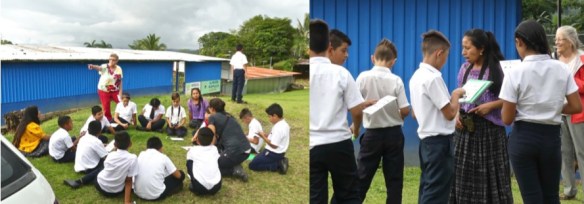
Teacher Exchange: What Fun–What Success!

A Detectives de Aves (BirdSleuth-International) teacher exchange program between San Vito Bird Club (San Vito, Costa Rica) and Community Cloud Forest Conservation in the highlands of Guatemala recently concluded, with bilateral reports of great success, good fellowship and a promise for the future of Detectives de Aves.

Our San Vito Bird Club education team–Paula Mesen, Carla Azofeifa and SVBC President Peter Wendell–returned from the beautiful highlands of Guatemala in April after spending a week observing and learning from their Guatemalan counterparts. Also attending the visit was Dr. Lilly Briggs from Cornell University, coordinator and leader of  this very special project.

In early May, the Guatemalan education team reciprocated by visiting us and participating in our local classes.  Again, many, many thanks to Dr. Briggs for her guidance and vision.

Based on reports from the Detectives de Aves teachers from both San Vito and Guatemala, this exchange of teaching techniques and styles proved very valuable to all involved and we hope that more of these international visits will become available in the future.

As always, your generous donations to the SVB and the Detectives de Aves classes are much appreciated.

combo2

combo3

Bird Quiz Quickie!/Prueba de Aves-Rapido!

The first correct identification of this bird (shown below) wins something good to eat (like cookies; about 12) home-baked by SVBC President-Emeritus Alison Olivieri.  Good luck!

Send your answer to: president@sanvitobirdclub.org

**************

La primera identificacion correcta de esta ave (abajo) gana algo buena para comer (como 12 galletas), horneado por Presidente-Emeritus Alison Olivieri.  Buena suerte!

Envia su repuesta a:  president@sanvitobirdclub.org

wwb

Trogon Songs of San Vito

This time of year our two most common Trogons–the Gartered Trogon (yellow) and the Collared Trogon (red)–spend a good portion of the day singing their songs of territory and romance.

The Gartered Trogon…with its yellow belly, blue head (male), green back, and bright eye ring…sings a high-pitched single tone call, about three notes per second, usually while perched on a horizontal branch.

The Collared Trogon…with its red belly, green head (male) and white stripe separating the two…sings out with a plaintive 1-3 note call; lower pitched and slower in cadence.  Again, the Collared Trogon usually does this while perched on a mid-canopy horizontal branch.

I am including two YouTube links to these beautiful birds giving their calls.  Hope you get to hear these two Trogons and even see them in or near your own neighborhood.

Buen viaje y buena suerte! Nuestra equipo de Detectives de Aves va a Guatemala!

Nuestra equipo de Detectives de Aves (Bird Sleuth) va Guatemala para un intercambio cultural.  Profesoras Carla Azofeifa y Paula Mesen y Presidente de SVBC Peter Wendell visitara y observara una escuela indigena y sus clases de Detectives de Aves por una semana.

Tendremos un informe a su regreso.

combo

Bird Quiz Quickie…We Have a Winner!

Congratulations to SVBC President-Emeritus Alison Wickwire Olivieri for correctly identifying our Bird Quiz Quickie.  The bird pictured below is a Pale-breasted Spinetail (Synallaxis albescens).

Note the faint eye stripe and particularly the very diagnostic tail configuration; hence the name Spinetail.

FYI: Some folks have mentioned the rather poor quality of this photograph, making identification a challenge.  In the field, birds rarely pose fully exposed and in full sunlight.  These Bird Quiz Quickies will regularly include photographs of less-than-perfect composition.  But there will always be visual clues to aid in identification.  In birding, we live by the motto: ‘If it was easy, it wouldn’t be any fun.’

(photo courtesy of Sarah Beeson-Jones)

PB Spinetail