
African elephant; locals call them “ellies”. Photo by Alison Olivieri.
Going to Africa is a lifelong dream for many who grew up looking at National Geographic magazines. So it was for us as we traveled recently to South Africa, Zimbabwe and Botswana for a three-week vacation.
It turns out Africa is as magical as we had hoped it would be – and more. It is ancient and majestic, savage and tender, thrilling and funny. You can hardly stop looking at elephants as they eat their way across the savannahs and finish the day playing in any available water source. Plus your attention is constantly diverted by rhinoceros, lions, baboons, leopards, giraffes, zebra, Cape buffalo, hyenas, warthogs, jackals, honey badgers and five or six antelope species.
Could this get any better? Well, try the birds as many tourists do after about the third day of seeking the Big Five on game drives. The “Big Five” — a phrase from African big game hunters referring to the most difficult animals to hunt on foot and now used by safari operators as a marketing ploy — are African lion, African elephant, Cape buffalo, leopard and rhinoceros.

Jackass Penguins at Boulders Beach, South Africa. Photo by Alison Olivieri.
As to the birds, in addition to excellent wine and the stunning city of Cape Town, South Africa has penguins which are every bit as comical and endearing as you think. From the ridiculous to the sublime, all three countries have ostriches. Male ostriches are almost three meters tall and – get this – they have bright red shins in breeding season.
Everyone wants to see hornbills, resembling nothing more closely than our Costa Rican toucans. Most are cavity nesters and the females of some species are known for sealing themselves in the holes and depending on the males to feed them during incubation. Along the way, we saw four species, including the now rapidly declining Southern Ground Hornbills.
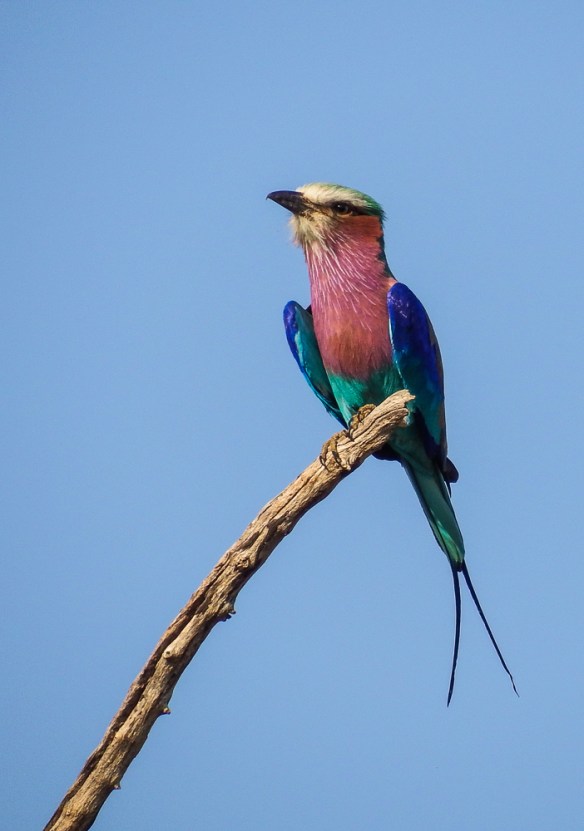
Exquisite Lilac-breasted Rollers, another highly desired quarry, are common residents with harsh rattling sounds and rolling displays, often seen perched and posing for photographs (see below).

Arrow-marked Babbler, after a dip in our plunge pool in the Manyeleti Reserve. Photo by Alison Olivieri.
Babblers, like rollers, are a group of Old World passerine birds not found in the Western Hemisphere. Of the five species in Southern Africa, we were lucky to see two, the Arrow-marked Babbler, and an endemic species, Southern Pied Babbler.
High on our ‘most desired’ list were mousebirds, a group endemic to Africa, that look like titmice with very long tails. They are found bush, scrub, forest edges and, luckily for us, suburbia where we found Speckled Mousebirds in our Johannes burg hotel garden!
Some years ago, landlocked Botswana became known as a hot birding destination due to the Okavango Delta, a huge, swampy inland delta with massive concentrations of animals including waterbirds. Maribou and Saddle-billed stork, Hamerkop, African Openbill, pelicans, herons, egrets, African Jacana, plovers, lapwings, vultures, raptors – it is enough to make you drop your binoculars as you pole through watery canals in a silent dugout canoe called a mokoro.

Cape Giraffe in Botswana, festooned with Red-billed Oxpeckers. Photo by Alison Olivieri.
Near the Moremi Game Reserve, we witnessed an unusual and merciless assassination. Two Blacksmith Lapwings attacked and killed a Pied Kingfisher in about 5 seconds flat. Our guide who had not seen this before said, “Poor Mr. Kingfisher, he must have been too close to their nest”.
This report is all the better for photographs and far less text but unmentioned, yet outstanding, experiences included the Apartheid Museum in Johannesburg, Victoria Falls in Zimbabwe, sunset cruises, sundowners under a full moon in acacia scrub, bush walks and our tents with impressive plumbing, decks and plunge pools – all nearly indescribable. Between us we have more than 1,000 photos which we would be happy to show you anytime. And, if you’re going, we’ll lend you our bird book because you are going to need it.
This trip was flawlessly arranged by Julian Harrison, an African tour specialist, and his team at Premier Tours in Philadelphia, PA.
Espanol aqui
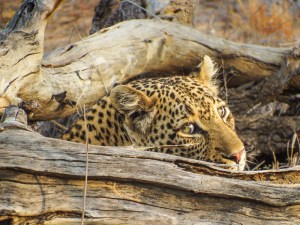
Leopardo en el Manyeleti Reserve, South Africa. Foto de Alison Olivieri.
Para muchos de quienes crecieron leyendo las revistas de National Geographic, ir a África es un sueño de toda la vida. Lo era también para nosotros, por lo que viajamos recientemente a África del Sur, Zimbabue y Botsuana para unas vacaciones de tres semanas.
Resulta que África es tan mágica como pensábamos que sería – más incluso. Es antigua y majestuosa, salvaje y delicada, emocionante y divertida. Difícilmente uno puede dejar de ver a los elefantes mientras se alimentan durante su viaje a través de las sabanas y terminan su día jugando en cualquier depósito de agua disponible. Llamaban nuestra atención constantemente los rinocerontes, leones, babuinos, leopardos, jirafas, cebras, Búfalos del Cabo, hienas, jabalíes, chacales, rateles, y cinco o seis especies de antílopes.
¿Podría ser mejor? Bueno, intente buscar las aves como tantos turistas hacen después del tercer día de buscar el Gran Cinco durante las travesías del juego. El “Gran Cinco” – una frase que los cazadores africanos utilizan para referirse a las cinco especies de animales más difíciles de cazar a pie y actualmente utilizada por los operadores de safaris como estrategia de mercadeo – son el león africano, el elefante africano, el Búfalo del Cabo, leopardos y rinocerontes.
Con respecto a los pájaros, bien, además del excelente vino y la impresionante Ciudad del Cabo, África del Sur tiene pingüinos; que son tan adorables y cómicos como usted se imagina. De lo ridículo a lo sublime, los tres países tienen avestruces. Los avestruces machos miden casi tres metros de altura y – ojo a esto – tienen canillas rojo brillante durante la temporada de apareamiento.
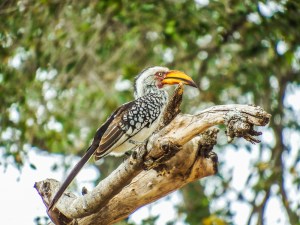
Un bucero, South Africa. Foto de Alison Olivieri.
Todo el mundo quiere ver buceros, que se parecen como nada a los tucanes costarricenses. La mayoría anidan en hoyos y las hembras de algunas especies son conocidas por encerrarse en los hoteles y depender de los machos para alimentarse durante la incubación. Durante el camino, vimos cuatro especies, incluyendo al amenazado cálao terrestre sureño. [Bucorvus leadbeateri]
La hermosa carraca lila [Coracias caudata], otra búsqueda altamente deseada, es un residente común con sonidos severos y exhibiciones circulares, se observan con frecuencia paradas posando para los fotógrafos.

Carraca lila en el Delta del Okavango. Foto de Alison Olivieri.
Los turdoides, como la carraca, son un grupo de aves paseriformes del Viejo Mundo que no se encuentran en el Hemisferio Oeste. De las cinco especies que habitan en África del Sur, tuvimos la suerte de ver dos, el Turdoide de Jardine [Turdoides jardineii] y el Turdoide bicolor [Turdoides bicolor], una especie endémica.
Entre los primeros en nuestra lista de los “más deseados”, estaban los cólidos, un grupo endémico de África, parecidos a herrerillos con colas muy largas. Se encuentran en arbustos, maleza, el margen de los bosques y, para nuestra suerte, los suburbios – donde encontramos al pájaro ratón común [Colius striatus] ¡en el jardín de nuestro hotel en Johannesburgo!
Hace algunos años, el pais de Botsuana, se volvió un atractivo destino para los pajareros gracias al Delta del Okavango, un enorme delta terrestre con masivas concentraciones de animales, incluyendo aves acuáticas, marabúes africanos [Leptoptilos crumeniferus], avemartillos [Scopus umbretta], picotenazas africanos [Anastomus lamelligerus], pelícanos, ardeidas, grazas, jacanas africanas [Actophilornis africanus], caradrinos, vanelinos, buitres, rapaces – suficiente para hacer que uno baje los binoculares mientras atraviesa los canales inundados en una silenciosa canoa labrada conocida como “mokoro”.
Cerca de la Reserva Moremi, parte del Delta, fuimos testigos de un cruel e inusual asesinato. Dos avefrías armadas [Vanellus armatus] atacaron y mataron un martín pescador pío [Ceryle rudis] en alrededor de cinco segundos. Nuestro guía, quien no había visto esto antes, dijo: “Pobre Señor Martín Pescador, debe de haber estado demasiado cerca de su nido”.
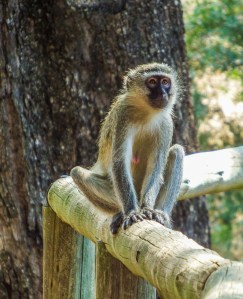
Mono verde [Chlorocebus pygerythrus] de Tintswalo Lodge. Foto de Alison Olivieri.
Este reporte es bastante para los fotógrafos y muy poco texto, pero hay experiencias sobresalientes no mencionadas como el Museo del Apartheid en Johannesburgo, las Cataratas Victoria, cruceros en el atardecer, puestas del sol bajo una luna llena en un matorral de acacia, caminatas entre los arbustos y nuestras tiendas con una plomería impresionante, piso y piscinas de inmersión – todos indescriptibles. Tenemos más de 1000 fotografías, que estaríamos felices de enseñarles en cualquier momento. Y, si usted va a viajar allá, le prestaremos nuestra guía de campo, porque la va a necesitar.
Este viaje fue perfectamente organizado por Julian Harrison, un especialista en tours africanos, y su equipo en Premier Tours en Filadelfia, Pensilvania.


 San Vito Bird Club
You must be logged in to post a comment.