Going to Heaven

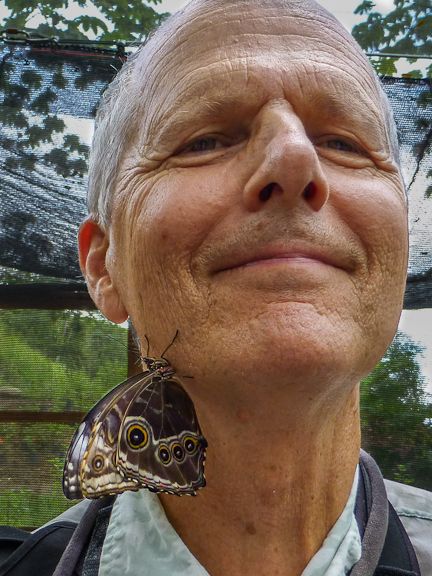
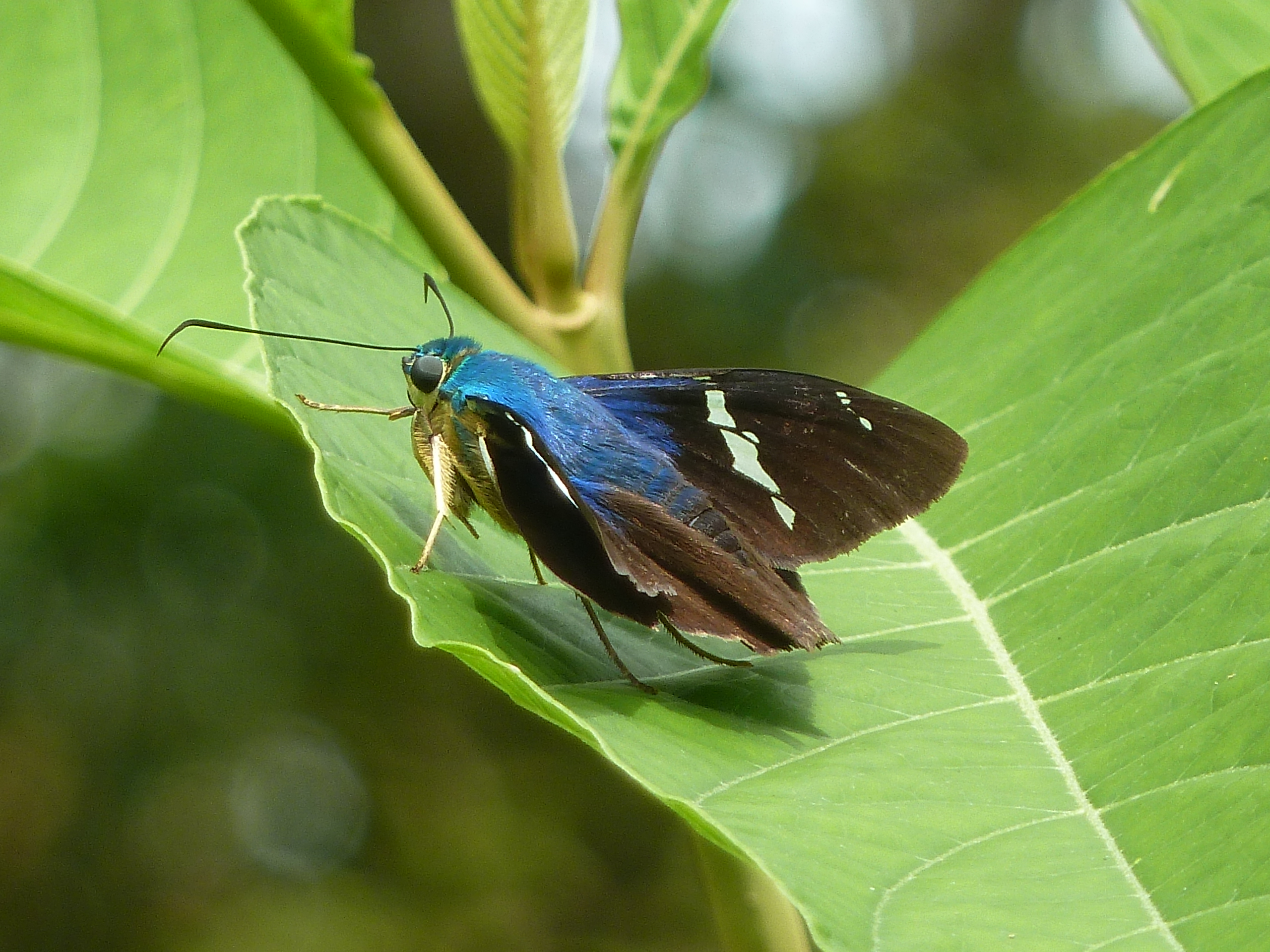
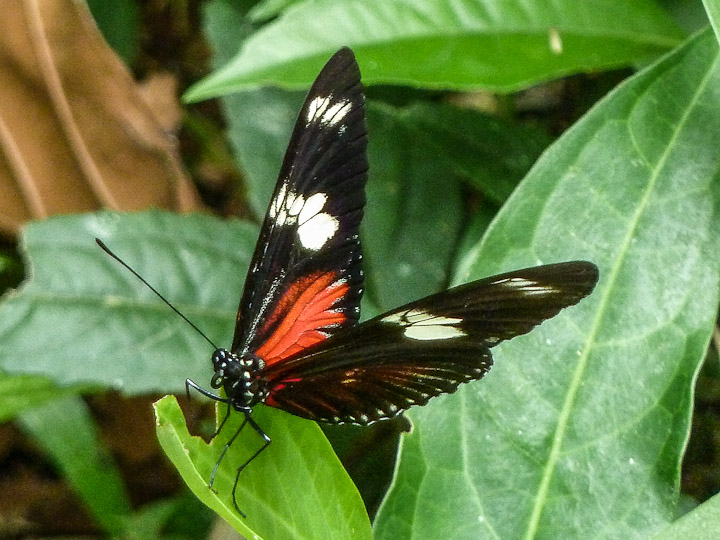
Unidentified Butterfly (Photo by Alison Olivieri)

The other day, Liz Allen and I went to heaven. At least, if there is anyplace resembling heaven anywhere on earth, this would be it. And it’s only about two hours northwest of San Vito, near the town of Uvita on the Pacific Coast.

Heaven’s real name is “Butterfly Paradise” and it is part of the Osa Mountain Village community. It looks like a 16-sided circus Big Top but instead of clowns and jugglers, it’s full of butterflies. We found ourselves surrounded by shining blue Morpho Butterflies and many other drop-dead beautiful creatures going about their butterfly business.

For you butterfly enthusiasts, we saw Malachites, Swallowtails, Crackers, Postmen and Caligos. Not only that, we found caterpillars and a chrysalis with help from Dave Fishell who owns, designed and built “Butterfly Paradise”.

So, I say, let’s all go to heaven! Admission is $12 per person; children under 5 get in free. We can arrange a tour with Dave and a group discount for a Sunday morning in September. Let’s plan to spend some time in heaven and then have lunch at Citrus or Exotica, wonderful restaurants in nearby Ojochal. Send us an email if you are interested with dates that work for you and we’ll make a plan!

Let the Breeding Bird Surveys Begin!

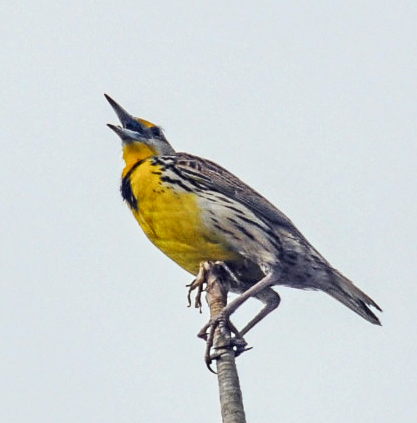
Eastern Meadowlark (Photo by Julie Girard)

In the mid-1960s, the US Geological Survey initiated a long-term, large-scale international avian monitoring program with the Canadian Wildlife Service called the North American Breeding Bird Survey (BBS). It was undertaken in response to the noted decline of songbird populations accompanying the widespread use of DDT for mosquito control at that time. (To learn more about this effort in North America, please click here.) Continuing to this day, the BBS is run out of the Patuxent Wildlife Research Center in Maryland, home to the Bird Banding Laboratory where records of all birds banded in the US are stored. Although rampant use of DDT has declined as a cause of songbird mortality, bird populations continued to be subjected to numerous omnipresent threats including habitat loss, habitat fragmentation, land-use changes, chemical contaminants and other problems. These issues occur worldwide and need to be closely monitored so that local populations are not lost and species do not become extinct simply because no one is paying attention.

In addition to North America, many other countries around the world use bird monitoring surveys to estimate populations, understand species’ distributions and discern decline. Although many professional ornithologists and biologists take part in these surveys, the vast majority of participants are local birders practicing citizen science.

Laughing Falcon (Photo by Alison Olivieri)

This year, Gerardo Obando of the Asociacion de Ornitologica de Costa Rica (AOCR) has taken the initiative and begun a national program of Breeding Bird Surveys! These surveys can be either a single place survey, like a garden, or a route with at least 10 stops, 200 m apart, for five-minute bird counts. The surveys must be completed between May 15 and June 30, the height of many of our resident birds’ breeding season.

Your bird club completed three surveys in mid-June consisting of one privately-owned garden, a route through Finca Cantaros (one of our Avian Monitoring Project field stations) and a route through the Wilson Botanical Garden. Very special thanks go out to Mauricio Sarmiento of the OTS Las Cruces Biological Station for helping record the GPS coordinates of each point along both of the routes. Next year we need to add more routes and we will need more volunteers to accomplish this! “Ace Birders” of the SVBC: please come join us in 2013 — we need your help!

You can read about this new effort — and practice your Spanish if you are not a native speaker — by clicking here.  We are proud to be a new Institutional Member of the AOCR, about which you can read more by clicking here.

The Departing Desvenains

Our VP Kate and her family, Patrick and Luca, recently left Costa Rica for Washington, DC, a city that Kate has described many times as one of her favorite places to live.

All of us who have enjoyed Patrick’s hospitality and culinary skills; who have walked, talked, birded and banded with Kate, and who have played with “Luca-paduca” will miss them terribly. But naturally we saw them off with a terrific Farewell Party at Las Cascatas and we wish them all the best the world has to offer!

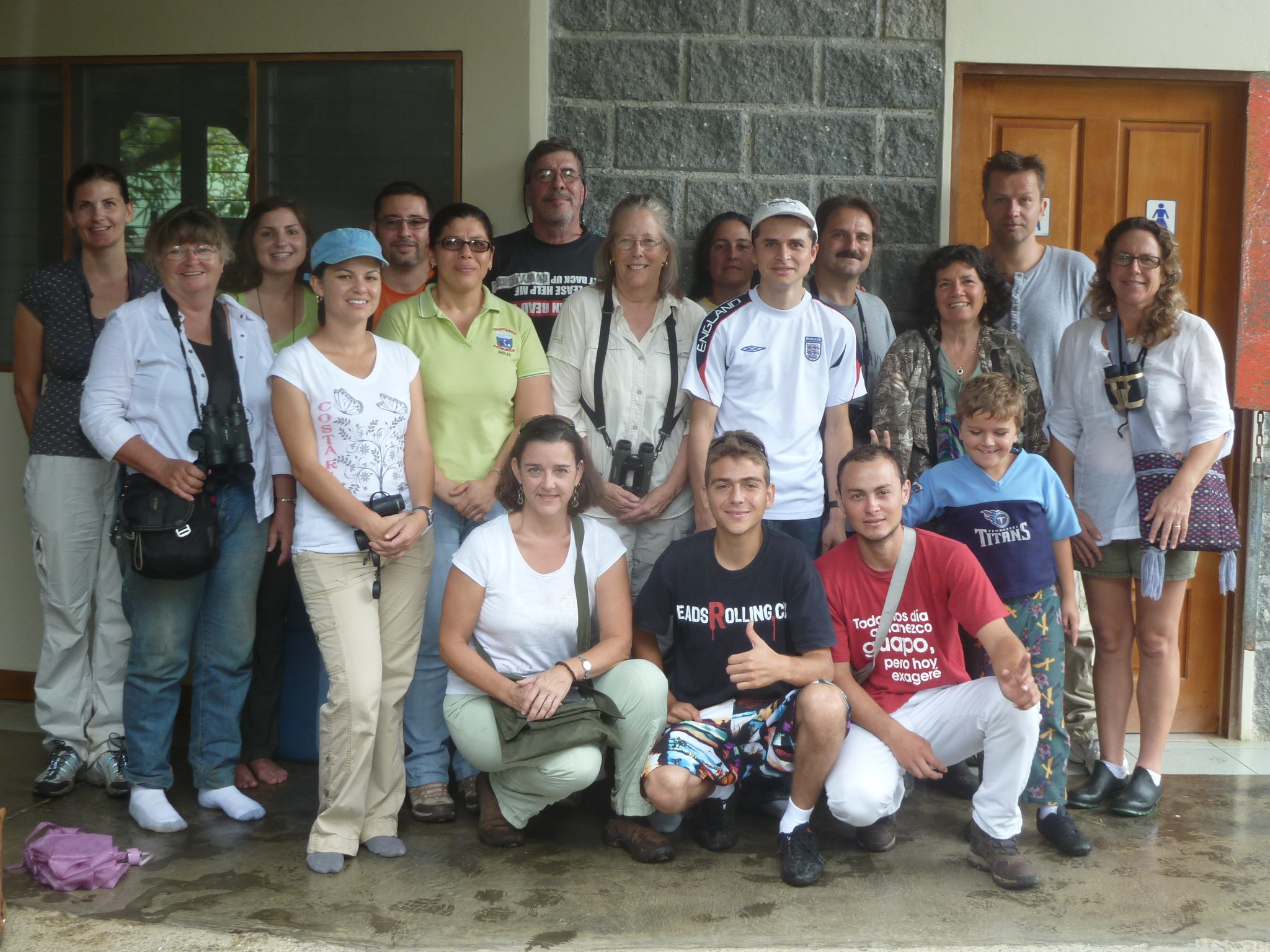
‘Kate’s Last Walk’ photo by Landon Daft

This photo was taken on June 16 at the Wilson Botanical Garden to commemorate what will now be known as “Kate’s Last Wilson Walk”. Standing from left to right are Liz Allen, Barbara Keeler-Barton, Peace Corps Volunteer Darien Combs, Elena Murillo, Heysen Esquivel, Hellen Castillo, Wally Barton, Alison Olivieri, Judith Ippolito, Erick Ilama Loria, Joe Ippolito, Roni Chernin, Mark (who is taking over Morphose Mountain Retreat B&B) and Wendy Schulz. Kneeling in front are (from left to right) Kate Allen Desvenain, Edwin Borbon Abarca, Yoiner and Royce Schulz (really not kneeling). Special thanks to visitor Landon Daft for taking this picture.

The Nidification of San Vito

Golden-hooded Tanager in nest. (Photo: Harry Hull)

This will sound a little strange to North Americans: “Winter’s in the air and nests are everywhere“! We are two months into our rainy season, aka tropical winter, and that puts us deep into the nesting season. When we stand still and watch, we find nests everywhere: under the eaves, high in the trees, low down in shrubs, under plant leaves, in tree trunk cavities and even on fence posts.

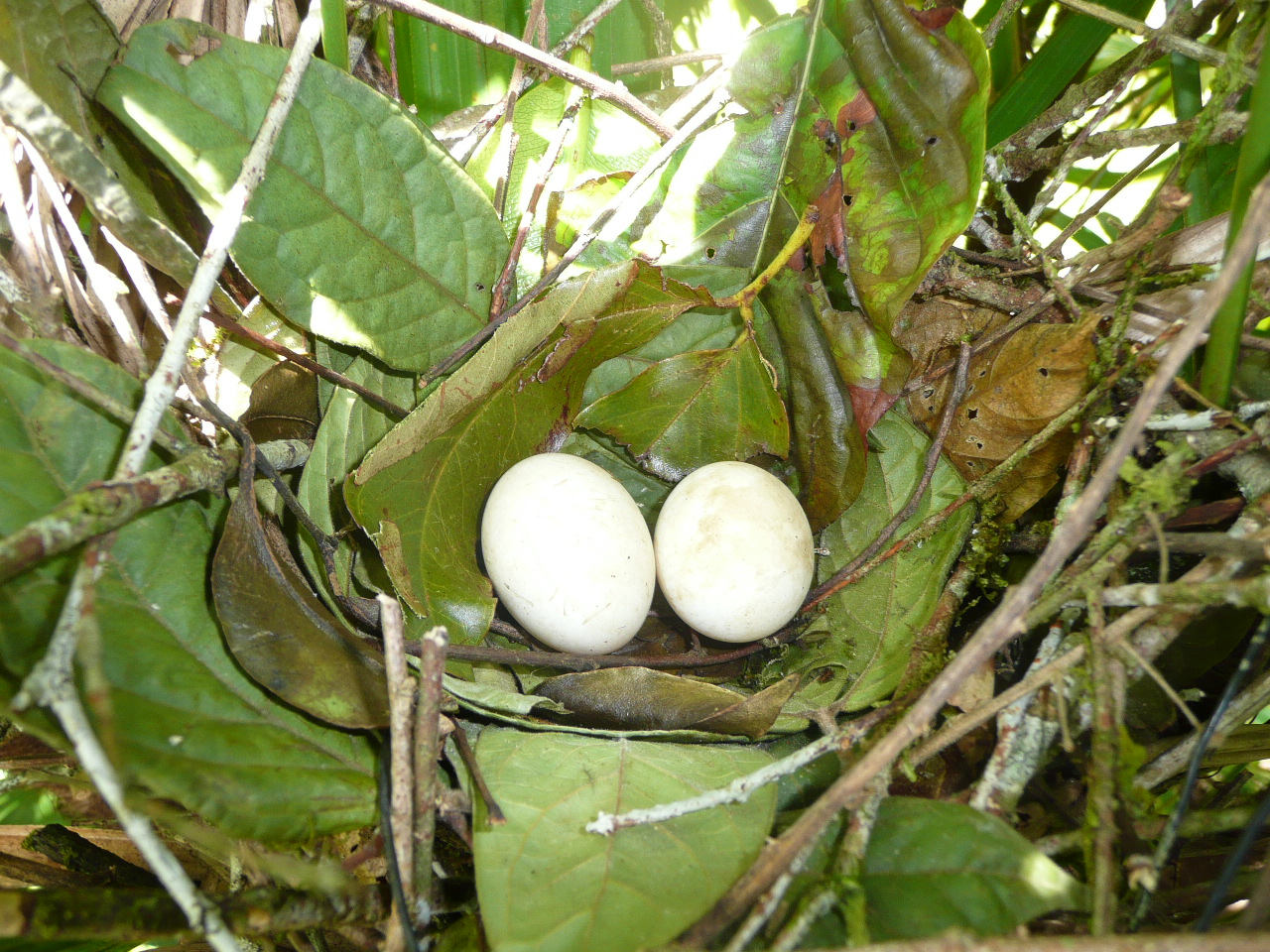
Common Potoo with its egg on a fence post. (Photo by Barbara Keeler Barton)

Because the nesting season started back in April we see now, in early June, fledglings chasing their parents begging to be fed. In a short walk this morning, I counted at least six young birds pestering adults: Tropical Kingbird, Cherrie’s Tanager, Variable Seedeater, Bronzed Cowbird peeping at a surrogate parent Rufous-collared Sparrow, Lesser Elaenia and Silver-throated Tanager. By the time they get to this stage, you can almost see the parent birds swiping their foreheads with the side of their wings thinking: will these young birds EVER learn to feed themselves?

A few days ago, an adult Blue-crowned Motmot led two young birds to our banana-papaya feeder and sat there alternatively stuffing pieces of fruit into the gaping bills of each of its offspring. This was, of course, a truly  thrilling ‘National Geo’ moment with my camera nowhere nearby.

Then, too, I recently caught a Fiery-billed Aracari peering into a large shrub outside our front door where a pair of Cherrie’s Tanagers are going for a second nesting. No doubt it was looking for food for its own young but it’s hard not to root for the littler guys.

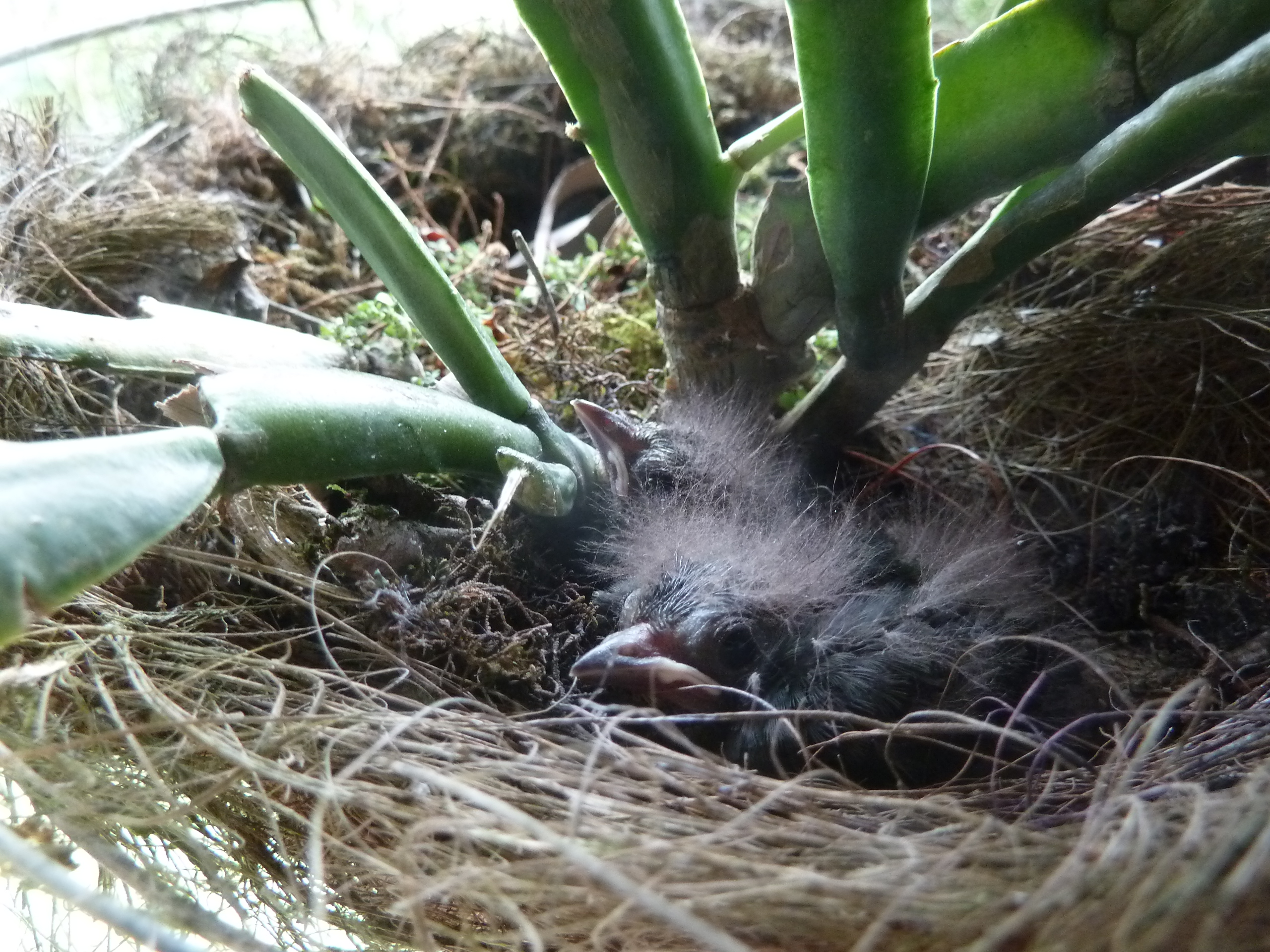
Golden-hooded Tanager nestlings, 11 days old. (Photo by Alison Olivieri)

We are puzzling over what happened to two nestling Golden-hooded Tanagers that seemed ultra-secure in a hanging basket on our porch. The adults chose a safe-looking spot where the voracious local squirrels might overlook them, but they disappeared in mid-day while we had a little pool party with friends. They were 15 days old and didn’t seem big enough or strong enough to fledge. Maybe a snake wound its way up there or the squirrels managed to grapple up the beams after all.

Squirrel Cuckoo nest. (Photo by Aracelly Barrantes)

Predators and other dangers are everywhere here. First-time nesters sometimes build flimsy nests without adequate protection from heavy rains that are subsequently washed away. Hummingbirds in the ‘hermit’ group build nests hanging from the underside of large maranta or heliconia leaves that can be toppled over in strong winds or unrelenting rain storms. Trees fall over regularly at this time of year and raptors, like the Swallow-tailed Kites that come from South America to breed here, are constantly on the hunt. This is to say nothing about the many opossums, raccoons, weasels and snakes that patrol at night. Or humans wielding weed-whackers, machetes and chainsaws.

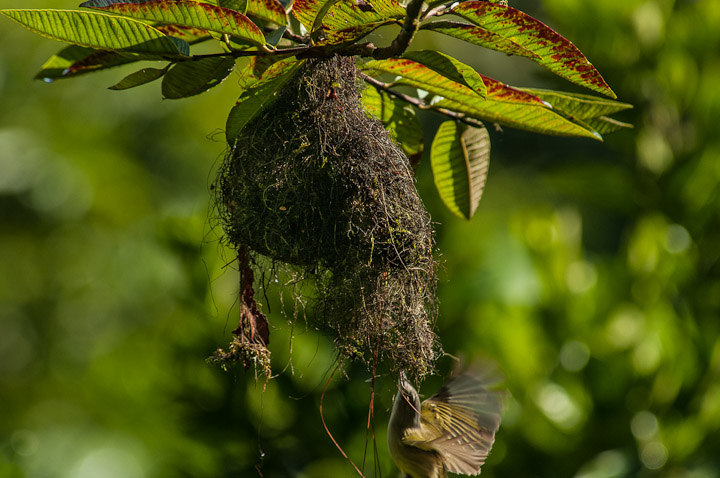
Because danger comes from all directions and at all times, birds must take counter-measures. My favorite is the swaying flycatcher nest attached to a wispy branch in a tall tree with the entrance hole on the side or at the bottom. It is an absolute marvel and one wonders how that clever pendant, retort or ovoid-shaped blueprint got started. No predator weighing more than a few ounces could ever get inside. We found a beauty at Finca Cantaros several weeks ago, painstakingly constructed by a Yellow-olive Flycatcher. In the meantime: go outside! Look around! It’s amazing what you will see.

Yellow-olive Flycatcher entering nest from below. (Photo by Harry Hull)

BirdSleuth Workshop at Las Cruces

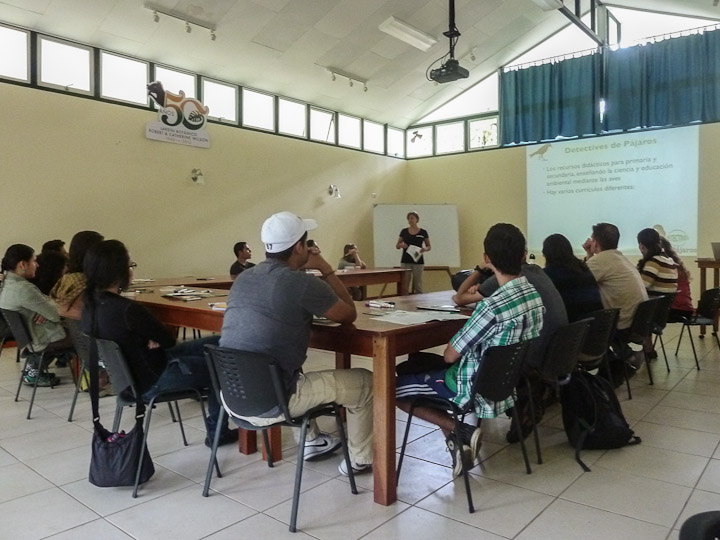
Lilly Briggs leads the BirdSleuth Workshop in San Vito, May 2012

Lilly Briggs leads the BirdSleuth Workshop in San Vito, May 2012

As noted on this website under the navigation bar Community>Current Projects>BirdSleuth, we hope to help implement this Cornell University Laboratory of Ornithology environmental education program in San Vito in some way, shape or form. To begin this process — and to familiarize us with the course material and classes — a day-long workshop for Spanish speakers was help at Las Cruces on Sunday, May 13, led by Lilly Briggs a Cornell PhD student in the Department of Natural Resources, and Jennifer Fee, the Lab of O’s Manager of K-12 Programs.

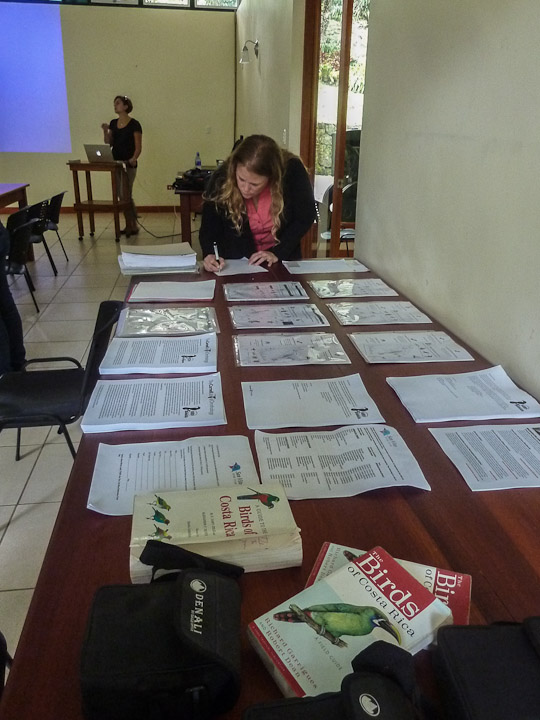
Jennifer Fee setting up the BirdSleuth Workshop

Jennifer Fee Setting up the BirdSleuth Workshop

Las Cruces Biologist Ariadna Sanchez spent months planning and organizing the workshop and, to judge by the participants enthusiastic reaction, it was an enormous success. Nearly half of the registrants were teachers from elementary and high schools. Almost everyone else had taken the recently-offered OTS Naturalist Guide Course.

This educational program is geared toward teaching children to engage in and enjoy science. It is all about discovery and learning to record data, using Bird Journals and Cornell’s amazing public database, eBird. It’s also about having fun with hands-on activities that include making a personal bird journal, drawing and studying birds, learning bird families by sight and, finally, counting species and individuals.

During the nine completed classes, students play the Bird Survivor! Game and the Migration Game, both of which teach about migratory birds’ perilous lives as they fly north from Central and South America to breed and south from North America to return home. These games also lead students to think about social connections as they learn to view birds as international citizens. The concept of global cooperation can be well understood by connecting students from different countries that share the same species of birds.

Bird Survivor! Game

Bird Survivor! Game

Perhaps even more importantly, this program is about empowering children to find solutions to the critical issue of bird (and other wildlife) conservation: becoming Citizen Scientists and helping to solve problems on local, national and international scales. One of the most important classes focuses on creating a local Conservation Project and carrying it out.

BirdSleuth-International could be offered here as an ‘after-school Bird Club’: basically, an extended learning program. Or it could be used as the curriculum for a week-long or two-week Summer Day Camp. Or in some different way, that we have not yet discovered.

As we move forward with this exciting project, we will need the help of all our members in the form of creative ideas, financial support and local volunteer action. Please let us know how YOU can help by clicking on contact us!

Making a Bird Journal

Making a Bird Journal

Wilson Walk Report: May 12, 2012

Several new member and guests joined our recent bird walk in the Wilson Botanical Garden, including the youngest member of the SVBC, Elias Castiblanco U., participating with his mother, Kathleen Ulenaers, and grandmother, Philomen Schutters.

L to R: Barbara Keeler Barton, Philomene Schutters, Kathleen Ulenaers, Elias Castiblanco U., Pat Morgan; back row: Wally Barton. Photo by Alison Olivieri

New member Barbara Keeler Barton joined us for the first time as did Morphose Mountain Retreat guests Celia Lucente and Randy Bonsignore, vacationing here from Florida.

As for the birds, for the second time in as many months we spotted a handsome Rufous-winged Woodpecker actively foraging near the entrance gate. Other favorites of the morning were two perched Blue-crowned Motmots, possibly a pair, and a White-crowned Parrot that obliged us by sitting still for several minutes on a palm trunk stump.

Although new member Wally Barton did not actually walk with us, he did make it for “Coffee-and-the-List” and found the last bird of the morning, a male Yellow-faced Grassquit, bringing our total to 35 seen or heard species on our one hour and 45-minute outing.

Don’t miss the fun: join us for the next walk on May 26 at 7:30 am at the main entrance to the Wilson Botanical Garden!

Eyes Up!

It’s that magical time of the year when hawks and other kinds of birds are migrating to North America for the spring breeding season. We have had a message from Marco Saborio, photographer and birder extraordinaire, who says the weather on the Caribbean side of Costa Rica is not ideal, so many birds are likely to be passing overhead using an alternate Pacific side route. So we say, “Go outside! Look up! Watch for groups of migrating hawks!” and please let us know the species, number of individuals, date and time if you happen to see this awe-inspiring natural spectacle by going to the Contact Us page.

Broadwing Hawk "kettle". (Photo: Dave McCauley)

Wilson Walk Report, April 14, 2012

Several new members joined us for one of our regular Wilson Walks on Saturday, April 14. In addition to Philomen Ulaeners and Tom Wilkinson, Donna Goodwin and Nick Green joined us along with Hellen Castillo and Juanita Castro and their students and guests. In total, we saw 31 species of birds — not an easy feat with such a large group. Highlights included Blue-crowned Motmot and Squirrel Cuckoo, both spotted by Nick Green without binoculars, an impressive feat. We hope to see all these participants and more at our next walk in two weeks, Saturday, April 28.

CR Banders Meeting 9 April 2012

InBio Parque, Santo Domingo de Heredia

The movers and shakers behind the Costa Rican Bird Banding Network hosted a day-long meeting at InBio Parque in Santo Domingo de Heredia on April 9 that started with an early morning Banding Demonstration led by Jorge Leiton who has helped at several of our mist netting project sessions in San Vito.

Attendees at Banders Conference April 9, 2012 (Photo: Sara Estrada)

Conference speakers delivered presentations on up-to-date research being conducted at several sites in Costa Rica, information on new tools and other innovations for bird monitoring projects, international capacity building provided by the North American Banding Council’s certification and training programs, a summary of one of Stanford University’s many long-term projects and information on the Banding Network and the new Costa Rican Bird Observatories. Additionally a LaMNA (Landbird Monitoring of North America) Data Analysis Workshop was held in the afternoon.

Jared Wolfe, a PhD candidate at Louisiana State University presented a paper, currently in review, titled “A Tropical Bird’s Dissimilar Response to Global Climatic Phenomenon in an Uneven Aged Forest.” The data for this paper were gathered at the oldest, continually-run banding station in Costa Rica at Tortuguero National Park on the Caribbean side.

VP Kate Desvenain and Sara Estrada (Photo: Alison Olivieri)

Another research project, from CATIE in Turrialba and presented by Fabrice DeClerck, showed a significantly increased bird population in agricultural landscapes by leaving unpruned the famous ‘living fences’ of Costa Rica, traditionally used to define pasture and agricultural acreage. Researchers at CATIE are teaching environmental education programs for teachers at nearby schools as well as involving the teachers and their students in their research projects.

C. J. Ralph of the USDA Forest Service displayed dazzling migration range maps for Indigo Bunting and Common Nighthawk created from eBird data. They literally made you want to run home to your computer and immediately update your eBird account. After seeing what C.J. was able to show, there is NO EXCUSE not to enter all your sightings and add to this powerful and complex data tool.

The San Vito Bird Club was well represented at the meeting and several members stayed for the afternoon presentation on data analysis that will surely benefit our Avian Monitoring Project.

Thanks to Pablo Elizondo of Partners in Flight and the Costa Rican Bird Observatories for an inspiring conference that provided new insights into bird population dynamics, a forum for exchanging ideas and answering questions, and stimulating new information.

Mist Netting Highlights: March 2012 Session

No less than four new species turned up at this session! At Finca Cantaros we caught a Squirrel Cuckoo, surely one of the most striking birds in the country with a glamorous black and white tail. Often, Squirrel Cuckoos give loud wolf whistles when they land on a tree branch and they are known for scurrying through trees like squirrels. At 18”, they are two inches longer than Blue-crowned Motmots.

At Finca Sofia, we netted an Emerald Toucanet; however, we did not have the correct band size for this species. Alas, we had to release it unbanded after all appropriate data were taken. Another one remained above the banding station, calling incessantly, while we worked. We cannot help but conclude this was a mated pair!

At Finca Corteza, we netted two new species. The first was a bird that has had both common and scientific names changed recently. In the original Stiles and Skutch field guide, it was called Whistling Wren (scientific name: Microcerculus luscinia). This changed to Scaly-breasted Wren (scientific name: Microcerculus marginatus) in the more recent Garrigues and Dean guide although the author points out the Costa Rican race has no scaling on the breast. The song is described as “remarkable” in S&S with short, fast ascending notes followed by a long (2-4 minutes) series of piercing whistles. Once heard, it is unmistakable.

Black-cheeked Ant-Tanager (Photo: Julie Girard)

Finally, to our surprise, we caught a Black-cheeked Ant-Tanager, a Costa Rican endemic with a limited range restricted to the Golfo Dulce and Osa Peninsula region. Interestingly, Stiles and Skutch had this to say, “. . . increasingly scarce as its forest habitat is reduced; still fairly common . . . where forest remains , but within a few years the entire population may be confined to Parque Nacional Corcovado.”  Those familiar with the southern Pacific lowlands will realize what an altitudinal change it represents to go from sea level there to approximately 4,000’ in San Vito. Consequently, we plan to write a short paper on this discovery for submission to the Asocacion Ornitologica de Costa Rica’s journal, Zeledonia.

Finally, we netted four “foreign recaptures”. These are birds banded by other researchers. Two of them, a Violet Sabrewing and a Green Hermit were caught at Finca Cantaros. Another Violet Sabrewing was captured at Finca Sofia and the last one, an Orange-billed Nightingale-Thrush, came from Finca Corteza. We have sent the band numbers, date, location and species name to the Stanford University study group and will also report this information to the Banders Network of Costa Rica.

As always, we want to express our thanks to our Principal Investigator Steve Latta, project founder Judy Richardson and our San Jose-based team of trainers including, at this session, Jorge Leiton and Sara Estrada.