Wilson Walk Report: May 12, 2012

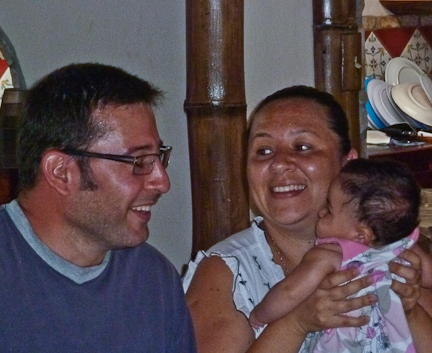
Several new member and guests joined our recent bird walk in the Wilson Botanical Garden, including the youngest member of the SVBC, Elias Castiblanco U., participating with his mother, Kathleen Ulenaers, and grandmother, Philomen Schutters.

L to R: Barbara Keeler Barton, Philomene Schutters, Kathleen Ulenaers, Elias Castiblanco U., Pat Morgan; back row: Wally Barton. Photo by Alison Olivieri

New member Barbara Keeler Barton joined us for the first time as did Morphose Mountain Retreat guests Celia Lucente and Randy Bonsignore, vacationing here from Florida.

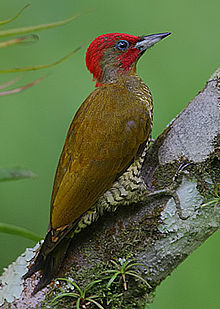
As for the birds, for the second time in as many months we spotted a handsome Rufous-winged Woodpecker actively foraging near the entrance gate. Other favorites of the morning were two perched Blue-crowned Motmots, possibly a pair, and a White-crowned Parrot that obliged us by sitting still for several minutes on a palm trunk stump.

Although new member Wally Barton did not actually walk with us, he did make it for “Coffee-and-the-List” and found the last bird of the morning, a male Yellow-faced Grassquit, bringing our total to 35 seen or heard species on our one hour and 45-minute outing.

Don’t miss the fun: join us for the next walk on May 26 at 7:30 am at the main entrance to the Wilson Botanical Garden!

Eyes Up!

It’s that magical time of the year when hawks and other kinds of birds are migrating to North America for the spring breeding season. We have had a message from Marco Saborio, photographer and birder extraordinaire, who says the weather on the Caribbean side of Costa Rica is not ideal, so many birds are likely to be passing overhead using an alternate Pacific side route. So we say, “Go outside! Look up! Watch for groups of migrating hawks!” and please let us know the species, number of individuals, date and time if you happen to see this awe-inspiring natural spectacle by going to the Contact Us page.

Broadwing Hawk "kettle". (Photo: Dave McCauley)

Wilson Walk Report, April 14, 2012

Several new members joined us for one of our regular Wilson Walks on Saturday, April 14. In addition to Philomen Ulaeners and Tom Wilkinson, Donna Goodwin and Nick Green joined us along with Hellen Castillo and Juanita Castro and their students and guests. In total, we saw 31 species of birds — not an easy feat with such a large group. Highlights included Blue-crowned Motmot and Squirrel Cuckoo, both spotted by Nick Green without binoculars, an impressive feat. We hope to see all these participants and more at our next walk in two weeks, Saturday, April 28.

CR Banders Meeting 9 April 2012

InBio Parque, Santo Domingo de Heredia

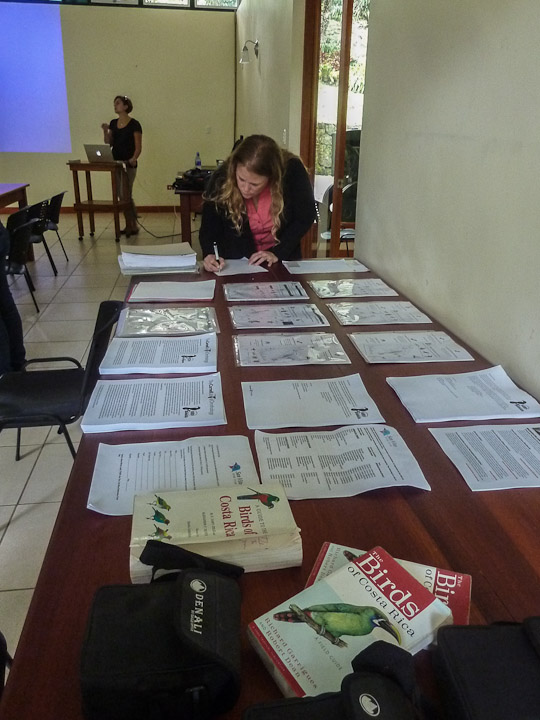
The movers and shakers behind the Costa Rican Bird Banding Network hosted a day-long meeting at InBio Parque in Santo Domingo de Heredia on April 9 that started with an early morning Banding Demonstration led by Jorge Leiton who has helped at several of our mist netting project sessions in San Vito.

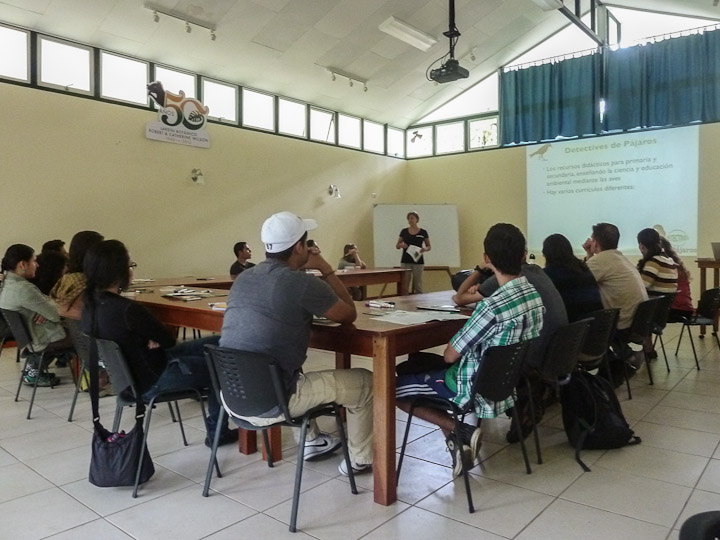
Attendees at Banders Conference April 9, 2012 (Photo: Sara Estrada)

Conference speakers delivered presentations on up-to-date research being conducted at several sites in Costa Rica, information on new tools and other innovations for bird monitoring projects, international capacity building provided by the North American Banding Council’s certification and training programs, a summary of one of Stanford University’s many long-term projects and information on the Banding Network and the new Costa Rican Bird Observatories. Additionally a LaMNA (Landbird Monitoring of North America) Data Analysis Workshop was held in the afternoon.

Jared Wolfe, a PhD candidate at Louisiana State University presented a paper, currently in review, titled “A Tropical Bird’s Dissimilar Response to Global Climatic Phenomenon in an Uneven Aged Forest.” The data for this paper were gathered at the oldest, continually-run banding station in Costa Rica at Tortuguero National Park on the Caribbean side.

VP Kate Desvenain and Sara Estrada (Photo: Alison Olivieri)

Another research project, from CATIE in Turrialba and presented by Fabrice DeClerck, showed a significantly increased bird population in agricultural landscapes by leaving unpruned the famous ‘living fences’ of Costa Rica, traditionally used to define pasture and agricultural acreage. Researchers at CATIE are teaching environmental education programs for teachers at nearby schools as well as involving the teachers and their students in their research projects.

C. J. Ralph of the USDA Forest Service displayed dazzling migration range maps for Indigo Bunting and Common Nighthawk created from eBird data. They literally made you want to run home to your computer and immediately update your eBird account. After seeing what C.J. was able to show, there is NO EXCUSE not to enter all your sightings and add to this powerful and complex data tool.

The San Vito Bird Club was well represented at the meeting and several members stayed for the afternoon presentation on data analysis that will surely benefit our Avian Monitoring Project.

Thanks to Pablo Elizondo of Partners in Flight and the Costa Rican Bird Observatories for an inspiring conference that provided new insights into bird population dynamics, a forum for exchanging ideas and answering questions, and stimulating new information.

Mist Netting Highlights: March 2012 Session

No less than four new species turned up at this session! At Finca Cantaros we caught a Squirrel Cuckoo, surely one of the most striking birds in the country with a glamorous black and white tail. Often, Squirrel Cuckoos give loud wolf whistles when they land on a tree branch and they are known for scurrying through trees like squirrels. At 18”, they are two inches longer than Blue-crowned Motmots.

At Finca Sofia, we netted an Emerald Toucanet; however, we did not have the correct band size for this species. Alas, we had to release it unbanded after all appropriate data were taken. Another one remained above the banding station, calling incessantly, while we worked. We cannot help but conclude this was a mated pair!

At Finca Corteza, we netted two new species. The first was a bird that has had both common and scientific names changed recently. In the original Stiles and Skutch field guide, it was called Whistling Wren (scientific name: Microcerculus luscinia). This changed to Scaly-breasted Wren (scientific name: Microcerculus marginatus) in the more recent Garrigues and Dean guide although the author points out the Costa Rican race has no scaling on the breast. The song is described as “remarkable” in S&S with short, fast ascending notes followed by a long (2-4 minutes) series of piercing whistles. Once heard, it is unmistakable.

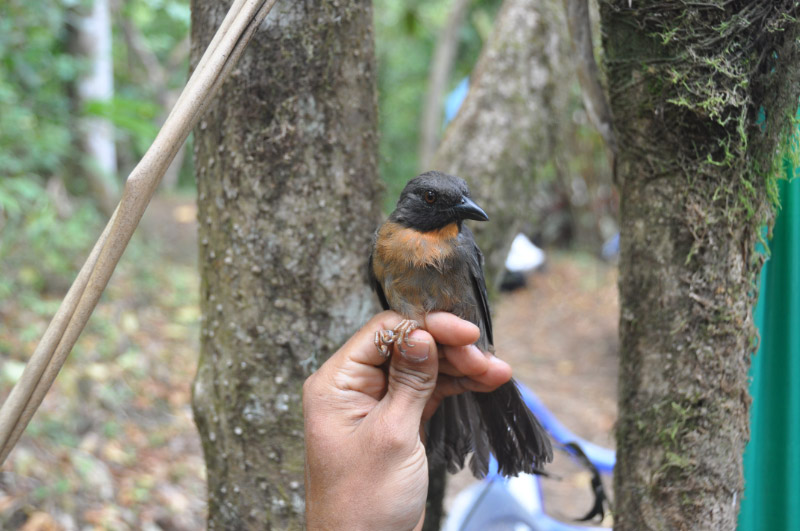
Black-cheeked Ant-Tanager (Photo: Julie Girard)

Finally, to our surprise, we caught a Black-cheeked Ant-Tanager, a Costa Rican endemic with a limited range restricted to the Golfo Dulce and Osa Peninsula region. Interestingly, Stiles and Skutch had this to say, “. . . increasingly scarce as its forest habitat is reduced; still fairly common . . . where forest remains , but within a few years the entire population may be confined to Parque Nacional Corcovado.”  Those familiar with the southern Pacific lowlands will realize what an altitudinal change it represents to go from sea level there to approximately 4,000’ in San Vito. Consequently, we plan to write a short paper on this discovery for submission to the Asocacion Ornitologica de Costa Rica’s journal, Zeledonia.

Finally, we netted four “foreign recaptures”. These are birds banded by other researchers. Two of them, a Violet Sabrewing and a Green Hermit were caught at Finca Cantaros. Another Violet Sabrewing was captured at Finca Sofia and the last one, an Orange-billed Nightingale-Thrush, came from Finca Corteza. We have sent the band numbers, date, location and species name to the Stanford University study group and will also report this information to the Banders Network of Costa Rica.

As always, we want to express our thanks to our Principal Investigator Steve Latta, project founder Judy Richardson and our San Jose-based team of trainers including, at this session, Jorge Leiton and Sara Estrada.

Wilson Garden 50th Anniversary

Member-volunteers will be on hand to help celebrate the 50th Anniversary of the Robert and Catherine Wilson Botanical Garden on Friday and Saturday, May 4-5. We will be in charge of children’s games art table and crafts outside of the dining room on the terrace. Please stop by and say ‘Hola’!

2012 Annual Meeting

Held on February 4 at Las Cascadas Restaurant near the Wilson Botanical Garden from noon to about 2:30pm, the Annual Meeting of the San Vito Bird Club for 2012 was attended by 30 members—an all-time high turnout!

Alison Olivieri & Harry Hull applauding something... (Photo: Olivieri)

Business transacted during the formal part of the meeting included approval of a revised version of the Bylaws and election of a new slate of Executive Committee members for the year as follows: Alison Olivieri, President; Kate Desvenain, Vice President; Lydia Vogt, Secretary, and Fred Schroeder, Treasurer.

Alison Olivieri then made a Special Presentation to the retiring Vice President, Julie Girard, who has served tirelessly and enthusiastically since the Club was founded in 2006—a gift of a tile-framed mirror wrapped in custom-printed paper handmade by member Gail Hull.

Julie Girard receiving gift from Alison Olivieri. (Photo: Olivieri)

At the conclusion of the formal business portion of the meeting, attendees were treated to two slide-shows: a presentation by the new Vice President, Kate Desvenain, about her trip to a Bird Banding Workshop in a remote region of Peru called Madre de Dios in November 2011; and a preview of this website by Communications Committee chairman, Harry Hull.

Lunch at the meeting was delicious, thanks to the entire Las Cascadas crew led by George Alcott; and we were all delighted to welcome the youngest “junior member” of the San Vito Bird Club, Mikaela Esquivel Chinchilla, daughter of Heysen Esquivel and Nancy Chinchilla Rosales!

Heysen, Nancy and young Mikaela Esquivel. (Photo: Olivieri)

Mist Netting Highlights: January 2012 session

Three new species were captured during the week: Gray-chested Dove (at Finca Cantaros), Violet-crowned Woodnymph and Spotted Woodcreeper (both at Finca Sofia)! We are always excited to have a “first” capture so to have three in one session was a thrill.

We found three banded birds that we record as “foreign recaptures”. This means they were banded by another research team that uses different sites and different band numbers. It is always fascinating to catch “someone else’s” bird and much can be learned from these data points. Of course, we will submit the records to see where the birds were originally banded.

The first was a Green Hermit that we know was originally banded by Stanford University researchers as a juvenile in March of 2011 because this was the second time we have caught it! The Stanford team captured this individual in Melissa’s Meadow, an area across the Rio Java in the Las Cruces forest that has served as a reforestation study site for many years. We caught it for the first time on November 27, 2011 at Finca Cantaros and again on January 22, 2012 at the same site. We feel now that this bird (band #A55817) is an old friend and we look forward to seeing it again!

The second foreign recapture was another hummingbird — a Snowy-bellied Hummingbird — with the band #A48431, netted on January 24 at Finca Sofia.

Finally, we caught an Orange-billed Nightingale-Thrush with the band code CSIB1616, at Finca Corteza on January 27, 2012.

At this session we welcomed participants new and old, including a group from Connecticut Audubon Society Birdcraft Museum: Faithful-Returner Judy Richardson and Somewhat-Less-Faithful-But-Nonetheless-A-Returner Patty Scott, plus a new bander, Julian Sproule. Judy runs the banding station at Birdcraft (the oldest, continually-run banding station in the state) and Patty and Julian are among her crew there.

Finally, I am happy to report our Principal Investigator Dr. Steve Latta of the National Aviary attended this session as did our supporters and trainers from San Jose, Juan Pablo Elizondo and Jorge Leiton. Steve has started working closely with us on compiling data that will be used to write several papers about the project. Needless to say, we are eager to help him accomplish this!