Ask the Experts: #6

Welcome back friends. Question #6 for our Ask the Experts feature comes from SVBC member Kyler Pham, who lives in beautiful Prescott Valley, Arizona.

I’m thinking about becoming a birding guide and would like your advice.  When you are leading a group on a bird walk, what are some of the do’s and don’ts?  What can I do to maximize the birding experience for the people I am guiding?

Now please enjoy the responses from our three Experts:

Pepe Castiblanco: Co-owner and proprietor of Casa Botania B&B and professional birding and nature guide. https://www.casabotania.com/en-gb

When practicing the craft of guiding, it does not matter if you know all bird sounds or can recognize each species by its nest shape, first you have to identify the capabilities of the participants and determine how far they can go physically and measure their interest in birds in order to select a course and look for species that will be enjoyable for everyone. Right then you can relax and start showing your knowledge off!

David Rodriguez Arias: Tropical Biologist and natural history guide in Monteverde, Costa Rica. https://www.facebook.com/david.rodriguezarias

To become a bird guide you need to have special skills. Sometimes people may think that bird guides are just having fun traveling around a place, country, region, continent or worldwide. It is true bird guides have the chance to know a lot of places, but they also need to study—study a lot! For example, they need to learn: the songs, calls and chips of residents and non-residents species; the different plumages and colors to identify a male or a female; the immature plumage and adult plumage; how birds behave; the best time to go to look for a specific target species; and about the habitat. Of course, you also need to learn about the culture of the places where you are thinking about going birding, to connect with the communities in a way that you can explain why it is so important to protect the forest habitat to keep species of birds. In other words, as you see, it is all about practice and experience, but the most important thing is to go out to the forest as much as you can, thus all those skills will start to appear soon or later. 

In terms of how to deal with groups, it is very variable, because as a bird guide you will be in touch with completely different points of view, so probably the most important thing to have is patience. There will be always situations when you have to say a bird name 20 times in a single day, due to the fact that your clients are just learning that name. If you can make the clients feel de-stressed, even when they can’t find a target species, you are doing well. How can you create that feeling? You have to go into the woods with the feeling that you are entering a holy place and show respect for every single creature; after that, the feeling you have will start to transmit to the people with whom you are sharing that moment. And remember it is always better when you go that extra mile to create the best experience for your client!

Uzvaldo Franzinni: Monthly contributor to the Zanti Journal of Ornithology.

I use the word TANAGER…it always reminds me of my birding do’s and don’ts when leading a group:

Take time to get to know the folks on your walk. Beginning birders? Advanced birders? Plus, you are responsible for the safety of each person you are guiding. Unless everyone can safely cross that stream…don’t cross that stream.

Ask questions.of your group. The birding experience will be a lot more fun and memorable if you engage your group with questions (.’Can you describe shape of the bill?’) rather than just saying ‘That is a Brown-billed Scythebill.’

Never bluff! If you’re not sure what a bird is…tell them you’re not sure.

Assistance; always give it when needed . When a bird is being secretive, assist everyone to a good vantage point. Use the unmistakeable landmark technique. (see below)

Gracious. Listen to everyone and respect what they say. I guarantee you’ll get a lot of comments like, ‘Well, back in Idaho we have a bird that looks a lot like that one. I remember one time……….’.

Expertise. Have it…do your homework.

Review. Following every walk (time permitting) go over and review what you saw on the walk. eBird is a great way to do that.

Best of luck, Kyler.

(photo courtesy of Helen LeVasseur)

Ask the Experts: #5

Please join me in welcoming back our three birding Experts as they once again answer a birding question as submitted by our most excellent San Vito Bird Club members.

Jim Zook: Professional ornithologist, bird population specialist for Stanford University and co-author of ‘The Wildlife of Costa Rica‘. https://www.amazon.com/Wildlife-Costa-Rica-Tropical-Publications/dp/0801476100/ref=sr_1_1?dchild=1&qid=1595426723&refinements=p_27%3AJim+Zook&s=books&sr=1-1&text=Jim+Zook

Pepe Castiblanco: Co-owner and proprietor of Casa Botania B&B and professional birding and nature guide. https://www.casabotania.com/en-gb

David Rodriguez Arias: Tropical Biologist and natural history guide in Monteverde, Costa Rica. https://www.facebook.com/david.rodriguezarias

QUESTION #5: From SVBC member Vincent Albright; Hall’s Gap, Victoria in Australia.
‘On my previous two visits to Costa Rica I’ve been fascinated by the diversity of your Flycatchers.  There are SO many different species!  Can you provide some tips on how I can best learn to identify them?’

Pepe: If you were looking for the most diverse family of birds of America, stop. You found it. Flycatchers are fascinating birds that range from very local to long distance migrants. All of them eat insects, except for the ones who don’t! (bad joke). Despite their name, many had been the pressures that have split these birds in over 400 species across America, going from bright scarlet, to dull gray/brown, long crests and tails to tiny pigmy tyrants, true insect catchers to berry eaters. 

So how can you ID them? 

Insect eaters are very acrobatic and like to jump up in the air in pursuit of a fly. So they mostly perch on a bare branch or a place with visual advantage. Easier to spot since most of them have a yellow belly-breast and are dull brown or gray on the back. Great Kiskadees or Social Flycatchers are great example. Their color patterns and their blatant nature helps them find themselves or confirm if a perch is free or taken. Fruit eaters are more passive. Their prey is not going anywhere so you can find them among the foliage of fruiting trees like ficus, melastomes, rubiaceae family or berry bushes. A couple fruit eaters have long crests and tails like the Long-tailed Silky Flycatcher or the Yellow-bellied Elaenia. Their colors are also very subtle. Most blend with the foliage. The deeper you go in the forest, the harder it will get to find and ID them for they turn almost invisible to the inexperienced eye and their colors get dark green, gray, rusty and their size gets smaller and so their physical appearance also varies a lot. So you can have super specialized birds like the Bentbills, or the Todies. All insect eaters but filling a different niche and found at various levels of the forest. 

Field guides and apps like Merlin are good companions to have but a local expert will be ideal to help you pick them out by call, habits or even bill shapes.

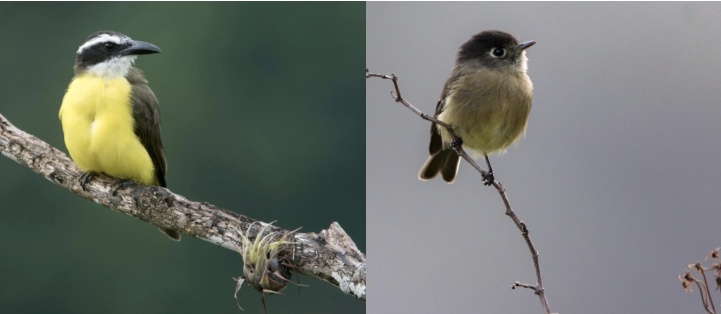
Below, a couple of extreme bill size differences between a Boat-billed Flycatcher and a Black-capped Flycatcher.

(photos courtesy of Pepe Castiblanco)

Jim: Yes, there are a bunch of flycatchers in Costa Rica. The Tyrannidae, or Tyrant Flycatchers (to distinguish them from Old World Flycatchers) is represented in Costa Rica by 81 species (mas o menos). Some of those are very rare species that have only been seen a few times here, others are migrants that are present only during the northern hemisphere winter or during migration, but at any one birding spot in the country one can expect to encounter regularly 10 to 20 different species – more if you include the rarer possibilities. One key is to know what the common species are in any given area, and learn to identify them well first. Then you’ll have a base for comparison and if you see something odd you can ask yourself “why isn’t this one of the common species?” Less common species are often associated with specific micro-habitats, so knowing what a species prefers is also important as in “that looks like a Yellow Tyrannulet, but those are only found in short, scrubby vegetation and we are in dense forest, so we can rule that out”. If you have to focus on one physical trait I’d say pay close attention to the bill – It’s length and width, color, and if bicolored the pattern, shape of bill tip (hooked or not), etc. But probably the best trick is to learn the vocalizations as that will be the key for separating those little green and gray birds that all look the same.

David: You’re right about the flycatchers diversity, in fact it is the most diverse family. It’s a new world family, which means that it is distributed only in the Americas. My recommendation is to observe the behavior; for example, flycatchers fly to try and catch an insect and then return to the same perch, making a loop. You can also learn the song and the call. When you’re fed up you catch them and analyze their features up close, because you when you catch them you can observe special characteristics on the primary and secondary feathers (I am talking about the Empidonax genus). You will understand that sometimes it is so difficult to identify them that you just give up and go to look for some other birds.

****

Reminder: Do you have a birding question you’d like to ask our Experts? Send it to…

eltangaral@gmail.com

Ask the Experts: Question #4

Welcome to Question #4 of our Ask the Experts feature where each week we pose one of your questions to our birding experts and then see their responses.

Please welcome this week’s two birding experts:

Pepe Castiblanco: Co-owner and proprietor of Casa Botania B&B and professional birding and nature guide. https://www.casabotania.com/en-gb

David Rodriguez Arias: Tropical Biologist and natural history guide in Monteverde, Costa Rica. https://www.facebook.com/david.rodriguezarias

Question #4: (from SVBC member Janelle Boyett-Hinds from Winnipeg, Canada) ‘I was visiting San Vito (and other parts of Costa Rica) I noticed some bird species could be found all over the place.  In particular, the Rufous-tailed Hummingbird, Scarlet-rumped Tanager and the Clay-colored Thrush.  Why are these species so successful?’

Pepe: Just as there are many species that don’t tolerate habitats with human impact, there are also species that won’t survive in primary forests. At some point in the evolutionary race, many saw the potential and wide range of food opportunities in the urban areas and adapted to them. Birds exist longer than humans and topographic and/or climatological changes were back then the trigger that would push a species to split into two or several more species. When humans also took part in that game by building cities, roads and plantations, birds did what they had been doing already for millions of years: they continued adapting. Our Thrushes and dear Grackles are no exception to that. Many others couldn’t find a quick way to adapt and disappeared as fast as new species replaced them filling the empty niches. Humans did that too until the Homo sapiens took over.

David: Surely there are others reasons in addition to what I am going to say, but in my opinion, these species of birds evolved in a such an interesting way that allows them to be adapted to live in different habitats. No doubt diet is one of the main reasons they can live in different places. There is a variety of things they can eat: worms, pollen, nectar, fruits, insects, seeds, spiders… The fitness of these species is definitely way stronger than the fitness of some other species that need a specific habitat, or elevation in order to nest and survive.

The best part of all this is that they all are special, one with amazing flight adaptation, one with a beautiful combination of colours on its feathers, and finally, one with a lovely melody.