At last–a website for the SVBC!

Harry Hull (Photo: Gail Hull)

In this age of the ever-expanding Internet, the San Vito Bird Club is excited to have its dream of its own website finally “hatch”! As the Club’s activities expanded, communicating more frequently with its members than the twice-annual Newsletter became more desirable, and we’re confident the website will accomplish that and much more besides.

As chairman of the Club’s Communications Committee (“CommComm”) appointed by Club president, Alison Olivieri late last summer to bring a website into being, I’d like to offer a few thoughts on the process of developing a website and the potential that it creates as well as give recognition to the key contributors (to date!).

Creating a website for a small organization such as the SVBC seems at first a rather straight-forward task: make it primarily a vehicle for announcing–and reporting on–the Club’s activities, throw in some of the “content” that the Club has generated over its relatively short history (like the old Newsletters and a few publications), and liven it up with plenty of photos, one of the great attractions of the Newsletters. The CommComm quickly realized that this view of what a website could be did not do justice to the powerful medium of the Internet: the observation that if a picture is worth a thousand words, a website is worth a million gives you the idea. The structure of the site grew to include topics and “content” that would be of interest to visitors to this corner of Costa Rica, whether real or virtual. So the site is enhanced with a Gallery of Local Birds and a guide to the best birding sites that will be of interest to almost any birder curious about the species special to our area and how best to see them. Plus there are links to websites useful for birders and travelers to Costa Rica in general. And of course, the site is a perfect way to explain what the SVBC is all about–its mission, goals, and projects past and present.

One of the greatest challenges for me personally has been reining in my ambitions for the website. The more we learn about the wealth of information “out there” relevant to the Club’s interests, the more tempting it is to find a way to make this information easily accessible from the site. Keeping the focus on what is really unique about our organization and location has kept the “construction” process from getting out of hand! But this doesn’t stop us from expanding the site over time into subjects that are dear to our hearts and mission. For example, we plan to add information on what to do if you encounter an injured bird, or what organizations to contact for birding trips.

A quick comment on the kind of website we’ve chosen. We decided early on that the website had to be easy for the Club’s leadership to personally maintain without having to become expert at HTML and the complexities of sophisticated websites. This led us to WordPress.com, a web-based website creation system developed primarily for bloggers. You’ve no doubt visited many such sites, perhaps without realizing it. WordPress.com (WP) is also very economical–free if you don’t want a few bells and whistles such as a custom domain name (like our sanvitobirdclub.org). And WP has a zillion “themes” or pre-designed “looks” from which to choose. This does limit control over a lot of possible website design features; but for our modest purposes, such limitations in no way frustrate our goals for the site, and, as it turns out, help satisfy our requirement for a web-masterless site. We’re very happy with the results and hope you will be, too.

Finally, I’d like to acknowledge the invaluable assistance of Liz Allen, a great friend of the Club with experience in creating custom websites, who has been our technical guide as well as frontline site developer using the WordPress system. It is comforting for us that she will continue to be a resource for us as the Club takes over the responsibility for managing the site. And the other members of the CommComm–Alison Olivieri and Lydia Vogt (the Club’s Secretary)–who have put in many hours of work, from brainstorming to content wrangling, should also take a virtual bow. It’s been a real pleasure working with such a dedicated–and jolly!–team.

So please, explore our site! Let us know what you think, and information you’d like included. And if you really like what you see, consider joining the Club… With your involvement, the sky’s the limit!

Eyes Up!

It’s that magical time of the year when hawks and other kinds of birds are migrating to North America for the spring breeding season. We have had a message from Marco Saborio, photographer and birder extraordinaire, who says the weather on the Caribbean side of Costa Rica is not ideal, so many birds are likely to be passing overhead using an alternate Pacific side route. So we say, “Go outside! Look up! Watch for groups of migrating hawks!” and please let us know the species, number of individuals, date and time if you happen to see this awe-inspiring natural spectacle by going to the Contact Us page.

Broadwing Hawk "kettle". (Photo: Dave McCauley)

Trip to Drake Bay, Feb 24-27, 2012

Summer Days on the Pacific Ocean at Drake Bay

by Gail Hull

Expedition members less photographer. (Photo: Dave Woolley)

(Please see the slide show of photos and complete bird list at the end of this article.)

Eight members of the San Vito Bird Club took a three-night trip to Las Caletas Lodge, just south of Drake Bay on Costa Rica’s famous Osa Peninsula from February 24-27. Fred and Jean Schroeder, Michael and Alison Olivieri, organizer Julie Girard and her husband, Dave Woolley, and my husband, Harry, and I enjoyed a marvelous get-away with unexpected good fortune. Part of the felicitous luck was owed to Jim Zook, ornithologist and bird guide extraordinaire, joining San Vito Bird Club members for the fourth consecutive year of the club’s annual outings.

After an early morning departure from San Vito, we stopped en route at a junction near the town of Rincon, where a new bridge offers a wide vantage point over the Rincon River. In just minutes a pair of Scarlet Macaws flew and squawked overhead, and soon thereafter we were delighted by a coveted sighting of several Yellow-billed Cotingas doing some aerial gymnastics over the towering trees on both the lowland side and the forested hill next to the river.

Fording one of the creeks. (Photo: Dave Woolley)

The gravel road from Rincon to the village of Agujitas on Drake Bay is in very good condition, but it can only be driven in the dry season due to various creeks that must be forded. The trip took less than an hour.

Las Caletas Lodge arranged the boat pick-up at the Agujitas beach, where we left our cars. It is just a 10-minute boat ride to Las Caletas beach, and a few minutes walk to the hill-top rustic cabins. After lunch in the Lodge’s family-style dining area, we spent the afternoon settling in and enjoying the vistas and rich bird life right on the property overlooking the Pacific to the southwest and the coastline in the distance to the northeast.

Las Caletas Lodge mirador. (Photo: Harry Hull)

On Day Two most of us opted for the main event of the trip—a visit to renowned Corcovado National Park (CNP), a wildlife refuge large enough to sustain populations of jaguars and tapirs, as well as the more common mammals. After a dawn breakfast, eight of us took a fast boat almost an hour further south to a beach near the La Sirena entrance to the Park, pausing en route near some off-shore rocks where we saw Brown Boobies and Brown Pelicans.

Trekking along the beach near Sirena. (Photo: Harry Hull)

Then, upon arriving at the rocky beach at La Sirena, we saw a Whimbrel, Ruddy Turnstones, a Least Sandpiper, and at least one Spotted Sandpiper among other shorebirds.

Red Brocket Deer. (Photo: Julie Girard)

Fortunately, we were joined by José Huertas, our Lodge’s resident naturalist guide, who was familiar with the trails of CNP. Very dry conditions prevailed, as they do over the whole Pacific region in January and February, but the rain forest habitat of primary and transitional secondary forest did not disappoint. Some of the high points for birders were the Long-tailed Woodcreeper; a Great Curassow, making its strange, deep and loud humming notes; a Common Potoo, cryptic but unusually active at its very high perch; a Great Tinamou; Baird’s Trogon; a Double-toothed Kite carrying nesting material, and a group of Tawny-crowned Greenlets. (See below for complete bird list.) Before the end of the walk we also saw two unexpected mammals—an adult Red Brocket Deer, about the size of a large dog; and oh-joy-of-joys, an adult Baird’sTapir. For many of us this was a thrill beyond compare. The tapir was snoozing in a muddy creek bed, cooling off under forest cover barely 50 yards from the beach. The sudden fall from a tree of a scrapping White-Nosed Coati, of which there were a half dozen or more between us and the tapir, woke the hippo-like tapir from its nap, and we were able to get some photos of its face from a safe distance. These animals can be dangerous, as are hippos, if one finds oneself between a mother and baby. During the four-hour forest walk we had also seen many Howler and Spider Monkeys.

Scarlet Macaws necking. (Photo: Julie Girard)

On the way back to Las Caletas after our picnic lunch, we enjoyed the company of dolphins swimming along off the bow and either side of the boat.

Our afternoons were relaxing, and the birding on the lodge grounds was superb. Imagine lounge chairs, hammocks, views of distant cruise ships, rainbows, cumulous clouds and a constant variety of bird species flying into and out of trees on all sides. A Scarlet Macaw pair preened and then did falling somersaults in either a mating act or a playful tumble. The hummingbirds, such as the Charming Hummingbird, kept us entertained in the verbena bushes covered with flowers just a few feet away. Overhead in the Cecropia trees, a pair of Golden-naped Woodpeckers were busy hunting ants.

Relaxing at the Lodge. (Photo: Harry Hull)

Northern Tamandua (anteater) near the Lodge. (Photo: Julie Girard)

Julie Girard was the one guest who encountered a Northern Tamandua (anteater), another exciting and uncommon sight, just about 25 meters from the Lodge. Julie did a super job organizing the trip, so she deserved this extra reward!

This was a perfect trip for both very experienced birders and some of the rest of us who are not exactly gifted practitioners of the art. All were very amply rewarded for their patience and passion for feathered friends as well as four-legged creatures.

This slideshow requires JavaScript.

Wilson Walk Report, April 14, 2012

Several new members joined us for one of our regular Wilson Walks on Saturday, April 14. In addition to Philomen Ulaeners and Tom Wilkinson, Donna Goodwin and Nick Green joined us along with Hellen Castillo and Juanita Castro and their students and guests. In total, we saw 31 species of birds — not an easy feat with such a large group. Highlights included Blue-crowned Motmot and Squirrel Cuckoo, both spotted by Nick Green without binoculars, an impressive feat. We hope to see all these participants and more at our next walk in two weeks, Saturday, April 28.

CR Banders Meeting 9 April 2012

InBio Parque, Santo Domingo de Heredia

The movers and shakers behind the Costa Rican Bird Banding Network hosted a day-long meeting at InBio Parque in Santo Domingo de Heredia on April 9 that started with an early morning Banding Demonstration led by Jorge Leiton who has helped at several of our mist netting project sessions in San Vito.

Attendees at Banders Conference April 9, 2012 (Photo: Sara Estrada)

Conference speakers delivered presentations on up-to-date research being conducted at several sites in Costa Rica, information on new tools and other innovations for bird monitoring projects, international capacity building provided by the North American Banding Council’s certification and training programs, a summary of one of Stanford University’s many long-term projects and information on the Banding Network and the new Costa Rican Bird Observatories. Additionally a LaMNA (Landbird Monitoring of North America) Data Analysis Workshop was held in the afternoon.

Jared Wolfe, a PhD candidate at Louisiana State University presented a paper, currently in review, titled “A Tropical Bird’s Dissimilar Response to Global Climatic Phenomenon in an Uneven Aged Forest.” The data for this paper were gathered at the oldest, continually-run banding station in Costa Rica at Tortuguero National Park on the Caribbean side.

VP Kate Desvenain and Sara Estrada (Photo: Alison Olivieri)

Another research project, from CATIE in Turrialba and presented by Fabrice DeClerck, showed a significantly increased bird population in agricultural landscapes by leaving unpruned the famous ‘living fences’ of Costa Rica, traditionally used to define pasture and agricultural acreage. Researchers at CATIE are teaching environmental education programs for teachers at nearby schools as well as involving the teachers and their students in their research projects.

C. J. Ralph of the USDA Forest Service displayed dazzling migration range maps for Indigo Bunting and Common Nighthawk created from eBird data. They literally made you want to run home to your computer and immediately update your eBird account. After seeing what C.J. was able to show, there is NO EXCUSE not to enter all your sightings and add to this powerful and complex data tool.

The San Vito Bird Club was well represented at the meeting and several members stayed for the afternoon presentation on data analysis that will surely benefit our Avian Monitoring Project.

Thanks to Pablo Elizondo of Partners in Flight and the Costa Rican Bird Observatories for an inspiring conference that provided new insights into bird population dynamics, a forum for exchanging ideas and answering questions, and stimulating new information.

Mist Netting Highlights: March 2012 Session

No less than four new species turned up at this session! At Finca Cantaros we caught a Squirrel Cuckoo, surely one of the most striking birds in the country with a glamorous black and white tail. Often, Squirrel Cuckoos give loud wolf whistles when they land on a tree branch and they are known for scurrying through trees like squirrels. At 18”, they are two inches longer than Blue-crowned Motmots.

At Finca Sofia, we netted an Emerald Toucanet; however, we did not have the correct band size for this species. Alas, we had to release it unbanded after all appropriate data were taken. Another one remained above the banding station, calling incessantly, while we worked. We cannot help but conclude this was a mated pair!

At Finca Corteza, we netted two new species. The first was a bird that has had both common and scientific names changed recently. In the original Stiles and Skutch field guide, it was called Whistling Wren (scientific name: Microcerculus luscinia). This changed to Scaly-breasted Wren (scientific name: Microcerculus marginatus) in the more recent Garrigues and Dean guide although the author points out the Costa Rican race has no scaling on the breast. The song is described as “remarkable” in S&S with short, fast ascending notes followed by a long (2-4 minutes) series of piercing whistles. Once heard, it is unmistakable.

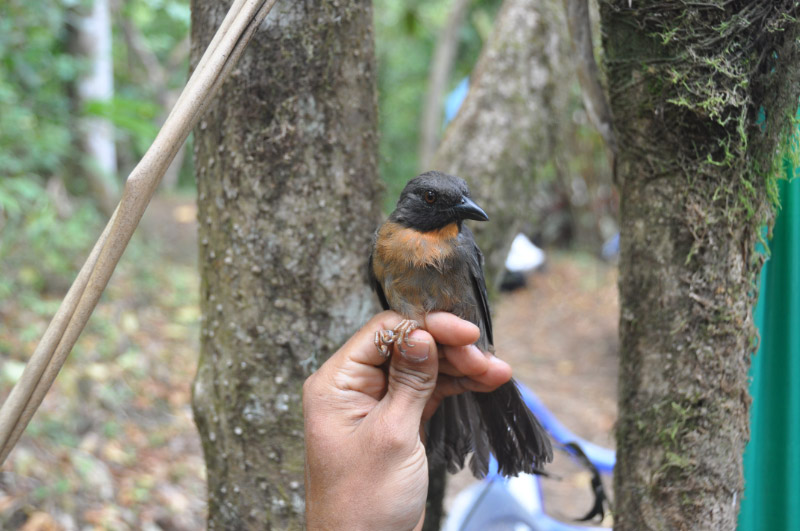
Black-cheeked Ant-Tanager (Photo: Julie Girard)

Finally, to our surprise, we caught a Black-cheeked Ant-Tanager, a Costa Rican endemic with a limited range restricted to the Golfo Dulce and Osa Peninsula region. Interestingly, Stiles and Skutch had this to say, “. . . increasingly scarce as its forest habitat is reduced; still fairly common . . . where forest remains , but within a few years the entire population may be confined to Parque Nacional Corcovado.”  Those familiar with the southern Pacific lowlands will realize what an altitudinal change it represents to go from sea level there to approximately 4,000’ in San Vito. Consequently, we plan to write a short paper on this discovery for submission to the Asocacion Ornitologica de Costa Rica’s journal, Zeledonia.

Finally, we netted four “foreign recaptures”. These are birds banded by other researchers. Two of them, a Violet Sabrewing and a Green Hermit were caught at Finca Cantaros. Another Violet Sabrewing was captured at Finca Sofia and the last one, an Orange-billed Nightingale-Thrush, came from Finca Corteza. We have sent the band numbers, date, location and species name to the Stanford University study group and will also report this information to the Banders Network of Costa Rica.

As always, we want to express our thanks to our Principal Investigator Steve Latta, project founder Judy Richardson and our San Jose-based team of trainers including, at this session, Jorge Leiton and Sara Estrada.

Golden-hooded Tanager nesting

Several weeks ago, Gail Hull spotted Golden-hooded Tanagers building a nest in one of the jaboticaba bushes near Laguna Zoncho at Finca Cántaros, and now, we assume, there are eggs in the nest being brooded. I shot the photos in the slide slow below of the female (?) Golden-hooded Tanager sitting in the nest. Frequently, the bird has its beak open as though panting, so I’m guessing that it was hot or tired. Harry Hull

This slideshow requires JavaScript.

Wilson Garden 50th Anniversary

Member-volunteers will be on hand to help celebrate the 50th Anniversary of the Robert and Catherine Wilson Botanical Garden on Friday and Saturday, May 4-5. We will be in charge of children’s games art table and crafts outside of the dining room on the terrace. Please stop by and say ‘Hola’!