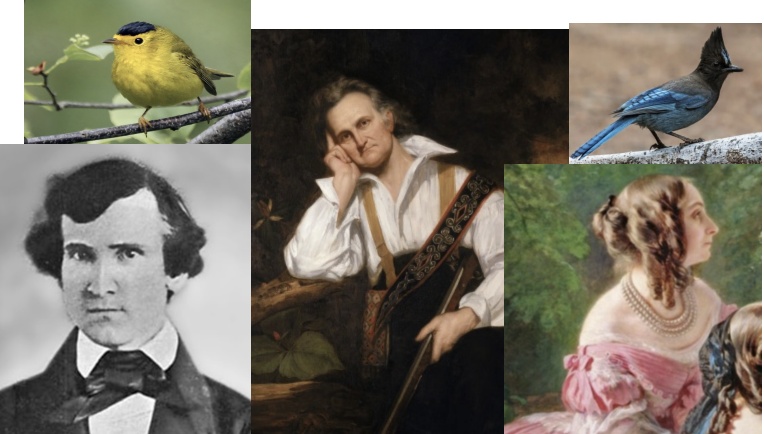
(Wilson’s Warbler, John James Audubon, Stellar’s Jay, John Kirk Townsend, Anna Massena)
Beginning next year, 2024, the common names of about 150 American birds will be changing. These common names, well, they have been the names we’ve all been using for decades. The American Ornithological Society (AOS), the organization responsible for naming American birds, believes it is time to assign new names.
Why so many changes and why now? The AOS believes that birds named after people (i.e. Lewis’s Woodpecker, Wilson’s Warbler and Kittlitz’s Murrelet) is a practice that must be discontinued.
What’s wrong with naming a bird after a person? According to the AOS:
- People who have a bird named after them (like Townsend’s Warbler) may have done bad things during their lives. Some birders may find this troubling.
- A bird named after a person doesn’t really provide any description of what the bird looks like.
The San Vito Bird Club always likes to give out with our two cents (dos centimos) on birding issues and this is a big one. So hang on. This SBVC posting is rather long…longer than our usual posts. Hopefully, you’ll gain some insight if you’re able to make it to the end.
We present three short essays on the AOS plan to rename birds. Alison Olivieri, Peter Wendell and Greg Homer share their thoughts with you, below.
We also encourage you, our readers, to kick in and send us your thoughts on this topic; more on that at the end.*
Our first essay comes from SVBC founder and President Emeritus, Alison Olivieri.
***

(Harris’s Hawk, Wikipedia)
After first rolling my eyes, now I am ambivalent about the ‘Bird Names for Birds’ Project. Why the Big Eye Roll? Oh, let’s see – other, more pressing concerns: the two wars, escalating climate disasters, increased international migrant populations, homelessness, dysfunction in the US House of Representatives, next year’s presidential election, increasing infant mortality rates in the US, anything else? Anybody?
But wait, we are a bird club. A group of people who are keenly interested in birds and birds’ welfare. We lead Bird Walks throughout the year in southern Costa Rica. We support environmental education in local elementary schools and we hold an Annual Meeting with reports and presentations. We work with the Organization for Tropical Studies and the Finca Cantaros Environmental Association. With all that time, energy and financial support spent connecting people to birds, we ought to speak to this national initiative to re-name Wilson’s Warblers, Bachman’s Sparrows, Swainson’s Thrushes and more.
To me, it absolutely abuts erasing history. It calls to mind removing the statue of a Confederate General of the Civil War instead of raising a plaque of information of who this person was, why there is a statue and how the history of that fits into current times. What is the famous quote about failing to learn from history dooms us to repeat it?
Re-naming Wilson’s Warblers to, say, ‘Black-capped Warblers’ is far less complicated than trying to explain the history of every eponymous bird name to each new birder taking a tentative step into the Wonderful Alternative Universe of Birds. But still, it seems to me, reflecting on Alexander Wilson’s life and work is interesting and informative for those of us who are curious about whose shoulders, exactly, we are standing on.
Well-known bird field guide authors, artists, illustrators, field trip leaders and, of course, ornithologists are weighing in on this: David Sibley is in favor of it. Kenn Kaufman ‘came around’, likewise John Fitzpatrick, Executive Director of the Cornell University Laboratory of Ornithology, who originally thought the name change was ‘throwing out a lot of history’ but came to agree more descriptive names would make it easier for ‘new birders of every stripe’ to enjoy and appreciate them.
As for me, I agree with Jerry Coyne, an avid birder and Professor Emeritus of Ecology and Evolution at the University of Chicago (hastening to add I don’t know him). He was quoted recently in the New York Times Science section saying the need for more descriptive names does not seem pressing and performative acts like this “. . . are really deeply injurious to science. We cannot go back through the history of science and wipe out everybody who was not a perfect human being.” He also said this effort would be better invested in something more impactful to society like teaching underprivileged children about birds.
The Executive Director of the American Ornithology Society Judith Scarl was quoted in the Times article saying, “We’re really doing this to address some historic wrongs,” adding that it would “. . . help to engage even more people in enjoying and protecting and studying birds.”
We can agree on that – we have the same goals. And it is incumbent upon us, as bird club members and bird walk leaders, to support anyone’s interest in birds whether it is learning their names, counting their populations, recording their vocalizations, planting trees to create successful habitats or just appreciating them for themselves.
Next, Peter Wendell, former SVBC President and Education Officer gives us his thoughts.
***
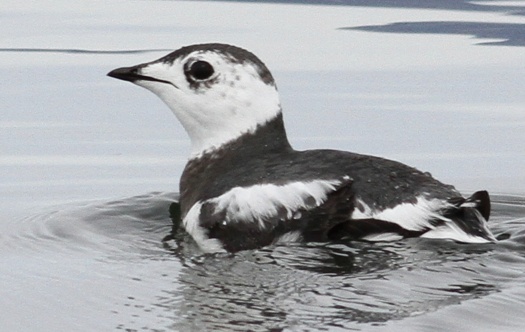
(Kittlitz’s Murrelet, eBird)
After Greg Homer invited me to contribute a short essay on the subject of the proposed elimination of certain eponymous bird names, I turned my attention to the Bird Names for Birds WordPress site, where I quickly discovered that it has little to do with bird names and everything to do with how we conceive race, identity, human complexity and the relation of all of these things to the social/historical context in which they are expressed by individuals. So, I find myself unable to write about bird names and their whys or why nots without giving credence to the underlying assumptions of the project, which I cannot do without first examining them critically. Before I start I want to acknowledge the work and the courage of Jordan, Gabriel, Jess, and Alex for putting this proposal together and expressing their views in public. Although I strongly disagree with many of their underlying assumption and conclusions, I believe that they are arguing in good faith and with conviction. I hope that my fundamental respect for them is
clearly demonstrated by the thoughtful seriousness of my response.
Diversity of opinion, insight, political philosophy, competence, moral character, etc. cannot be achieved or measured merely by the number of individuals of a specific color, sex, or ethnicity that participate in a given conversation or project. The ability or inclination to form a given opinion, and the right to express it without fear, is not limited by race, sex or ethnicity. Ever. It is demeaning to everyone concerned to think otherwise. It is also obviously factually incorrect. Each person grows up within a web of cultural influences and narratives, many of which are often contradictory. We were each born with different brains and bodies that have their own strengths and weaknesses. We grow up rich or poor, urban or rural, in loving families or in violent ones. We are lucky or unlucky, but in all cases we have to stitch ourselves together out of all of these threads into someone that has never been seen before. It is not possible to put a limit a priori on what a person has woven based on “race” or anything else. Within the contemporary United States, and perhaps even more so in other liberal Democracies, Race is an increasingly poor proxy for social success or political ideology. To assume that a person would or should think or believe “differently” about politics, morality, equality, power, etc. because of their skin color, or cultural/ethnic background is simply prejudice. When I came across the following in the FAQs on the Bird Names for Birds website, I was really taken aback:
Not every person honored with a bird name seems bad or concerning. Why can’t we just focus on the most egregious individuals and only change those names?
First, most of the people currently in a traditionally accepted role of determining official common names are White. For White people to determine what actions were problematic enough to warrant a name change is completely inappropriate and perpetuates the very system that BN4B is working to change. White people simply do not have the perspective to decide what is or isn’t harmful.
Why? Are all white people contaminated or morally deficient? If so, by what mechanism? Is it inheritable, or is it simply a kind of “moral stain” that they receive at birth? Why are other races immune? There are many assumptions implicit here which need to be elaborated.
The above quote is all the stranger given the following quote from the Introduction:
The vast majority of eponymous common names were applied to birds by European and American naturalists during a period of time known as colonialism, when (primarily) European countries subjugated, exploited, and populated territories held by non-white peoples. To legitimize this endeavor, the concept of race as a classification system was developed, and the white “race” and civilization were considered superior to all others. The impacts of
colonialism were global, and the false concept of race used to justify colonialism resulted in the reality of racism, a reality which has structured societies, interactions, and even survival ever since (emphasis mine).
If the concept of race that was elaborated in the 18 th century to justify an intrinsic hierarchy of peoples was false and inherently racist, which I, and virtually everyone else reading this, believe to be the case, then why resurrect it in the current context when the idea of a racial hierarchy has been legally eliminated from all Western democracies, and is held by very few people in their private lives? Is Race useful in the current context simply because it purports to invert the hierarchy in the name of “equity”? How can that be justified morally or logically in light of its unavoidable injustice and the danger of merely recreating the same oppressive hierarchies inverted or not?
When, at the end of the FAQs, they write:
…the core group of individuals behind BN4B (Jordan, Gabriel, Jess, and Alex) are White. As White folks, for us to say what the new names should be would be perpetuating the very system that we’re trying to raise awareness about and change.
What do they mean? How would it be different if there were no white people and the bird names came out the same? Would it be better morally if a group of Asian, Latino and Black people decided to keep the names just the way they are now? Is the underlying assumption that non-white people necessarily have different, and maybe even more accurate opinions than white ones? Are the opinions and work of Jordan, Garbriel, Jess, and Alex less valid, important and true in their own eyes because they are white and there is no “non-white” person to validate them? Would they be more diverse by having a collaborator of color who agrees with them or by having a white one who disagrees?
I believe that any honest attempt to address these questions can only demonstrate that the concept of Race is incoherent in the present day and that it should be abandoned to history. I welcome discussion on this issue.
History and Moral Value
Before turning my attention to a specific, historical person, I want to make a couple of brief observations about the history of slavery and the idea that all humans have intrinsic worth.
Slavery was not invented by the Europeans and American colonialists. It had been practiced throughout human history in nearly all parts of the world. It was a common practice among some of the human communities present in Africa, the Americas, and Asia before the Europeans arrived and after. It was common throughout Asia for as long as we have records and was nearly universal in the Arab world as well. The Europeans and Americans used slavery to power their expansion and acquire wealth. They also put an end to it and codified its prohibition in both Law and Moral Philosophy for the first time on such a large scale.
The foundational principle of liberal democracy is that each person has intrinsic value, rights, and the freedom to pursue them. I believe it is difficult for those of us who have always lived in societies where that idea is an obvious truth to appreciate just how radical it was, and how new. It was born out of the Protestant Reformation and the Enlightenment. It turned the world on its head and it spread like wildfire through the West. It took generations to live up to and for it to include everyone. Those who wrote the founding documents of constitutional democracy in the New World and the Old made promises they could not live up to. Their offspring, however, realized many of them. We are still working on it. It may seem contradictory that the very people who sowed the revolutionary seed of Liberty and Equality were also conquering and subjugating other peoples. They were living in two worlds at once –for the adventurers more than two – and were all still figuring out how to move from one to the other.
The authors of the project reserve their strongest condemnation for John Bachman. I hope you willforgive me for quoting the Bio in its entirety, but I think it is necessary and very revealing:
At first read, the life of the Reverend John Bachman (1790-1874) seems quite admirable. An ordained minister who spent 56 years serving his flock at St. John’s Lutheran in Charleston, South Carolina, he had a passion for science and natural history. He was regarded by some in the South as radical for ministering to enslaved people, and for his argument that all humans were the same, unified species, rather than separate. He was elected as an Associate
Fellow of the American Academy of Arts and Sciences in 1845, and corresponded with many of the other leading naturalists and scientists of his day.
But this seemingly progressive outlook is only surface level. The reverend may have been a proponent of the unity of humanity in a single species; he was certainly, however, not a proponent of equality among it. A slave-owner himself, he saw no issue with holding fellow humans in bondage, even as he acknowledged their humanity. He vigorously denied that a belief in the oneness of humanity necessitated becoming an abolitionist, and sought to
provide both scientific and religious reasoning for slavery within his framework:
“We are induced yet to offer a few remarks on the bearing of the doctrine of the Unity of the Human Race on the domestic institutions and vital interest of the South…those who have supported the doctrine of Unity, have sometimes been stigmatized as Abolitionists and enemies of the South…[t]he following are our views: That all the races of men, including the negro, are of one species and of one origin. That the negro is a striking and now permanent variety, like the numerous permanent varieties in domesticated animals. That varieties having become permanent, possess an organization that prevents them from returning to the original species, although other varieties may spring up among them. Thus the many breeds of domesticated animals that have arisen, some only within a few years, would never return to the form of the wild species, without an intermixture. That the negro will remain as he is, unless his form is changed by an amalgamation, which latter is revolting to us. That his intellect, although underrated, is greatly inferior to that of the Caucasian, and that he is, therefore, as far as our experience goes, incapable of self-government. That he is thrown to our protection. That our defense of slavery is contained within the Holy Scriptures. That the Scriptures teach the rights and duties of masters to rule their servants with justice and kindness, and enjoin the obedience of servants.”
THE REVEREND JOHN BACHMAN, QUOTED IN THE NEW ENGLANDER
Bachman presents us with an uncomfortable window into the rationalizations of a racist that is at odds with how many of us wish to think the defenders of slavery supported their views. We are often taught, either explicitly or implicitly, that those who enthusiastically participated in the institution of slavery did so out of a sheer unthinking hatred of Black people. But many of the most vocal– and successful– proponents of racism have sought to make appeals similar to Bachman’s. These people are not soulless monsters without human emotion: they are something far more frightening. They are people who, in some deep reach of their soul, felt the seed of discomfort at what they did. They knew, if only unconsciously, that they were doing something wrong– and so, if they were to live with themselves, they had a choice. They could acknowledge the wrong and repudiate the beliefs they had been taught; or they could rationalize them, to tell themselves and others that that wrong was in fact right. Bachman was one of many who chose the latter.
Bachman’s defense of slavery offers a further level of discomfort for those of us who study evolution. He wrote extensively on his views of humanity as a single species, linking in ideas of what a species is and how they might develop. We know that Darwin read and was influenced by Bachman’s ideas, especially as Darwin himself explored the origin of humanity in later writings. We may not wish to remember today that this toxic vein of scientific racism was a key part of what would become the fields of evolution and genetics, but it is all the more important to
acknowledge and challenge for that.
Of all the passages of vile racism that we have uncovered in this project, Bachman’s is one that is among the most haunting. He took what could have been the beginnings of a moral revelation– “we’re all united in our humanity!”– and instead of following them to a conclusion of equality, used them to further defend the right of one human to own another. He was neither the first nor last to make such an argument: after all, it survives in some form to this day. Bachman serves as a warning that, whether someone believes themselves good or not, they can still give life to evils that long outlive them.
J.F. McLaughlin
The author, Jess, is very confident of their capacity to condemn Bachman for his failure to follow his revelation that humans are all essentially united to its necessary, moral conclusion of actively abolishing slavery. Jess seems to be able to see into his soul, take its measure and find him wanting. I respectfully suggest that this demonstrates a lack of humility on her part, and perhaps of self-awareness. I think this lack of self-critique combined with a less than fully elaborated and yet absolute moral vision that hasRace at its foundation is what concerns me the most. Here is one last quote from the FAQs:
And even though bird names are a fairly minor issue, the pushback that BN4B has received—like most initiatives perceived as “politically correct”—is a strong indicator that this change is needed, and that as a community, we are not yet as open-minded or unbiased as we would like to be.
The fact that their initiative was called into question was proof that it is needed…
I, on the other hand, can’t help but be surprised that a man of Bachman’s class and position would even allow the idea of the humanity of “The Negro” into his mind, and much less express it publicly. Surely it would have been much easier and more convenient to consider them to be mere animals, as just a few decades earlier nearly everyone would have. He would have saved himself a lot of bother. I found myself very intrigued by this utterance, “…That his (the Negro’s) intellect, although underrated…”(emphasis mine). Where did that “although underrated” come from? Why even mention it? I imagine he was thinking of someone in particular when he wrote that. Perhaps a boy he owned on one his plantations whom he got to know and who impressed him with a quick mind – with interesting questions. He must have known many of his slaves very well, even from childhood. It would have been hard for a thinking man to not see them as individuals, and just as property. I don’t know. But surely it’s when we stop seeing groups and see individuals that race begins to lose importance. The Reverend appears to have been complicated. He lived in complicated times.
I have to be honest and say that there is no pseudo-scientific philosophy that I despise more than Social Darwinism and its offshoots. I used to literally use Herbert Spenser as the example intellectual anathema. The application of the concept of Fitness elaborated by Darwin to justify the supposed essential, and even God-given superiority of one group of human beings over all others seemed to me beneath contempt, as it does, I’m sure, to most all, if not all, of you. There are very few people anymore in the West who believe this, and I rather believe that those who now say they do, do so mostly for attention. I had to understand how Race was conceived and elaborated in the past in order to understand those times, and how Race affected the USA directly well into my adolescence, but I don’t have to accept its categories as a given. I won’t accept them even if the values associated with each “race” are inverted or revalued – not even for rhetorical purposes or for political ends. Categorizing humans thusly can only lead to intellectual and moral error, as well as great suffering.
As far as bird names go, well I prefer Blue-crowned Motmot to Lesson’s Motmot, but I prefer Pájaro Bobo even more. That’s the name everyone knows here, even the kids. I can’t see any reason in the digital age that we can’t all be accommodated. It should be relatively easy to allow users of applications, such as eBird, to configure their own common names, import an entire set of them and share them. All of these apps are already built on top of databases and each species already has a unique identifier. The common names won’t affect recording or sharing observations. I would be happy to support a “Go Fund Me” campaign to cover the costs. This would be extremely helpful here in Latin America where the Spanish common names change from country to country, and even from county to county.
Thank you all for your patience and attention. I encourage everyone to read the website and other documents and form their own opinions. I would love to hear what you think.
Peter Thomas Wendell
pedro@induna.us
Alto Santa Teresita de Sabalito de Coto Brus
November 14, 2023
Lastly, Greg Homer, former SVBC President and Natural History Officer passes along his insights.
***

(Heerman’s Gull, eBird)
I went right to the horse’s mouth to find out more on this issue. I hopped on a carbon-neutral EV Greyhound bus and rode it all the way to the American Ornithological Society’s headquarters in Chicago, Illinois to speak with the two officers from the AOS; the ones who came up with the idea to make the name changes.
I (GH) spoke with Dr. Willow Biggs-Kelso (WBK), Nomenclature Officer of the AOS and Mr. Seung Shin (SS), Inclusion and Diversity Officer of the AOS. Here are some highlights from that 1 ½ hour interview.
GH: First of all, thank you both for meeting with me. I know this must be a very busy time for the AOS.
WBK: It is. But we’re always happy to reach out to people interested in birds. And I must say, we at the AOS are all big fans of your San Vito Bird Club. We appreciate the work that you’re doing for nature down there in Puerto Rico.
GH: Uh, Costa..never mind. So, those people that had birds named after them…bad people?
SS: Almost all of them were European white males; Audubon, Wilson, Kittlitz, Heermann, Barrow and Clark.
GH: And what bad things did they do?
SS: Well, aside from just being European white males…many had slaves or lived in places where there were slaves or they never protested slavery. You do know, DON’T YOU, that not all birders are European white males…RIGHT?
GH: Hey, calm down dude. I’m not challenging your decision. I’m just in search of some clarity.
SS: Sorry, sorry, sorry.
GH: So will you also be changing geographical bird names that could be offensive to people?
SDS: Like what?
GH: Oh, Tennessee Warbler comes to mind…Connecticut Warbler…Philadelphia Vireo…Canada Goose…California Condor. A lot of horrible racial injustices have happened in those places.
SS: Well, yeeees; I guess we should change those names too. I mean, in the name of diversity and inclusion.
GH: Didn’t you folks just change the Clapper Rail to Ridgeway’s Rail less than a decade ago?
WBK: We did but that was before we recognized how hurtful the name Ridgeway’s Rail was to people; how exclusionary it was. Be assured, Mr Ridgway’s name will no longer be around to trigger any birders in 2024!
GH: Do either of you, or any of your colleagues here at the AOS, have a boyfriend or a girlfriend?
WBK/SS: Nope.
(End of interview.)
- On a personal note, birds named after people or birds with geographical names don’t really help out us birders with identification. Black-capped Warbler or Wilson’s Warbler…you tell me which is better. Say’s Phoebe or Rufous-bellied Phoebe…slam dunk.
- And on another note; if I was the author of a bird guide, I’d be DEE-lighted with these coming changes. Everyone will be obliged to buy my book again.
- And on another note; I wonder if the AOS would change the name of a bird named after pop superstar Taylor Swift…you guessed it; Swift’s Swift. BOOM
***

(Taylor’s Swift, People Magazine)
Again, please send along your thoughts on the AOC’s decision and we will share them with SVBC readers. Send your thoughts/comments in an email to:
 San Vito Bird Club
You must be logged in to post a comment.